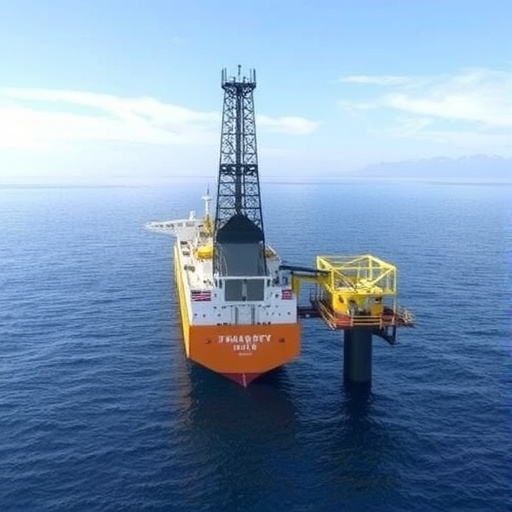
A new study in Communications Engineering reports a construction strategy that could change how offshore reclaimed land is stabilized—using carbonation to strengthen deep cement mixing from microscopic reactions to full in-situ performance.
Conventional deep cement mixing relies on mechanically blending cement and soil, but its long-term durability in waterlogged, newly dredged environments remains a challenge. The researchers propose “carbonation-empowered” mixing: a process that uses carbon dioxide to drive mineral formation within the cemented soil matrix, improving both strength and stability.
At the micro-scale, carbonation converts reactive components in the cement into carbonate minerals. This reaction can refine the pore structure, reduce permeability, and bind loose particles more effectively than ordinary curing alone. In practical terms, the cement-soil composite becomes less vulnerable to water ingress and chemical attack.
Moving beyond laboratory observations, the team links those microscopic changes to measurable material behavior—tracking how early-age curing influences later-age performance. They emphasize microstructural indicators such as pore refinement and the distribution of newly formed minerals, because these features help explain macroscopic outcomes.
The paper also describes how the carbonation-empowered approach performs when translated to deep mixing conditions—where mixing energy, geometry, and groundwater flow can strongly affect uniformity. By addressing these construction realities, the authors argue the method can produce a more reliable cementation profile along the treated depth.
In-situ relevance is central to the work: land reclamation projects often involve uncertain ground conditions and aggressive environmental loading. Strength gains alone are not enough; long-term durability and reduced fluid pathways matter for preventing degradation over the project lifetime.
The study’s “micro-scale to in-situ” framing suggests a pathway for engineers to design carbonation protocols based on reaction kinetics and target pore structure outcomes. If replicated at project scale, the approach could help reduce the variability that typically plagues deep ground improvement.
Because carbonation uses CO₂ as a reactant, the method also has a sustainability angle. While exact climate benefits depend on emissions sources and supply chains, the mechanism inherently turns captured or utilized carbon into construction-relevant minerals.
Overall, the findings make a strong case that carbon chemistry can be engineered into offshore deep cement mixing—transforming reclaimed ground from a mechanically treated substrate into a chemically stabilized system. Expect follow-up studies on field implementation, monitoring, and cost-performance tradeoffs as this viral science news spreads through the engineering community.
Subject of Research: Offshore deep cement mixing for undredged land reclamation; carbonation-empowered soil stabilization.
Article Title: Carbonation-empowered offshore deep cement mixing for undredged land reclamation: micro-scale to in-situ construction.
Article References: Yin, K., Zhang, L., Shen, P. et al. Carbonation-empowered offshore deep cement mixing for undredged land reclamation: micro-scale to in-situ construction. Commun Eng (2026). https://doi.org/10.1038/s44172-026-00728-y
Image Credits: AI Generated
DOI: 10.1038/s44172-026-00728-y
Tags: carbonation-driven mineral formationchemical stabilization of reclaimed landDeep cement mixing stabilizationgroundwater flow effects on cement stabilityin-situ performance of cemented soilsinnovative offshore construction techniqueslong-term durability of cement-soil compositesmicrostructural pore refinementmineralization reactions in cementoffshore land reclamationpermeability reduction in deep mixingwaterlogged dredged environments