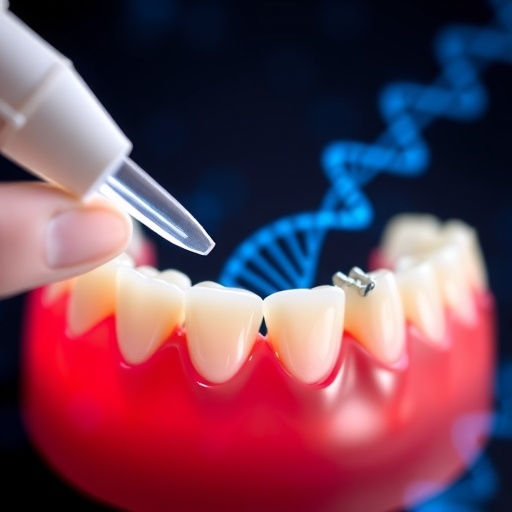
Periodontitis, a chronic inflammatory condition affecting millions worldwide, is driven by bacterial biofilms beneath the gums. The resulting immune activation gradually erodes the tissues and alveolar bone that anchor teeth, leaving patients vulnerable to progressive damage despite standard interventions such as scaling and antibiotics. However, these treatments often struggle to fully suppress microbial triggers, quell inflammation, and restore lost bone in a coordinated way.
Seeking a more integrated strategy, researchers at Sichuan University led by Dr. Geru Zhang, Prof. Yunfeng Lin, and Prof. Xiaoxiao Cai designed a DNA-based nanotherapy that couples antimicrobial and anti-inflammatory functions with osteogenesis support. Their concept centers on loading two distinct agents—curcumin and the antimicrobial peptide defensin—into a single programmable carrier built from tetrahedral framework nucleic acids (tFNAs).
The team engineered the Cur-de-tFNA nanocomplex by assembling tFNAs to co-deliver curcumin alongside defensin. They then assessed formulation properties, including stability and drug-loading performance, before moving to biological testing in human periodontal ligament stem cells (PDLSCs). In parallel, antibacterial activity was evaluated against key periodontal pathogens to determine whether the platform could directly reduce disease-associated bacteria.
Beyond microbial control, the study tested anti-inflammatory and antioxidant effects in lipopolysaccharide-stimulated PDLSCs. Using molecular and cellular assays, the researchers focused on signaling pathways linked to inflammation, particularly the TLR4/NF-κB axis. They also measured markers related to bone formation to evaluate whether the system could influence regenerative processes.
In a rat model of periodontitis, Cur-de-tFNA’s therapeutic impact was examined through imaging and histological analyses, along with molecular readouts for inflammatory damage and bone remodeling. The results indicated that the nanocomplex simultaneously addressed several disease hallmarks: stronger antibacterial action, reduced oxidative stress and inflammatory signaling, and increased expression of proteins involved in osteogenesis.
A key advantage of the approach is the DNA carrier’s dual role as both delivery vehicle and protective scaffold. The DNA structure improved curcumin stability and cellular uptake, while shielding defensin from degradation, enabling both cargoes to function more effectively. Importantly, the platform’s biodegradability and nucleic-acid composition supported a favorable biocompatibility and safety profile in preclinical settings.
Across experiments, Cur-de-tFNA consistently outperformed either cargo used alone, suggesting true synergy from co-delivery rather than additive effects. The work therefore provides proof-of-concept for multifunctional DNA nanomedicine as a holistic option for periodontitis treatment, targeting bacterial infection, chronic inflammation, and bone destruction together.
While the findings remain limited to laboratory and animal studies, the researchers argue that further validation in larger models and eventual human trials could translate this platform into a next-generation therapy. The same design logic may also be adaptable to other chronic inflammatory diseases where microbial drivers and tissue regeneration both must be addressed.
Subject of Research: Animals; human periodontal ligament stem cells (PDLSCs)
Article Title: DNA framework-based nanomedicine platform: a triple-function strategy for treating periodontitis via antibacterial, anti-inflammatory, and osteogenesis-promoting activities
News Publication Date: 29-Apr-2026
Web References: http://dx.doi.org/10.1038/s41368-026-00439-2
References: DOI: 10.1038/s41368-026-00439-2
Image Credits: Dr. Geru Zhang and Sichuan University
Keywords: periodontitis; DNA nanotechnology; tetrahedral framework nucleic acids (tFNA); curcumin; defensin; antimicrobial peptide; TLR4/NF-κB; osteogenesis; bone regeneration; nanomedicine; PDLSCs; biodegradability
Tags: bioactive nanomaterials for tissue regeneration in periodontitisco-delivery of curcumin and defensin in periodontal therapyDNA-based nanotherapy for gum diseaseinnovative nanocarrier for bone regeneration in gum diseasemulti-functional nanoplatform for periodontal pathogen suppressionnanoparticle-based strategies for inflammation control in gum diseaseprogrammable nucleic acid carriers for oraltargeted antimicrobial and anti-inflammatory treatment for periodontitistetrahedral framework nucleic acids (tFNAs) drug delivery system