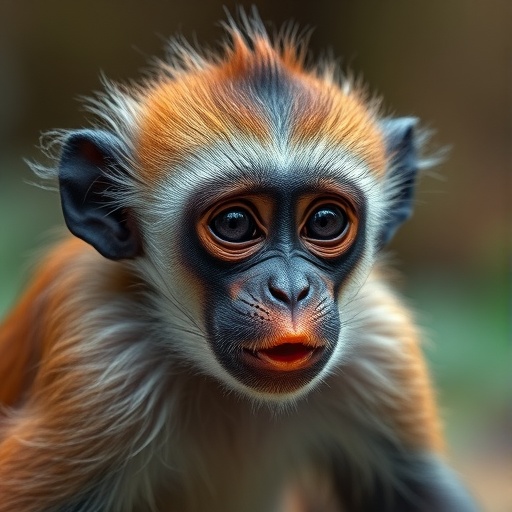
A team of primatologists has announced the discovery of a previously unknown colobus monkey in the forests of the Democratic Republic of Congo. Reporting in PLOS One, the researchers describe the species as Colobus congoensis, nicknamed “likweli” by local communities, and present evidence from field observations, detailed anatomical comparisons, and genetic analyses.
The first clues surfaced in 2008, when conservationists captured photographs of an unidentified monkey during an expedition to Lomami National Park. A later sighting in 2018 prompted a focused search, culminating in systematic surveys designed to document behavior, appearance, and vocalizations.
Likweli are visually distinctive despite their predominantly black coloration. They have an orange patch around the mouth, bare grey skin over the cheekbones that contrasts with darker skin around the eyes, and a conspicuous white fur patch around the anus. Together, these traits form a recognizable pattern that separates them from known colobus species in both field and comparative contexts.
Their calls add another layer of differentiation. The monkeys produce loud roaring vocalizations interspersed with snorts, with an acoustic structure distinct from that of related colobus taxa. The researchers also note that the striking orange lips make the roaring display notable both audibly and visually.
Mapping field records indicates the species occupies at least 1,700 square kilometers of closed-canopy forest between the Lomami and Lilo rivers. The authors argue that the monkey’s range is likely substantially smaller than those of most other colobus species, implying sensitivity to habitat quality.
Morphological and molecular results converge on a surprising relationship: likweli are most closely related to black colobus monkeys (Colobus satanas), despite being separated by more than 1,200 kilometers of forest. The estimated divergence time—between 5.78 and 3.44 million years ago—suggests an early split within the genus.
Because sightings generally involved small groups and the estimated population is limited by the restricted habitat, the team recommends listing Colobus congoensis as Endangered on the IUCN Red List. Protecting the remaining forests of Lomami National Park is therefore framed as an urgent conservation priority.
The study also underscores how much remains undocumented in the Congo Basin: only five new African monkey species have been formally described in the past 75 years. The authors stress that increasing human pressure on forest landscapes could rapidly shrink the already narrow window for survival.
Finally, the work highlights a viral-ready conservation message: a species can remain “hidden in plain sight” until multiple lines of evidence—behavior, anatomy, sound, and DNA—bring it into scientific focus.
Subject of Research: Animals
Article Title: Likweli: A remarkable new species of Colobus monkey from the Lomami National Park, Democratic Republic of Congo
News Publication Date: 15-Jul-2026
Web References: https://plos.io/4wvCq0I
References: Hart JA, Amboko JD, Arenson JL, Horton ER, Coates KF, Kapale J-PI, et al. (2026) Likweli: A remarkable new species of Colobus monkey from the Lomami National Park, Democratic Republic of Congo. PLOS One 21(7): e0349857. https://doi.org/10.1371/journal.pone.0349857
Image Credits: Credit: Mardoché B. Koko, CC-BY 4.0
Keywords: new species, primatology, colobus monkey, Congo Basin, Lomami National Park, conservation, acoustic communication, species discovery, PLOS One
Tags: African rainforest primatesconservation of newly discovered speciesDemocratic Republic of Congo primatesimpact of habitat on primate evolutionLomami National Park wildlifeNew colobus monkey species discoveryorangish-lipped colobus monkeyprimate anatomical and genetic analysisprimate behavioral observationsprimate species identification and differentiationprimate vocalization studiesunique physical traits in colobus monkeys