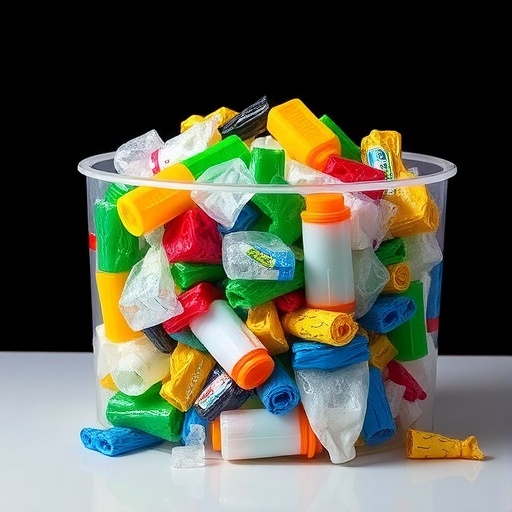
A new chemical route could turn society’s most stubborn plastics into a clean hydrogen feedstock—without the sorting step that currently makes recycling so inefficient. Researchers led by UCLA Samueli School of Engineering and Ewha Womans University report that mixed polyethylene terephthalate (PET), polyethylene (PE), and polypropylene (PP) waste can be processed in a single reactor to produce high-purity hydrogen.
The approach, alkaline thermal treatment (ATT), uses sodium hydroxide (NaOH) under heat to drive hydrogen generation from plastic-derived organics. Crucially, it also aims to prevent carbon dioxide release. Instead of venting carbon to the atmosphere, the carbon is converted into a solid mineral product embedded in the process chemistry.
In their experiments, the team ran the reaction at temperatures 300–400°C lower than conventional steam gasification, a shift that matters for energy demand and potential scalability. The study shows that ATT can handle heterogeneous waste streams while maintaining hydrogen purities above 90%, eliminating the need to separate plastics by type before treatment.
A major scientific challenge is that PE and PP are chemically inert under alkaline conditions because their polymer backbones contain only carbon–hydrogen bonds. To overcome this, the researchers introduced a thermal oxidation pretreatment: the plastics receive a brief, mild exposure to air and heat. That step adds oxygen-containing functional groups to the polymer chains, creating reactive sites that make subsequent alkaline conversion possible.
Once activated, all three plastics decompose effectively. Carbon released during ATT does not escape as CO2; it is captured by NaOH and transformed into solid sodium carbonate. Post-reaction analysis indicates that more than 75% of the original plastic carbon ends up as stable carbonate or liquid organic residues, while less than 13% appears in gaseous form.
The team also outlines a recovery pathway to convert sodium carbonate into calcium carbonate using a simple treatment process. Calcium carbonate is a mineral already used broadly in carbon-intensive industries, suggesting the carbon can be permanently sequestered in an established material supply chain.
The authors position ATT as a first-in-class method addressing three common bottlenecks at once: it tolerates unsorted mixed plastics, avoids the high temperatures of gasification, and mitigates greenhouse-gas release through inherent carbon storage. Further optimization and economic evaluation are still required before deployment at scale, but the results point toward a potential “next-generation” bridge between hydrogen and circular-economy goals.
Subject of Research: Not applicable
Article Title: Selective and direct hydrogen generation from mixed plastic waste via alkaline thermal treatment with inherent carbon storage
News Publication Date: 6-Jul-2026
Web References: https://www.pnas.org/doi/10.1073/pnas.2537552123
References: 10.1073/pnas.2537552123
Image Credits: Younghee Lee/CUBE3D Graphic
Keywords
plastics, hydrogen production, alkaline thermal treatment, carbon storage, recycling, chemical conversion, PET, PE, PP
Tags: alkaline thermal treatment for plastic recyclingcarbon capture in plastic-to-hydrogen processchemical recycling of mixed plasticsenvironmentally friendly plastic waste processinghigh-purity hydrogen from plastic wastehydrogen production from mixed polymer wasteinnovative chemical routes for plastic recyclinglow-temperature gasification of plasticsplastic waste to hydrogen fuelreducing greenhouse gases from plastic wastescalable plastic waste-to-hydrogen technologywaste plastic conversion without sorting