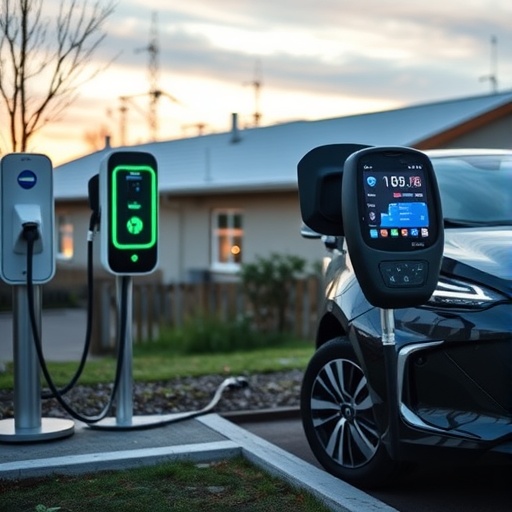
As Europe accelerates its transition to electric mobility, a groundbreaking study from Delft University of Technology sheds new light on the optimal integration of electric vehicle (EV) charging technologies within national energy systems. The research, led by Francesco Sanvito and published in Nature Energy, presents a sophisticated European energy system model that evaluates the economic viability of two charging paradigms: unidirectional smart charging (V1G) and Vehicle-to-Grid (V2G) technology. This model uniquely treats the deployment of charging infrastructure as an optimization problem, balancing the costs against the system-wide benefits.
Currently, the European Union’s Alternative Fuels Infrastructure Regulation (AFIR) mandates uniform charging targets for member countries. However, Sanvito’s analysis reveals that a one-size-fits-all approach is suboptimal since the cost-effectiveness of V1G and V2G infrastructure varies significantly by country, driven by differences in national energy mixes and grid flexibility. The study argues for tailored infrastructure ambitions that correspond closely to each country’s unique energy landscape.
V1G technology, which enables controlled charging to moderate demand peaks, is widely considered a baseline smart charging solution. Conversely, V2G technology allows EVs to not only charge but also discharge electricity back to the grid, offering a dynamic energy resource. While V2G demands higher upfront infrastructure investments, it can provide crucial grid balancing services, especially in systems with variable renewable energy sources and constrained transmission capacity.
For instance, the Netherlands stands out as a promising candidate for V2G adoption due to frequent grid bottlenecks and volatile electricity prices that sometimes dip below zero. Here, V2G-enabled vehicles could inject stored electricity during peak times, alleviating stress on the grid before expensive reinforcements are completed. In contrast, Norway, with its hydropower-dominated and comparatively stable energy system, can achieve cost efficiencies primarily through V1G solutions.
The core insight from the study is that infrastructure planning divorced from broader energy system contexts risks either inflating consumer costs or missing opportunities for grid flexibility gains. Coordinated deployment of EV charging must therefore be integrated with national energy policies and market dynamics to maximize societal benefits.
Furthermore, both technologies contribute to enhanced system flexibility, but scaling them up entails heightened infrastructure expenditure—costs reflected in consumer charging prices. Nevertheless, this investment triggers broader energy system savings as optimized charging strategies reduce peak load stresses, thereby lowering wholesale electricity costs.
Sanvito underscores that recognizing the interplay between EV infrastructure and energy systems is pivotal for policymakers. As the EU reassesses its AFIR guidelines, this research advocates for nuanced, country-specific targets that foster economic and technical synergies rather than rigid uniformity.
This study represents a significant advancement in the strategic planning of Europe’s decarbonized transport and energy future, highlighting how smart, system-aware policies can unlock the full potential of electric vehicles while promoting affordable and resilient grids.
Subject of Research:
Not applicable
Article Title:
Coordinated planning of European charging infrastructure and energy system for optimal V1G and V2G deployment
News Publication Date:
14-Jul-2026
Web References:
http://dx.doi.org/10.1038/s41560-026-02107-5
Image Credits:
TU Delft
Keywords
Electric vehicles, Smart charging, Vehicle-to-Grid, V1G, V2G, Energy system modeling, European energy policy, Charging infrastructure, Grid flexibility, AFIR
Tags: cost-effective EV integration strategiesdynamic energy resource managementelectric vehicle integrationEU energy regulation challengesEuropean energy system modelingEV charging infrastructure costsgrid flexibility and demand managementnational energy mix impactrenewable energy and EV synergysmart charging optimizationtailored EV charging policiesvehicle-to-grid technology benefits