• HOME
  • NEWS
  • EXPLORE
    • CAREER
      • Companies
      • Jobs
    • EVENTS
    • iGEM
      • News
      • Team
    • PHOTOS
    • VIDEO
    • WIKI
  • BLOG
  • COMMUNITY
    • FACEBOOK
    • INSTAGRAM
    • TWITTER
Saturday, February 7, 2026
BIOENGINEER.ORG
No Result
View All Result
  • Login
  • HOME
  • NEWS
  • EXPLORE
    • CAREER
      • Companies
      • Jobs
        • Lecturer
        • PhD Studentship
        • Postdoc
        • Research Assistant
    • EVENTS
    • iGEM
      • News
      • Team
    • PHOTOS
    • VIDEO
    • WIKI
  • BLOG
  • COMMUNITY
    • FACEBOOK
    • INSTAGRAM
    • TWITTER
  • HOME
  • NEWS
  • EXPLORE
    • CAREER
      • Companies
      • Jobs
        • Lecturer
        • PhD Studentship
        • Postdoc
        • Research Assistant
    • EVENTS
    • iGEM
      • News
      • Team
    • PHOTOS
    • VIDEO
    • WIKI
  • BLOG
  • COMMUNITY
    • FACEBOOK
    • INSTAGRAM
    • TWITTER
No Result
View All Result
Bioengineer.org
No Result
View All Result
Home NEWS Science News Health

Overcoming immune suppression to fight against bovine leukemia

Bioengineer by Bioengineer
June 7, 2017
in Health
Reading Time: 2 mins read
0
Share on FacebookShare on TwitterShare on LinkedinShare on RedditShare on Telegram
IMAGE

Credit: Satoru Konnai, Hokkaido University

Bovine leukemia is a systemic, malignant lymphosarcoma in cows which is mainly caused by infection with a retrovirus, bovine leukemia virus (BLV). In 2016, 3,125 cases of bovine leukemia were reported in Japan, which was the largest number of cases among the infectious bovine diseases designated by the Act on Domestic Animal Infectious Diseases Control. Bovine leukemia is commonly seen in other Asian countries, South America and North America.

About 35 percent of cows in Japan have been reportedly infected with BLV. Although the rampant infection has caused a considerable economic loss to dairy and beef farmers, there has been no effective vaccine or treatment available to control the spread and progression of the disease.

In a previous study, scientists from Hokkaido University, Tohoku University and the Hokkaido Research Organization found that the lymphocytes called T-cells are functionally suppressed by a receptor/ligand interaction between PD-1 and PD-L1 while infected with BLV. The immune suppression was closely related to progression of the disease. Furthermore, they developed an anti-PD-L1 antibody which was found effective in blocking PD-1/PD-L1 interaction and reinvigorating T-cell response in the infected cows.

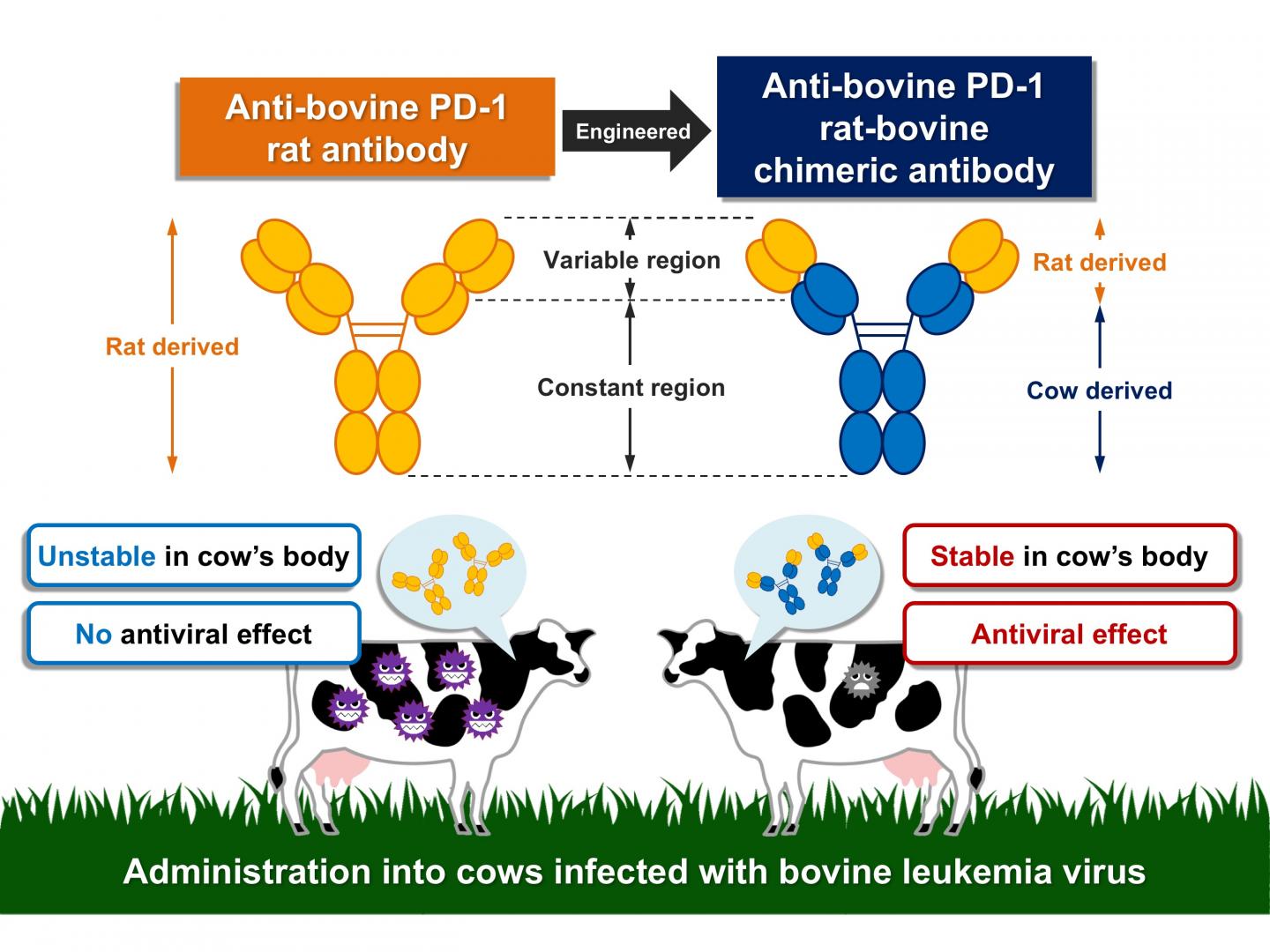
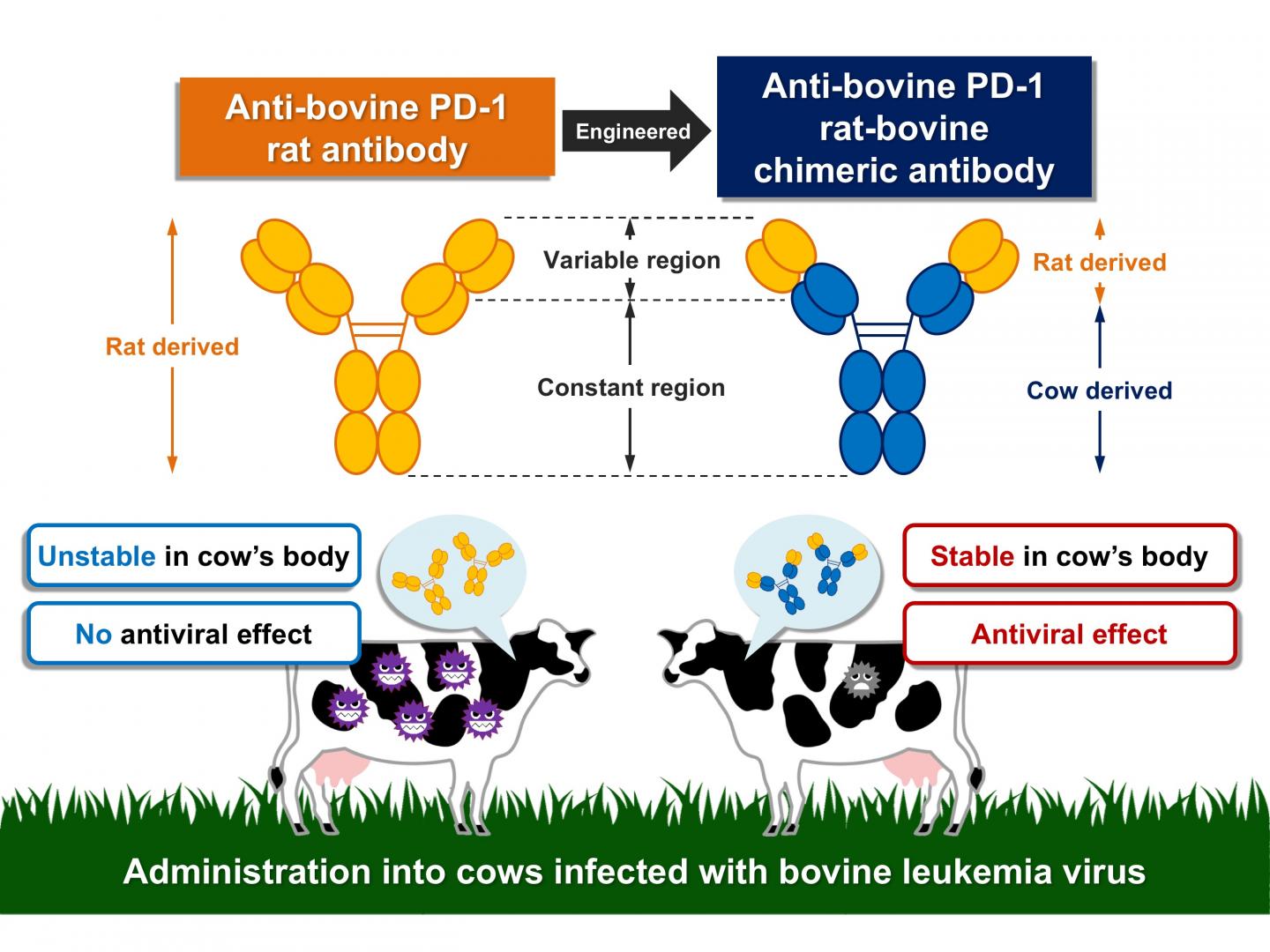
In the current study, the research team developed an anti-PD-1 antibody derived from rats. They then tested its effectiveness on a cow in preventing progression of the disease. However, no significant improvement in T-cell activity or the virus count was found, apparently due to the antibody instability in the cow's body when administrated.

The team then engineered the anti-PD-1 rat antibody to form an anti PD-1 "rat-bovine" chimeric antibody, which was again administered to the infected cow. They discovered the newly developed antibody blocks the binding between PD-1 and PD-L1, reinvigorating the antivirus immune response and thus decreasing the virus count in the infected cow. Furthermore, the antibody is not easily expelled from the cow's body, enabling it to remain effective within the cow for a longer period.

"The new antibody could pave the way for developing biomedicines that effectively treat cows infected with the bovine leukemia virus. Such biomedicines are also expected to reduce the use of antibiotics or steroids in other intractable infectious diseases," says Associate Professor Satoru Konnai of the research team at Hokkaido University. "We plan to conduct animal experiments this year to verify if our antibodies are effective in treating other diseases."

###

Media Contact

Naoki Namba
[email protected]
81-117-062-185
@hokkaido_uni

https://www.global.hokudai.ac.jp/

Original Source

https://www.global.hokudai.ac.jp/blog/overcoming-immune-suppression-to-fight-against-bovine-leukemia/ http://dx.doi.org/10.3389/fimmu.2017.00650

############

Story Source: Materials provided by Scienmag

Share12Tweet8Share2ShareShareShare2

Related Posts

Inflammasome Protein ASC Drives Pancreatic Cancer Metabolism

February 7, 2026

Phage-Antibiotic Combo Beats Resistant Peritoneal Infection

February 7, 2026

Boosting Remote Healthcare: Stepped-Wedge Trial Insights

February 7, 2026

Barriers and Boosters of Seniors’ Physical Activity in Karachi

February 7, 2026
Please login to join discussion

POPULAR NEWS

  • Robotic Ureteral Reconstruction: A Novel Approach

    Robotic Ureteral Reconstruction: A Novel Approach

    82 shares
    Share 33 Tweet 21
  • Digital Privacy: Health Data Control in Incarceration

    63 shares
    Share 25 Tweet 16
  • Study Reveals Lipid Accumulation in ME/CFS Cells

    57 shares
    Share 23 Tweet 14
  • Breakthrough in RNA Research Accelerates Medical Innovations Timeline

    53 shares
    Share 21 Tweet 13

About

We bring you the latest biotechnology news from best research centers and universities around the world. Check our website.

Follow us

Recent News

Inflammasome Protein ASC Drives Pancreatic Cancer Metabolism

Phage-Antibiotic Combo Beats Resistant Peritoneal Infection

Boosting Remote Healthcare: Stepped-Wedge Trial Insights

Subscribe to Blog via Email

Enter your email address to subscribe to this blog and receive notifications of new posts by email.

Join 73 other subscribers
  • Contact Us

Bioengineer.org © Copyright 2023 All Rights Reserved.

Welcome Back!

Login to your account below

Forgotten Password?

Retrieve your password

Please enter your username or email address to reset your password.

Log In
No Result
View All Result
  • Homepages
    • Home Page 1
    • Home Page 2
  • News
  • National
  • Business
  • Health
  • Lifestyle
  • Science

Bioengineer.org © Copyright 2023 All Rights Reserved.