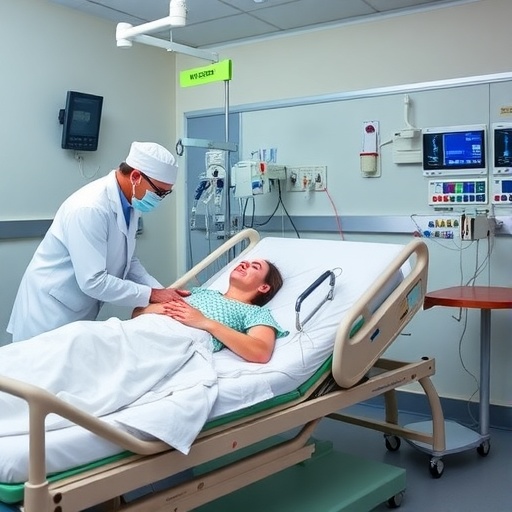
A landmark clinical trial funded by the National Institutes of Health has delivered crucial insights that challenge existing paradigms in the recovery of critically ill patients. The Nutrition and Exercise in Critical Illness (NEXIS) Trial—a multi-center study across nine leading U.S. academic medical institutions—explored whether combining early in-bed cycling with enhanced protein nutrition could accelerate physical recovery in ICU patients suffering from acute respiratory failure.
This rigorous trial enrolled 115 patients and investigated if this dual intervention could mitigate the profound muscle loss and physical debilitation commonly observed after severe illness. The rationale stemmed from prior evidence in frail and elderly populations, where combining exercise and protein supplementation showed promise in improving functional outcomes. However, this study’s findings diverged notably, revealing no statistically significant improvement over standard ICU care in measures such as mobility, physical strength, cognitive function, and quality of life up to six months post-discharge.
Dr. Dale Needham, the study’s lead author and a professor at Johns Hopkins University, emphasized that these results refine our understanding of recovery in critical illness. The trial demonstrated the safety and feasibility of delivering early rehabilitation alongside nutritional support during intensive care but underscored the complexity of biological responses during acute phases of critical illness. Researchers hypothesize that anabolic resistance—a diminished capacity to utilize protein effectively in the body’s early stressed state—may blunt the intended benefits of such nutritional interventions.
Beyond these primary outcomes, NEXIS sheds light on the heterogeneity of recovery trajectories among ICU survivors, highlighting a pressing need for personalized rehabilitation strategies that consider individual physiological and metabolic differences. Despite the absence of observable gains in this combined therapy, the sustained physical impairments in study participants reinforce the urgency for innovative therapeutic approaches.
The study’s outcomes pivot the field toward investigating alternative or adjunctive interventions that could more effectively counteract ICU-acquired weaknesses. This includes a focus on underlying molecular mechanisms, timing of interventions, and patient-specific factors contributing to recovery variability. The NEXIS trial exemplifies how rigorous clinical research can challenge entrenched assumptions and pave the way for future breakthroughs.
This work also builds on decades of pioneering efforts at Johns Hopkins Medicine, where researchers have established foundational knowledge on ICU rehabilitation and long-term recovery science. The trial’s extensive data set will inform the next generation of studies aiming to tailor critical care rehabilitation protocols to maximize functional outcomes and quality of life for survivors of acute respiratory failure worldwide.
Ultimately, while the NEXIS Trial did not confirm the hypothesized benefits of combined exercise and protein supplementation during critical illness, it delineates a clearer pathway for future inquiries. By fostering a nuanced appreciation of biological complexities and recovery dynamics, it steers critical care research towards more targeted, effective interventions capable of transforming patient recovery after ICU discharge.
Subject of Research: Recovery interventions for critically ill patients
Article Title: Nutrition and Exercise in Critical Illness (NEXIS) Trial: Combined Rehabilitation and Nutrition in Acute Respiratory Failure
News Publication Date: July 13, 2023
Web References:
https://academic.oup.com/ajrccm/advance-article/doi/10.1093/ajrccm/aamag287/8732445?searchresult=1
Keywords: critical illness, ICU rehabilitation, acute respiratory failure, nutrition, protein supplementation, exercise therapy, anabolic resistance, physical recovery
Tags: cognitive and quality of life assessments post-ICUcomplex biological responses in critical carecritical illness recoveryearly in-bed cycling in ICUevidence-based ICU rehabilitation protocolsICU rehabilitation strategiesmulti-center clinical trials in critical caremuscle preservation during ICU staynutritional interventions for ICU patientsphysical therapy in critical illnesspost-ICU functional outcomesprotein nutrition in critically ill patients