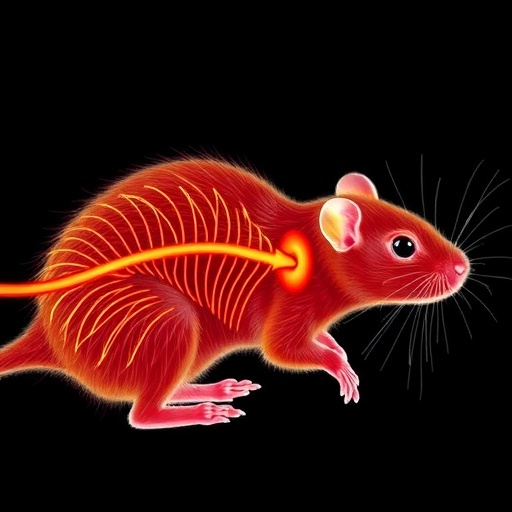
A groundbreaking advancement in neuroscience has emerged with the development of a novel technique for surface circumferential spinal cord recording in freely moving rodents. This innovative method, unveiled by El Hadwe, Ruiz-Mateos Serrano, Psaltakis, and their colleagues, promises to revolutionize the way researchers monitor spinal cord activity in naturalistic settings, offering unprecedented insights into neurophysiological processes.
Traditional approaches to spinal cord electrophysiology often require invasive procedures that restrict the subject’s movement or rely on immobilized preparations, limiting the ecological validity of the data collected. The new technique circumvents these limitations by employing a surface-based electrode array that can be wrapped circumferentially around the spinal cord. This design allows continuous, high-fidelity recordings without impeding the rodent’s voluntary behaviors.
At the core of this technology is a flexible, biocompatible electrode array that maintains stable contact with the spinal cord surface through a minimally invasive surgical placement. The array is engineered to conform seamlessly to the spinal cord’s curvature, ensuring comprehensive coverage of the neural tissue and capturing electrical signals with exceptional spatial resolution. The researchers demonstrate that this setup minimizes tissue damage and inflammatory responses commonly associated with intraparenchymal electrodes.
One of the standout features of this approach is its suitability for chronic implantation, which enables longitudinal studies of spinal cord function in behaving animals. The authors report recordings spanning several weeks, illustrating the method’s potential for tracking disease progression, recovery after injury, and the effects of therapeutic interventions over time. The recorded signals encompass a broad spectrum of spinal cord activity, including motor, sensory, and autonomic components.
Moreover, the technique integrates advanced signal processing algorithms to filter out movement artifacts and noise, which traditionally confound electrophysiological data in freely moving animals. By addressing these challenges, the method ensures reliable interpretation of complex neural dynamics. This capability opens avenues for exploring how spinal circuits coordinate movement and respond to environmental stimuli in real-time.
In addition to fundamental neuroscience, this technology holds promise for translational research. It could facilitate the development of novel neuroprosthetics and spinal cord stimulation therapies by providing detailed mapping of functional spinal regions. Clinicians and engineers might leverage these insights to design better interventions for spinal cord injuries and neurodegenerative diseases.
The breakthrough aligns with broader trends in neurotechnology aimed at increasing the precision and context relevance of neural recordings. By maintaining the subject’s natural behaviors during data acquisition, the new method bridges a critical gap between laboratory conditions and real-world physiology.
Overall, this pioneering work delivers a versatile and powerful tool for the neuroscience community, heralding a new era of spinal cord research. It paves the way for explorations of spinal neurodynamics with a granularity and ecological validity that was previously unattainable.
As this technology matures, it is expected to inspire further innovations in neural interfacing and enhance our understanding of the spinal cord’s intricate role in health and disease.
Subject of Research: Neural recording technology and spinal cord electrophysiology in freely moving rodents
Article Title: Surface circumferential spinal cord recording in freely moving rodents
Article References:
El Hadwe, S., Ruiz-Mateos Serrano, R., Psaltakis, G. et al. Surface circumferential spinal cord recording in freely moving rodents. Nat Commun (2026). https://doi.org/10.1038/s41467-026-75128-z
Image Credits: AI Generated