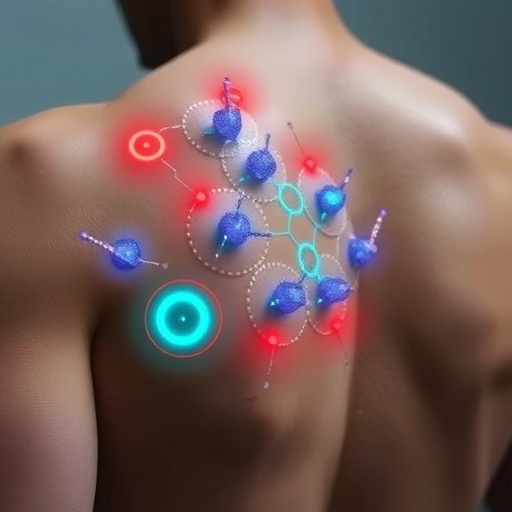
A team of researchers led by scientists from The Hong Kong Polytechnic University has developed a revolutionary bionic cooling skin designed to accelerate healing of infected wounds while providing thermal comfort and active antibacterial protection. This novel dressing integrates advanced materials engineering with biomimicry, addressing longstanding challenges in wound care.
Traditional wound dressings struggle to combine protection, comfort, and effective antimicrobial activity in a single product. The new bionic skin dressing overcomes these limits by employing a hierarchical Janus nanofiber structure fabricated via solvent welding combined with a visible light-responsive metal–organic framework (MOF). This unique design mimics natural skin’s mechanical properties, allowing tensile strength and elasticity comparable to human skin.
The outer hydrophobic layer of the dressing reflects sunlight and exhibits high mid-infrared emissivity, enabling passive cooling of wounds by radiative heat dissipation with an approximate 4°C reduction under sunlight exposure. Meanwhile, the inner hydrophilic layer absorbs moisture and carries Fe-modified zeolitic imidazolate framework-8 (Fe-ZIF8) nanoparticles. These nanoparticles harness visible light (>420 nm) to generate reactive oxygen species (ROS) through photocatalytic activation at Fe-N4 coordination sites, which effectively eradicate bacteria by triggering redox reactions.
This bionic skin demonstrates exceptional breathability with air permeability exceeding 1.8 mL s⁻¹ and a water vapor transmission rate above 12.5 kg m⁻² day⁻¹, ensuring comfort during prolonged wear. In vivo experiments with infected rat wound models validated these effects, showing an average cooling effect of 1.7°C outdoors and antibacterial efficiency reaching 97.1% against Staphylococcus aureus under white light, rivaling antibiotic treatments.
On the molecular level, gene expression analyses revealed that the dressing actively regulates key wound healing pathways. It upregulates angiogenesis-related genes, cell migration markers, and antimicrobial peptides while downregulating inflammatory cytokines. Functional enrichment analysis confirmed involvement of PI3K-Akt, HIF-1, and NF-κB signaling pathways, fostering a balanced environment promoting tissue regeneration without excessive scarring.
Histological evaluation supported these findings, showing nearly double the epidermal thickness of normal skin and uniform collagen deposition, indicative of robust healing. The bionic cooling skin thus offers a multifunctional platform that combines passive thermal management with light-activated bacterial suppression, all while maintaining skin-like mechanics.
This breakthrough paves the way for next-generation bioengineered wound dressings which deliver superior healing outcomes by harmonizing structural biomimicry with advanced material science. The integration of thermal comfort, active infection control, and genetic regulation represents a significant leap forward in intelligent wound care solutions.
As researchers continue exploring this technology, potential applications may extend beyond wound dressings to other biomedical devices requiring dynamic environmental responsiveness. This innovation underscores the power of interdisciplinary collaboration in tackling complex medical challenges.
Subject of Research: Bionic wound dressing materials combining thermal management and antibacterial activity
Article Title: Bionic Cooling Skin for Infected Wound Healing
News Publication Date: 28-May-2026
Web References: http://dx.doi.org/10.1007/s40820-026-02240-6
Image Credits: Shuo Shi et al., The Hong Kong Polytechnic University
Tags: Active antibacterial protection in wound managementAdvanced antimicrobial wound dressingsBiomimetic nanofiber wound dressingbionic cooling skin for wound healingFe-ZIF8 nanoparticles for bacterial eradicationHierarchical Janus nanofiber structureInfrared emissivity in wound coolingMoisture-absorbing wound healing materialsNatural skin mimicking in medical dressingsRadiative passive cooling in wound careThermally comfortable wound dressingsvisible light-responsive antibacterial materials