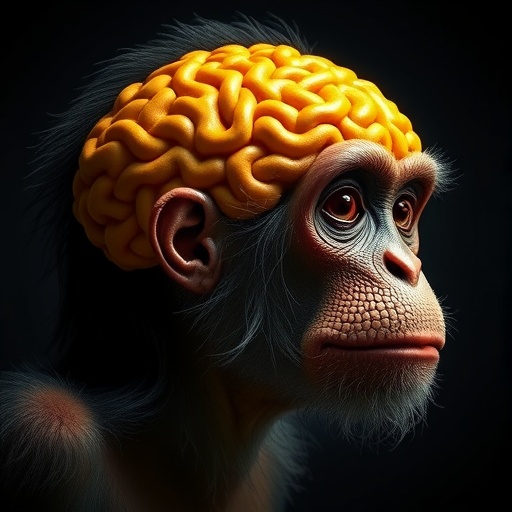
In a groundbreaking revisit to a longstanding debate in evolutionary biology, a new study authored by Robin Dunbar of the University of Oxford has reignited discussions about the developmental trajectories of brain and body sizes in primates. Published in the prestigious open-access journal PLOS One, this research challenges previous assumptions and provides fresh insights into the evolutionary relationship between brain enlargement and body growth in our closest relatives, including humans.
The enigmatic question at the heart of this inquiry revolves around the timing and sequence of evolutionary changes: did primate brains enlarge in sync with body growth, or was there a discernible lag between these two critical adaptations? The “brain lag” hypothesis posits the latter—that in some primate lineages, the evolution of larger bodies preceded a delayed expansion in brain size. This concept counters the notion that brain and body sizes co-evolved at a steady, linear rate, suggesting instead a more complex selective history involving phases of delayed cerebral development followed by catch-up growth.
Previous investigations, notably a pivotal 1999 analysis, failed to identify statistically significant evidence supporting the brain lag hypothesis. This earlier study relied heavily on fossil-derived anatomical data and dating methods that, while robust for their time, lacked the precision afforded by modern molecular techniques. Consequently, their conclusions reflected an evolutionary narrative that leaned towards synchronous development of brain and body sizes.
However, technological and methodological leaps in the years since, particularly advances in molecular genetics, have revolutionized our ability to establish accurate primate evolutionary timelines. These new tools allow for more nuanced analyses of the intricate patterns underlying anatomical changes. Leveraging these advancements, Dunbar conducted a comprehensive re-examination of the same dataset analyzed in 1999, applying updated statistical methodologies that better capture evolutionary lags and accelerations.
The results provide compelling evidence that, in numerous primate lineages—including the human lineage—brain size evolution did indeed lag significantly behind increases in body size. More intriguingly, after this lag phase, brain sizes not only caught up but in several instances exceeded expected allometric baselines that relate brain to body size. This phenomenon of “overshoot” suggests that certain primates embarked on a path of cerebral expansion that transcended the previously understood adaptive constraints, venturing into a realm associated with elevated cognitive capacities.
Dunbar’s findings carry profound implications for our understanding of primate cognition and social behavior. The study supports the long-debated “social brain” hypothesis, which argues that the pressures of living within larger, more complex social groups drove the evolutionary escalation in primate brain sizes. Such social structures demand intricate cognitive processing—recognizing individuals, managing alliances, and navigating social hierarchies—that likely imposed selective pressures favoring increased brainpower.
One proposed facilitator of this evolutionary brain enlargement was a dietary shift among primates. Transitioning from fiber-heavy foliage to more energy-dense foods such as fruits, seeds, and nuts could have alleviated the energetic burdens of maintaining larger brains. This nutritional upgrade may have provided the metabolic capital necessary for brain tissue expansion, supporting the cognitive demands of sophisticated social living.
Despite the elegance of this scenario, it is not without controversy. The social brain hypothesis has faced scrutiny and debate from various quarters, with some researchers pointing to ecological or other physiological factors as primary drivers of brain size evolution. Dunbar himself notes that while his results align with social brain theory, the full evolutionary narrative likely involves a complex interplay of multiple variables, necessitating ongoing research to tease apart these intertwined factors fully.
At a broader evolutionary scale, this research underscores a pivotal transition in primate survival strategies—from reliance on physical prowess (“brawn”) to intellectual faculties (“brain”). By evolving larger brains capable of supporting complex social cognition, primates, and especially humans, appear to have adopted a fundamentally different approach to predator avoidance and environmental adaptation. These cerebral enhancements underpin the sophisticated behaviors that distinguish us from most other animals.
This study’s methodological advancements highlight how the integration of molecular genetic data with refined statistical techniques can transform our comprehension of evolutionary processes. By revisiting old datasets through the lens of contemporary science, Dunbar exemplifies how scientific paradigms are never fixed but continuously refined as new evidence emerges.
In summary, this research not only rejuvenates the brain lag hypothesis but also enriches it by revealing the subsequent cerebral overcompensation that may have been crucial for primate cognitive evolution. It invites a reevaluation of our evolutionary past and offers a nuanced framework that better captures the dynamic and multifaceted pathways through which brain and body sizes co-evolve.
As we continue to explore our own origins, studies like Dunbar’s remind us that evolutionary history is complex and often nonlinear, shaped by a mosaic of biological, ecological, and social pressures. Understanding these patterns deepens our appreciation of the unique journey that led to the emergence of the remarkable cognitive capacities that define our species.
Subject of Research: Animals
Article Title: Evolutionary lags in the primate brain size/body size relationship revisited
News Publication Date: 1-Jul-2026
Web References: http://dx.doi.org/10.1371/journal.pone.0351073
References: Dunbar RIM (2026) Evolutionary lags in the primate brain size/body size relationship revisited. PLoS One 21(7): e0351073.
Image Credits: Christopher Walsh, Harvard Medical School; Jane Bradbury, 2005, PLOS Biology, CC-BY 4.0
Keywords: Primate evolution, brain size, body size, evolutionary lag, brain lag hypothesis, social brain hypothesis, cognitive evolution, molecular genetics, phylogenetics, dietary evolution, primate cognition, human evolution
Tags: body size and brain size relationshipbrain enlargement timeline in primatesbrain lag hypothesis in primatesco-evolution of brain and body sizedelayed brain growth in primatesevolutionary biology of primatesfossil evidence in brain evolutionhuman brain evolution insightsPLOS One evolutionary researchprimate brain evolutionRobin Dunbar primate studyselective pressures on brain development