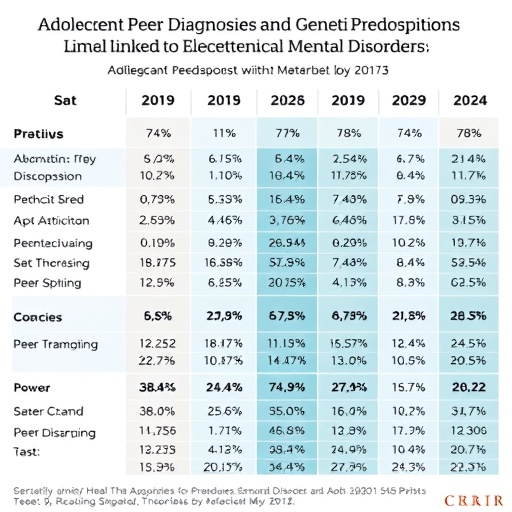
A groundbreaking cohort study published in the reputable journal JAMA Psychiatry has unveiled significant insights into how peer environments within upper secondary schools shape mental health trajectories. This pioneering research underscores that adolescence, a critical period marked by dynamic social and psychological development, is profoundly influenced by the social context in which young individuals are embedded, particularly their peer groups at school. The study meticulously tracks mental health outcomes over time, offering compelling evidence that peer environments are intrinsically linked to the progression or amelioration of mental health conditions among teenagers.
Mental health trajectories refer to the patterns and changes in mental health status individuals experience as they age or as their circumstances evolve. This study provides a nuanced understanding of these trajectories by factoring in social determinants, such as peer interactions and group dynamics within the secondary educational setting. Unlike previous studies that have predominantly concentrated on individual risk factors like genetics or family history, this research places a spotlight on external social environments, introducing a broader, systemic perspective to adolescent mental health research.
The methodology employed in this study involves longitudinal cohort analysis, which is particularly suited to observing temporal changes and inferring potential causal relationships. By following a diverse cohort of upper secondary school students over several years, the researchers were able to observe how variations in peer environments correspond with mental health changes. This approach offers robustness in capturing the complexity of social interactions and their psychological impacts, moving beyond static cross-sectional assessments.
Significantly, the study identifies that certain peer environments act as either protective or risk factors for mental health. Positive peer support, inclusion, and healthy social interactions were linked with improved mental health outcomes, while negative peer influences such as bullying, exclusion, or association with high-risk groups correlated with deteriorations in mental health status. These findings emphasize the multifaceted role peers play—not merely as companions but as powerful contributors to psychological resilience or vulnerability during adolescence.
One of the pioneering aspects of this study is its integrative focus on both social and genetic components that may modulate mental health trajectories. While the primary focus is on the peer environment, researchers acknowledge the interplay with genetic predispositions, suggesting that the social context might amplify or mitigate inherent risks. This gene-environment interaction is a frontier in psychiatric research, as it disrupts deterministic views and highlights potential avenues for intervention through social modifications.
The implications for educational policy and mental health interventions are profound. Schools are not just venues for academic learning but are also critical ecosystems influencing psychological well-being. This research advocates for enhanced attention to peer group dynamics in mental health strategies, suggesting that fostering supportive peer networks and mitigating toxic social environments can substantially improve adolescent mental health outcomes. This marks a shift towards preventive psychiatry grounded in social ecology.
Despite the robust findings, the study urges caution in interpreting the mechanisms underlying the observed associations. Future investigations are necessary to disentangle the causal pathways and identify mediating variables such as communication patterns, social cognition, and emotional regulation within peer groups. Understanding these mechanisms will enable the development of targeted interventions that can be implemented within educational settings to optimize mental health trajectories.
Furthermore, the study raises questions about the role of digital social environments, considering the pervasive influence of social media on modern peer interactions. Although the current cohort predominantly examines face-to-face peer environments, emerging research suggests that online interactions can potentiate similar psychological effects, both positive and negative. Integrating digital peer environment analysis represents an essential next step in comprehensively understanding adolescent mental health.
On the methodological front, the study also showcases the advantages of leveraging large, longitudinal datasets that incorporate both psychological assessments and social network analytics. This dual approach allows for a granular exploration of peer relationships and their mental health consequences. Such data-driven strategies are expected to become increasingly fundamental in psychiatric epidemiology and social sciences at large.
This research contributes to the field of clinical psychology by bridging social science theories with psychiatric practice, demonstrating how empirical evidence from cohort studies informs real-world mental health challenges. It serves as a clarion call for multidisciplinary collaboration among psychologists, educators, geneticists, and policymakers to address adolescent mental health holistically.
In conclusion, this pioneering cohort study published in JAMA Psychiatry advances our understanding of adolescent mental health by firmly situating peer environments as key determinants of mental health trajectories during upper secondary schooling. As adolescents navigate this vulnerable yet formative stage, balancing biological, psychological, and social influences, this research highlights the critical importance of nurturing positive peer environments. It sets the stage for innovative, socially informed mental health interventions that promise to improve the wellbeing of future generations.
Correspondence concerning this study can be addressed to the lead author, Dr. Jussi Alho, at [email protected]. The study, under embargo, will be accessible through the For The Media platform linked on the JAMA Network website, allowing for comprehensive peer review and media dissemination upon release.
Subject of Research: Mental Health Trajectories in Adolescents within Peer Environments of Upper Secondary Schools
Article Title: [Not provided in the content]
News Publication Date: [Not provided in the content]
Web References: [Not provided in the content]
References: (10.1001/jamapsychiatry.2026.1752)
Image Credits: [Not provided in the content]
Keywords: Mental health, Adolescents, Peer environment, Upper secondary school, Cohort studies, Psychiatry, Psychological science, Clinical psychology, Risk factors, Genetics, Longitudinal studies
Tags: adolescent mental health trajectoriesadolescent psychological development and social contextcausal relationships in psychiatric epidemiologygenetic and environmental factors in mental disordersgenetic predispositions and mental illnessimpact of school environment on mental healthlongitudinal cohort studies in psychiatrymental health risk factors in teenagerspeer group dynamics in secondary schoolspeer influence on teenage mental disorderssocial determinants of adolescent mental healthsystemic approaches to adolescent mental health