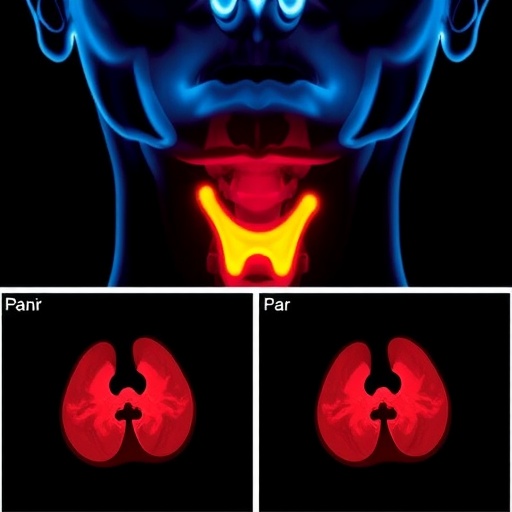
In a groundbreaking advancement poised to transform thyroid cancer diagnostics, researchers at Houston Methodist have unveiled an innovative noninvasive imaging technique leveraging second harmonic generation (SHG) microscopy. This emerging technology offers a sophisticated means to analyze collagen remodeling, a critical biomarker within the tumor microenvironment, thereby promising to markedly enhance the accuracy and objectivity of diagnosing papillary thyroid carcinoma (PTC), the prevalent and most commonly diagnosed form of thyroid cancer globally.
SHG microscopy distinguishes itself by utilizing nonlinear optical phenomena, specifically relying on the interaction of intense pulsed laser light with collagen fibers embedded in the extracellular matrix of thyroid tissue. Unlike conventional imaging that primarily visualizes cellular morphology, SHG directly interrogates the structural organization of collagen without the necessity of exogenous dyes or markers. This label-free contrast mechanism exploits the intrinsic non-centrosymmetric properties of collagen’s triple helix, converting incident photons into emitted light at exactly half the wavelength, enabling researchers to capture high-resolution, three-dimensional images revealing subtle architectural changes indicative of malignancy.
The Houston Methodist-led study, published in the Journal of Biomedical Optics, was spearheaded by Dr. Stephen Wong and Dr. Raksha Raghuanthan. Their collaborative efforts harnessed quantitative statistical modeling, which systematically characterizes collagen microstructure alterations unique to cancerous nodules. Unlike opaque artificial intelligence models often criticized for their “black box” nature, this approach underscores interpretability and biological relevance, pinpointing collagen signatures that correlate directly with tumor progression. Such insights can empower clinicians with robust, repeatable metrics for differentiating benign from malignant thyroid lesions, a clinical challenge that frequently necessitates invasive biopsies and sometimes unnecessary surgeries.
Moreover, this SHG-based modality could alleviate the diagnostic bottlenecks encountered with fine-needle aspiration cytology, which remains the gold standard yet is susceptible to subjective interpretation and sampling errors. By providing a more consistent and quantifiable readout of the extracellular matrix remodeling, the technology has the potential to serve as an adjunct tool, streamlining clinical workflows and expediting decision-making processes. Early detection and precise characterization of PTC could ultimately lead to better patient management, reducing overtreatment and improving prognostic accuracy.
Thyroid cancer holds the unfortunate distinction of being the most common endocrine malignancy worldwide, with a pronounced incidence among young adults aged 16 to 33. The urgency for more reliable diagnostic modalities is underscored by this demographic trend, alongside the complexity of distinguishing indolent nodules from aggressive tumors based on conventional cytology alone. The noninvasive SHG microscopy technique not only promises enhanced diagnostic clarity but also underscores a shift towards personalized medicine by profiling the tumor microenvironment’s biomechanical properties in situ.
Significantly, this study’s methodologies encompass advanced computational image analysis techniques that quantitatively measure collagen fiber density, orientation, and cross-linking patterns within tissue samples. These high-dimensional data sets reveal a collagen remodeling phenotype specific to papillary thyroid carcinoma, offering a novel biomarker that aligns with pathological hallmarks recognized in thyroid oncology. This represents a leap forward from traditional histopathology, which has mostly focused on cellular abnormalities, by integrating stromal context into diagnostic evaluation.
The implications of this technology extend beyond differential diagnosis. By potentially discriminating between various thyroid cancer subtypes through distinct collagen signatures, the SHG microscopy platform could guide tailored therapeutic strategies. Accurate subtype classification is crucial, given the differential prognosis and treatment regimens associated with variants such as follicular, medullary, and anaplastic thyroid carcinomas. As ongoing research validates and refines the technique in larger patient cohorts, the prospects for deploying SHG microscopy as a routine clinical tool become increasingly tangible.
Supporting this endeavor, the collaborative team, comprising scientists from Houston Methodist, Texas A&M University, and Shanghai Jiao Tong University, brought together expertise spanning biomedical engineering, pathology, optical physics, and computational modeling. This multidisciplinary approach was instrumental in translating sophisticated optical imaging principles into a clinically actionable diagnostic technology. The study’s funding by the National Cancer Institute alongside philanthropic contributions illustrates growing recognition of innovative imaging’s potential to revolutionize oncologic diagnostics.
Looking ahead, the researchers aim to integrate SHG microscopy into minimally invasive biopsy workflows, potentially replacing or augmenting current sampling methods that often entail patient discomfort and procedural risk. Furthermore, the scalability and adaptability of this imaging technique could inspire applications across other fibrotic and neoplastic diseases where collagen remodeling is pivotal. The vision is clear: a future where diagnosis is not only faster and more precise but also deeply interpretable, providing clinicians with transparent pathophysiological insights to improve patient outcomes.
In summation, the Houston Methodist study introduces second harmonic generation microscopy as an impactful diagnostic innovation with promising clinical utility for papillary thyroid carcinoma. By revealing previously inaccessible collagen dynamics within tumor tissues, this technology stands on the cusp of redefining thyroid cancer diagnostics — making it faster, more objective, and significantly less invasive. As scientific validation continues, SHG microscopy could emerge as a vital tool in the arsenal against thyroid cancer, benefiting patients through enhanced early detection and personalized care pathways.
Subject of Research:
Papillary thyroid carcinoma diagnosis using second harmonic generation microscopy to characterize collagen remodeling.
Article Title:
Quantitative second harmonic generation microscopy for characterizing collagen remodeling in papillary thyroid carcinoma
News Publication Date:
25-May-2026
Web References:
https://www.spiedigitallibrary.org/journals/journal-of-biomedical-optics/volume-31/issue-05/056501/Quantitative-second-harmonic-generation-microscopy-for-characterizing-collagen-remodeling-in/10.1117/1.JBO.31.5.056501.full
References:
Houston Methodist Research Institute, Journal of Biomedical Optics, National Cancer Institute
Keywords:
Thyroid cancer, papillary thyroid carcinoma, second harmonic generation microscopy, collagen remodeling, noninvasive imaging, biomedical optics, tumor microenvironment, diagnostic innovation, extracellular matrix, optical biopsy, computational modeling
Tags: advanced thyroid cancer diagnostic techniquescollagen remodeling biomarkersextracellular matrix analysis in tumorshigh-resolution 3D collagen imaginglabel-free optical imagingnoninvasive thyroid cancer imagingnonlinear optical phenomena in cancer detectionoptical biopsy alternativespapillary thyroid carcinoma diagnosisquantitative collagen microstructure modelingsecond harmonic generation microscopytumor microenvironment collagen changes