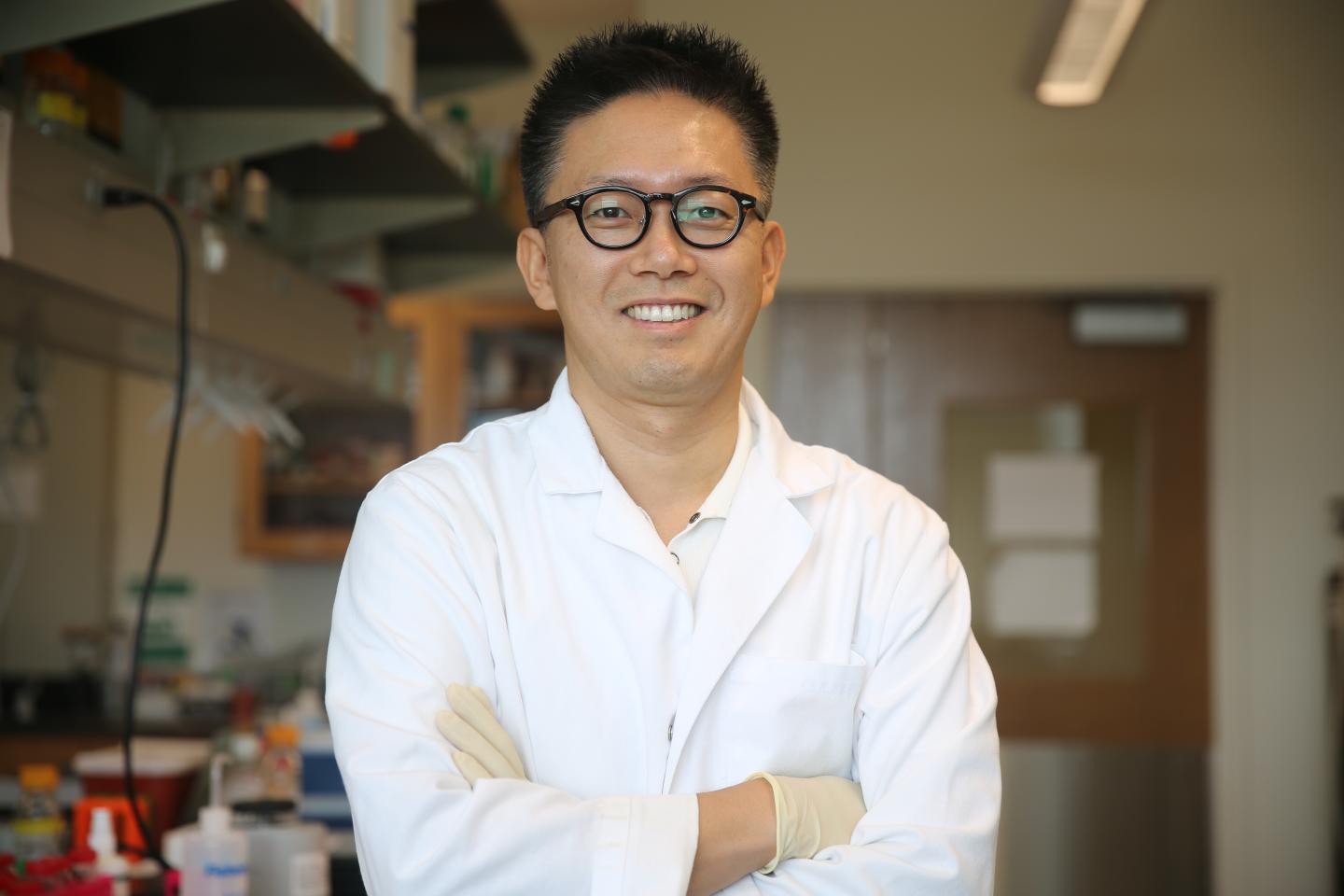

Credit: UCF, College of Medicine
A team of researchers at the University of Central Florida is using breakthrough gene-editing technology to develop a new screening tool for Parkinson's disease, a debilitating degenerative disorder of the nervous system. The technology allows scientists in the lab to "light up" and then monitor a brain protein called alpha-synuclein that has been associated with Parkinson's.
"Alpha-synuclein is a protein that is normally found in the brain. We all have it," said Burnett School of Biomedical Sciences doctoral student Levi Adams, one of the lead researchers on the project. "But for some reason, when you have Parkinson's the levels become abnormal. So if we can monitor this protein in the cell, we can start to measure what causes it to go up and also what treatments can cause it to go down."
The team published its findings in the Scientific Reports journal. The National Institutes of Health (5R21NS088923-02 ) funded the work. The researchers believe their work is a crucial step toward identifying new drug therapies for Parkinson's disease.
Adams is partnering with doctoral student Sambuddha Basu, associate professor and neurosciences researcher, Associate Professor Yoon-Seong Kim, and scientist Subhrangshu Guhathakurta to study Parkinson's, which affects motor functions caused by a gradual loss of brain cells. There are about 60,000 new cases of Parkinson's each year in the United States.
They are using CRISPR Cas9 (Clustered Regularly Interspaced Short Palindromic Repeats) gene-editing technology. The system is one of research's fastest growing biomedical techniques that allows scientists to make specific changes in the DNA of plants and animals while not killing cells. The system is becoming instrumental in studying genetically based treatments for diseases including cancer and Parkinson's.
"It's the most powerful and widely used gene-editing technique in use because it allows us to change the DNA in living cells," said Kim, who is also a medical doctor. "The innovation of this method is that it enables us to monitor this gene in real-time without killing the cell. Without the CRISPR Cas-9 method, you would have to extract all the proteins from the cell to measure them, which kills the cell."
Using the CRISPR technique, the Burnett team edited the alpha-synuclein gene and inserted a luminescent tag made from proteins that causes fireflies to light up. Every time the cell creates the alpha-synuclein protein, the tag gives off a light. That reaction "makes it much easier to measure," Adams said. "More light means an increased level of alpha-synuclein, which would be considered a diseased state."
The team found that measuring light was a reliable method to measure alpha-synuclein production.
"If we take one of these modified cells and treat it with a particular drug, if it doesn't produce light anymore, then this means the drug is a potential treatment for this disease," Basu said.
With the engineered cells, researchers can screen new and existing drugs to see how they regulate alpha-synuclein level in patients.
"With an easy-to-measure reporter like light production, this will allow us to do high throughput screening, where you can test a large panel of drugs at once," Guhathakurta said.
With the new technology, the scientists hope to identifying ways to reduce alpha-synuclein production that can possibly prevent Parkinson's or its progression in patients diagnosed with the disease.
The team said research will focus on what aspects of the alpha- synuclein protein kill neurons during Parkinson's disease.
###
The University of Central Florida, one of the largest universities in the nation with more than 64,000 students, uses the power of scale and the pursuit of excellence to make a better future for our students and society. Described by The Washington Post as demolishing "the popular belief that exclusivity is a virtue in higher education" and credited by Politico with creating a "seamless pipeline of social mobility," UCF is recognized as one of the best values in higher education. UCF aligns its teaching, research and service with the needs of the community and beyond, offering more than 200 degree programs at more than a dozen locations, including its main campus in Orlando. Faculty and students are creating innovations in areas as diverse as simulation and training, optics and lasers, hospitality management, video game design, business, education and health care to solve local and global problems. For more information, visit http://www.ucf.edu.
Media Contact
Zenaida Gonzalez Kotala
[email protected]
407-823-6120
@UCF
http://www.ucf.edu
############
Story Source: Materials provided by Scienmag