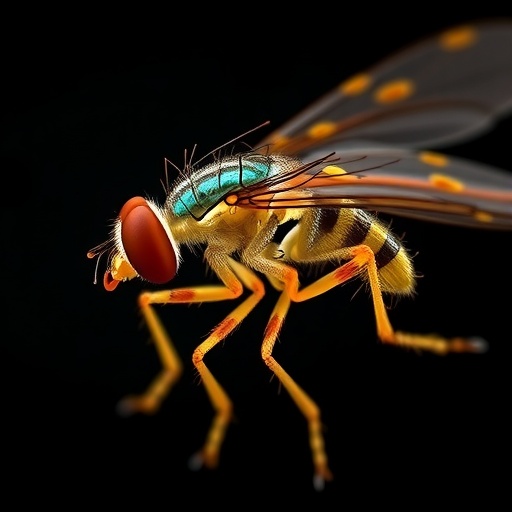
In the intricate world of biological phenomena, few curiosities rival the extraordinary dimensions and behavior of fruit fly sperm. Researchers at the Flatiron Institute’s Center for Computational Biology, under the auspices of the Simons Foundation, have embarked on a journey to decode the perplexing dynamics of these supersized swimmers. Unlike the modestly proportioned sperm of most organisms, the sperm of the common fruit fly (Drosophila melanogaster) stretch to an awe-inspiring length of approximately 2,000 microns, nearly equaling the length of the fly itself. This size discrepancy raises profound questions about the physical and biological mechanisms enabling such cumbersome cells to navigate their limited spatial environment effectively.
Fruit fly sperm display a peculiar propulsion mechanism that starkly contrasts with that of human sperm and many other species. Instead of propelling themselves through fluid by generating traveling waves along their flagella, fruit fly sperm utilize a distinctive push-off strategy. This involves individual sperm pressing against the tails of adjacent sperm, a form of mechanical interaction that transforms a seemingly chaotic assembly into a coordinated, collective movement. This interaction not only prevents entanglement but also orchestrates a synchronized churning motion inside the sperm storage sac, an organ markedly smaller than the sperm themselves, approximately one-tenth their length.
The sperm storage organ’s spatial constraints present a paradox: how can sperm, each bearing an enormous, slender tail, coexist in such a confined environment without intertwining into knots that would inevitably impair fertilization? The research team tackled this question by integrating rigorous mathematical modeling with experimental data, creating simulations that accurately mirror the biological environment of the fruit fly’s reproductive system. These computational models revealed that the ordered flows of sperm arise naturally from the collective mechanical interactions among thousands of individual cells, essentially self-organizing into waves that resemble fluidic patterns.
Remarkably, this study ventures beyond describing an anatomical curiosity, offering insights into the fundamental principles that govern collective dynamics in biological systems. The fluid-like organization of the sperm within the storage sac represents a compelling example of how complex macroscopic phenomena can emerge from simple, local interactions. Such principles extend beyond reproductive biology, potentially informing our understanding of nutrient transport through vascular systems, intracellular organelle assembly, and early embryonic pattern formation.
As supersized sperm navigate their cramped habitat, each cell endures the physical challenge of dragging its enormous tail while simultaneously coordinating with peers to avoid mechanical interference. This coordination suggests a finely tuned evolutionary adaptation optimized for reproductive success, where sperm gigantism, paradoxically, enhances motility efficiency through collective cooperation rather than individual actuation. The team’s findings propose that the unique mechanical propulsion mode and collective flow patterns observed are evolutionary innovations tailored to the fruit fly’s reproductive ecology.
The implications of this discovery ripple through interdisciplinary fields, especially those focused on modeling biological complexity. By translating observable biological phenomena into quantitative frameworks, the researchers have moved closer to a truly systemic understanding of life processes. Their work demonstrates how integrating computational modeling with experimental biology allows scientists to hypothesize and validate mechanisms that might otherwise remain elusive due to observational limitations.
The Flatiron Institute’s Center for Computational Biology has showcased how computational prowess can illuminate the mysteries of life-scale data sets, which often contain high-dimensional, nonlinear interactions. Employing sophisticated mathematical tools, the team unraveled the interdependent movements of thousands of sperm cells, transforming a biological puzzle into a solvable physics problem. This approach underscores the rising importance of theoretical and computational biology in modern scientific inquiry.
Notably, the research was published on June 22, 2026, in Nature Physics, highlighting the physical consequences of sperm gigantism and offering a novel perspective on how physical constraints shape biological form and function. The study epitomizes a trend in contemporary biology that leverages principles from physics, engineering, and applied mathematics to interpret complex living systems.
A key takeaway from this study is the insight into self-organization within dense cellular systems, where mechanical forces and spatial limitations dictate the emergent behavior of cells. The fruit fly sperm’s arrangement and propulsion mechanism challenge classical views on motility, showing that cooperation among cells can introduce efficiencies even when individual cells operate under severe geometric constraints.
Looking ahead, these findings may spark analogous investigations into other biological systems exhibiting collective behaviors. Whether examining cellular transport networks, tissue morphogenesis, or microbial communities, the integrative methods used here pave the way for cross-disciplinary exploration. The study’s legacy lies in providing foundational knowledge that can influence the design of biomimetic materials and inform reproductive health technologies.
By elucidating the physical principles dictating how fruit fly sperm navigate confined spaces without tangling, this research enriches our comprehension of biological fluid dynamics and the mechanics of life at the microscale. It reveals a symphony of cellular interactions governed by physics, orchestrated to optimize reproductive efficiency in a species renowned for its genetic and developmental studies.
For those captivated by the intersection of biology and physics, this study offers a profound example of how large-scale phenomena in living organisms can be decoded through precise computational and theoretical work. It serves as an inspiring model for future research endeavors that strive to unify empirical biology with quantitative science, ultimately advancing our understanding of life’s intricate designs.
Subject of Research: Cells
Article Title: The physical consequences of sperm gigantism
News Publication Date: 22-Jun-2026
Web References: http://dx.doi.org/10.1038/s41567-026-03305-4
Image Credits: Lucy Reading-Ikkanda/Simons Foundation
Keywords
Life sciences, Developmental biology, Physical sciences, Modeling, Applied mathematics, Reproductive biology
Tags: biological fluid mechanicscollective sperm movementcomputational biology in reproductionDrosophila melanogaster reproductionFlatiron Institute researchfruit fly sperm lengthmechanical interaction in spermsperm motility strategiessperm propulsion mechanismssperm storage sac dynamicssupersized sperm biologyunusual sperm behavior