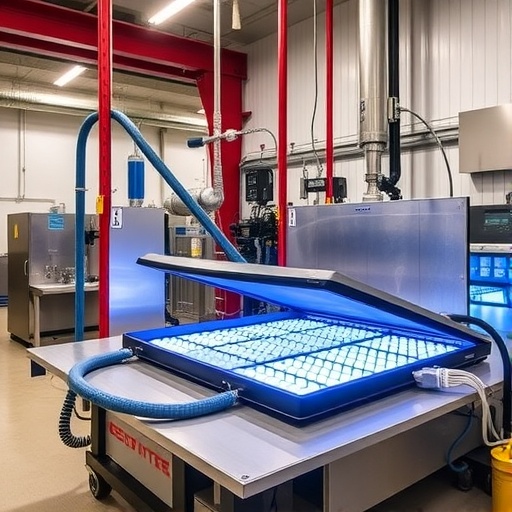
Southwest Research Institute (SwRI) has recently announced the completion of an extensive three-year upgrade project to its High Energy Annex Test (HEAT) facility, a groundbreaking center dedicated to the realistic testing of gas turbine combustors. Established in 2016, HEAT quickly positioned itself as an indispensable resource for the propulsion and energy sectors, addressing the critical demand for accurate, real-world combustion system evaluations that go beyond theoretical modeling.
The facility, designed to replicate operational conditions of gas turbines under controlled but realistic environments, plays a pivotal role in validating combustion system performance, safety, and design efficiencies. According to Griffin Beck, head of SwRI’s Propulsion and Energy Machinery section, the limitations of computational models necessitated a physical testbed where engineers can observe combustors under authentic operational stresses, pressures, and thermal environments, elevating confidence in design outcomes and enabling safer, more efficient turbine technologies.
A defining feature of the HEAT facility is its capacity for continuous combustor testing—a capability that sets it apart from many test sites where intermittent runs are the norm. Real-world turbines operate continuously for extended periods, and this continuous testing framework allows for a more accurate assessment of combustor durability, emissions, and performance, providing vital data for manufacturers and researchers attempting to push the boundaries of turbine technology.
One of the principal goals of this recent renovation was to lower operational costs without compromising test quality. Fueling this initiative was the development of cost-efficient combustion rigs produced via additive manufacturing technology. Employing 3D printing techniques to create combustor components, SwRI achieved an impressive 80% reduction in cost compared to traditional manufacturing approaches. This breakthrough mitigates one of the primary financial hurdles facing combustion research, allowing broader experimental runs and accelerated innovation cycles.
The facility’s upgrades are also strategically aligned with the global energy transition towards low-carbon and zero-carbon fuels. Recognizing that alternative fuels such as hydrogen exhibit different combustion characteristics like flame velocity and temperature profiles, the HEAT facility has been reconfigured to allow seamless switching between fuel types. This flexibility is essential for comprehensive testing across a variety of fuel chemistries, from conventional natural gas to emerging synthetic fuels that hold promise for decarbonization.
Handling these alternative fuels safely requires not only system adaptability but also robust equipment capable of replicating the high-pressure, high-flow conditions typical of industrial turbines. To this end, the installation of a new, high-capacity air compressor has tripled HEAT’s airflow and pressure capabilities, enabling it to safely conduct tests under demanding scenarios that mimic real turbine operating environments. This advancement is critical for hydrogen and other fuels that behave differently under pressure, necessitating precise control over test parameters.
SwRI’s internal research and development funding facilitated this ambitious project, illustrating the organization’s commitment to advancing propulsion technologies independently from external grants or contracts. In 2025 alone, SwRI allocated over $13 million towards cutting-edge innovations, highlighting a strategic investment in cultivating new knowledge, enhancing scientific expertise, and supporting professional growth within its research staff.
The significance of these facility enhancements extends beyond cost savings and operational versatility. By providing an advanced platform for validating gas turbine combustor designs, the HEAT facility is directly contributing to the development of next-generation turbines that meet stringent environmental and efficiency standards. This has profound implications for the power generation industry, aviation, and any sector dependent on high-performance combustion engines.
Moreover, the adoption of additive manufacturing marks a cultural shift in machine design and fabrication methodologies within combustion research. As more components transition from traditional machining to additive processes, researchers can explore innovative geometries and materials that were previously unattainable, opening doors to optimized combustion characteristics and longevity enhancements.
The successful integration of multi-fuel testing capabilities at HEAT also positions the facility as a key player in investigating combustion dynamics associated with the hydrogen economy. Hydrogen combustion presents unique challenges such as elevated flame speeds and localized hot spots, which affect turbine materials and emissions. By simulating these conditions accurately, HEAT provides invaluable insights that can accelerate the commercialization of hydrogen-powered turbines.
In summary, the revitalization of the HEAT facility embodies a critical nexus of innovation, cost-efficiency, and environmental stewardship. By equipping engineers and scientists with state-of-the-art tools to test combustors across a spectrum of fuels and conditions, SwRI is accelerating the transition towards cleaner combustion technologies that align with global carbon-neutral goals. This forward-thinking approach ensures that the HEAT facility remains an indispensable asset for both academic research and industrial development in the era of sustainable energy.
For those interested in further technical details and project insights, SwRI offers comprehensive resources detailing the internal R&D efforts that powered this transformation. The commitment to advancing combustion testing technology places HEAT at the forefront of addressing the evolving challenges of energy production in the 21st century.
Subject of Research:
Gas turbine combustor testing and facility upgrades for alternative fuel compatibility.
Article Title:
SwRI Completes Major Upgrade of Gas Turbine Combustion Test Facility to Accelerate Clean Energy Innovations
News Publication Date:
June 16, 2026
Web References:
https://www.swri.org/what-we-do/internal-research-development/2025/energy-environment/heat-facility-improvements-support-carbon-free-economy-18-r6243
https://www.swri.org/node/6005
Image Credits:
Southwest Research Institute
Keywords
Turbines, Gas turbine engines, Internal combustion engines, Combustion testing, Additive manufacturing, Energy, Machine design, Alternative fuels, Hydrogen combustion, Decarbonization, Test facility upgrade, Propulsion engineering
Tags: advanced gas turbine safety testingalternative fuel combustion evaluationcombustion system performance validationcontinuous combustor testing technologygas turbine combustor testingHigh Energy Annex Test facility upgradephysical testbed for turbine researchpropulsion and energy machinery testingreal-world turbine operation simulationSouthwest Research Institute alternative fuel researchturbine design efficiency improvementsturbine emissions and durability analysis