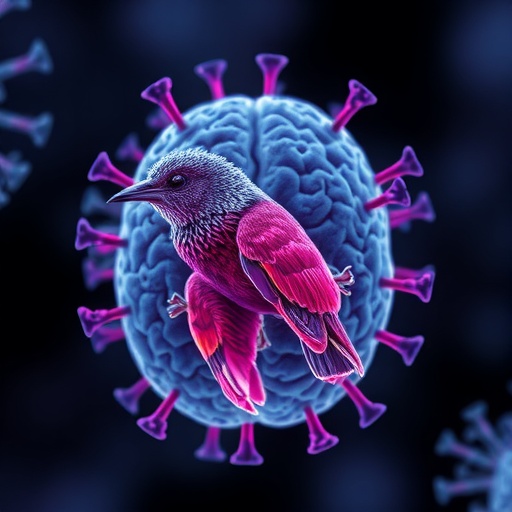
In a groundbreaking study published in Nature Communications, researchers have identified a novel pegivirus linked to encephalitis in red-legged partridges, revealing a troubling capacity for neurotropism across multiple avian species. This discovery not only deepens the understanding of viral infection in birds but also poses significant implications for wildlife health and viral ecology. The comprehensive investigation, led by Matos, Bilic, Viloux, and colleagues, sheds light on the molecular and pathological characteristics of this pegivirus, adding a vital piece to the complex puzzle of avian infectious diseases.
Encephalitis, inflammation of the brain, has long presented diagnostic challenges when the precise etiological agents are not well characterized. Traditional studies on avian viruses have focused largely on well-known agents such as avian influenza virus or West Nile virus. However, the identification of this pegivirus signifies a pivotal shift, emphasizing the importance of previously overlooked viral families in neurological disease presentations. Pegiviruses, members of the Flaviviridae family, are generally considered to have limited pathogenicity, often dubbed as “hepacivirus relatives” with benign effects in their hosts. This study disrupts that paradigm by demonstrating clear neuropathogenic potential.
The research team commenced their work following alarming reports of neurological symptoms and mortality in populations of red-legged partridges (Alectoris rufa), a species widely distributed across Europe and valuable for both ecological reasons and game management. Birds afflicted exhibited classical signs of encephalitis: disorientation, seizures, and lethargy. Post-mortem examinations revealed widespread brain inflammation. Seeking a causative agent, the researchers employed high-throughput sequencing technologies on brain tissue samples, unraveling the complete genomic sequence of a previously unidentified pegivirus.
Subsequent phylogenetic analyses indicated that this avian pegivirus represents a distinct lineage within the Pegivirus genus. The virus’s genome encodes typical flaviviral proteins, including the RNA-dependent RNA polymerase and structural envelope proteins, but harbors unique amino acid substitutions possibly linked to neurotropism. These molecular signatures, absent in other known pegiviruses isolated mainly from mammals, might contribute to the observed neural invasion and pathology in affected birds.
The investigation advanced through a combination of experimental infections and in situ hybridization techniques that mapped viral RNA within affected brain regions. Viral localization was prominently noted in neurons and glial cells, confirming active replication within neural tissue. This neurotropism, unusual for pegiviruses, raised critical questions about the mechanism of neuroinvasion. Hypotheses include receptor-mediated entry exploiting specific cell-surface molecules expressed in avian neural cells, or disruption of the blood-brain barrier facilitated by systemic inflammation.
Cross-species transmission experiments further revealed the virus’s capacity to infect other avian species beyond red-legged partridges. When exposed experimentally, species such as the common quail and pheasant developed encephalitis-like symptoms, indicating that the virus’s host range is broad within the Galliformes order. This broader host susceptibility underlines potential ecological ramifications, particularly regarding wild bird populations that act as reservoirs or vectors for viral dissemination.
The pathological findings are compelling, with histopathology highlighting lymphohistiocytic perivascular cuffing, neuronal degeneration, and microglial nodules within affected brains. Immunohistochemical staining for viral proteins confirmed a direct correlation between viral presence and tissue lesions. Notably, infected birds did not show significant systemic viral load, suggesting a preference or selective replication within the central nervous system, a hallmark of neurotropic pathogens.
Understanding the transmission dynamics of this pegivirus is critical for controlling potential outbreaks. While the study did not definitively establish transmission routes, epidemiological data suggest a combination of direct contact, possibly facilitated by communal feeding or crowded living conditions, and vector-borne transmission via blood-sucking arthropods. Given that several pegiviruses in mammals are blood-borne, this finding aligns with known transmission modes but adds complexity when considering CNS infection.
The implications for wildlife management are profound. Red-legged partridges serve as an integral part of Mediterranean ecosystems, and their decline due to viral encephalitis could cascade through food webs. Furthermore, the risk that this virus might spill over into domestic avian species or other wild birds necessitates urgent monitoring and surveillance protocols. Conservationists and game managers must now consider diagnostic screening for pegivirus infections when investigating neurological disease outbreaks.
From a virological perspective, this discovery opens avenues for the study of viral evolution towards neurotropism in a genus not previously associated with brain infections. The molecular determinants identified provide targets for further functional analysis, potentially revealing mechanisms underlying viral neuroinvasion and persistence. Moreover, these findings may prompt a reassessment of the pathogenic potential of pegiviruses in other hosts, including mammals, where their role has largely been underestimated.
The researchers also stress the need for developing specific diagnostic tools capable of detecting this novel pegivirus efficiently. Current serological assays and PCR primers designed for mammalian pegiviruses have limited sensitivity and specificity in avian contexts. Advancing molecular diagnostics is imperative for early detection, outbreak response, and epidemiological studies aiming to map the virus’s spread and impact.
Beyond immediate disease control, this study enriches our understanding of viral biodiversity and ecology. The existence of neurotropic pegiviruses in birds suggests an underexplored viral niche, highlighting how viral evolution adapts according to host species and environmental pressures. This viral adaptation reflects complex virus-host interactions and may hint at undiscovered viruses with potential zoonotic capabilities.
Finally, this research underscores the power of modern genomic tools and interdisciplinary collaboration in unveiling cryptic viral pathogens. Using next-generation sequencing, bioinformatics, immunohistochemistry, and experimental infection models, the team elucidated the link between the pegivirus and avian encephalitis, a feat that would have been unattainable a decade ago. Such integrative approaches are critical as emerging infectious diseases continue to challenge both wildlife and human health sectors.
In conclusion, the identification of a neurotropic pegivirus associated with encephalitis in red-legged partridges expands the horizon of avian virology and raises essential questions about viral pathogenesis, transmission, and host adaptation. This novel virus exemplifies the dynamic nature of viral evolution and the necessity to remain vigilant in monitoring new and reemerging pathogens within wildlife populations. Future studies are anticipated to unravel the intricate host-pathogen interplay further and to develop strategies to mitigate the impacts of this emerging infectious agent.
Subject of Research: Identification and characterization of a novel pegivirus causing encephalitis in red-legged partridges and its neurotropism in various avian species.
Article Title: A pegivirus associated with encephalitis in red-legged partridges shows neurotropism across avian species.
Article References:
Matos, M., Bilic, I., Viloux, N. et al. A pegivirus associated with encephalitis in red-legged partridges shows neurotropism across avian species. Nat Commun (2026). https://doi.org/10.1038/s41467-026-73858-8
Image Credits: AI Generated
Tags: avian infectious diseases neurotropismavian neurotropism of pegivirusemerging avian neurotropic virusesflaviviridae family neurovirulenceneurological disease in wild birdsnovel pegivirus in red-legged partridgespegivirus encephalitis in birdspegivirus impact on avian healthpegivirus molecular pathologypegivirus neuropathogenic potentialviral encephalitis in wild birdswildlife viral ecology