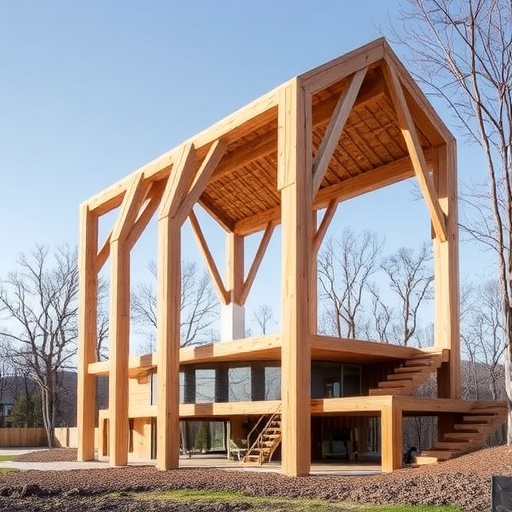
In an era where sustainability and resource efficiency have become imperative in architecture and construction, a pioneering study by Aalto University architect and researcher Jaakko Torvinen breathes new life into the overlooked potential of what is known as “misfit wood.” This research challenges long-standing norms in timber utilization by focusing on the structural viability of organically shaped roundwood logs—those that have been traditionally discarded due to their irregular forms, such as forked, curved, or double-curved logs.
For centuries, the construction and timber industries have gravitated towards standardized, straight planks and beams, essentially sidelining any wood that does not conform to these rigid geometries. Torvinen’s latest work disrupts this convention by applying traditional load-bearing calculation methods to these irregular shapes, demonstrating through structural tests that their strength can be reliably predicted by surprisingly straightforward equations. His groundbreaking research reveals that structural assessment need not be confined to the geometrically regular elements, thus opening new avenues for the wood economy.
The implications of this paradigm shift are profound. Massive quantities of timber, currently relegated to pulpwood or burned as energy wood, represent wasted potential that could otherwise serve economically valuable and aesthetically appealing roles in building construction. By highlighting that these non-standard logs possess measurable load-bearing capacity, Torvinen’s work urges a reassessment of forest resource management and wood product design, paving the way for innovative use of so-called “imperfect” timber.
Central to the study is the application of existing structural formulas, proving that current engineering approaches—long trusted in timber design—are sufficiently robust for assessing the strength of misfit wood. This outcome removes a significant barrier for architects and engineers hesitant to incorporate such materials due to uncertainty over their reliability. Moreover, with the evolving landscape of digital design and fabrication technologies, mass-customization of wood components that embrace natural variations and organic forms transitions from a niche notion to an attainable industrial practice.
This research is not merely theoretical but also finds resonance in Torvinen’s architectural accomplishments, which spotlight the visual and tactile appeal of misfit wood. His notable projects, including the ephemeral “Pikku Finlandia” venue in Helsinki, showcase the architectural possibilities of integrating knotty, forked, and charred wood elements. These designs embody a shift towards celebrating natural wood forms, balancing structural legitimacy with artistic expression and environmental consciousness—a harmony often elusive in modern construction.
Beyond mere aesthetics, Torvinen’s vision is pragmatic. He anticipates a future where the construction industry embraces mass-customized organic timber solutions, motivated by economic incentives and consumer readiness to move away from uniform, processed materials. His study lays a foundational framework intended to erase skepticism and establish misfit wood as a credible, legitimate design option capable of answering contemporary sustainability challenges without sacrificing structural integrity.
One of the study’s technical achievements lies in conducting the first-ever load tests on organically shaped roundwood columns. Until now, the structural engineering community has lacked empirical data on these shapes, often dismissing them as unsuitable for load-bearing purposes. By systematically testing and validating load capacities, Torvinen’s research fills this critical knowledge gap, providing designers and builders with the confidence to incorporate such materials safely.
The potential environmental benefits are equally significant. By making full use of imperfect timber that would otherwise be wasted, the demand for sawn, standardized timber could decrease, lessening pressures on forests and reducing carbon footprints associated with timber processing and waste management. This aligns with the broader goals of sustainable building practices, emphasizing reduction of material waste and enhanced utilization efficiency.
Moreover, the advent of digital fabrication technologies complements this research by allowing complex wood geometries to be digitally modeled, optimized, and cut with precision, enabling the integration of misfit logs in ways previously impossible. This synergy between empirical load-bearing validation and digital production workflows could catalyze a renaissance in timber architecture, marrying tradition with cutting-edge approaches for environmental and economic benefit.
Torvinen’s work also offers social implications, as it encourages a recalibration of how society values natural wood materials. Moving away from the entrenched notion that only geometrically perfect lumber deserves a place in construction encourages a more mindful, appreciative relationship with forests and the materials they provide. This cultural shift could inspire innovative architectural expressions and contribute to a more sustainable future.
The timeframe for this research’s impact is already underway, with Torvinen’s “Puusauna” project being featured prominently in Aalto University’s “Designs for a Cooler Planet 2026” exhibition in Helsinki. This underscores the timely relevance of his work and demonstrates its appeal not only in scientific circles but also in public discourse on sustainable living and design.
In conclusion, Jaakko Torvinen’s study on the structural potential of curved and bifurcated misfit wood logs ushers in a new chapter for timber construction. By validating the load capacities of organic timber shapes through scientifically rigorous testing, his research challenges centuries-old assumptions, providing a practical framework that could revolutionize wood utilization. Combined with advancing digital technology and growing sustainability imperatives, this shift could significantly reduce wood waste, inspire architectural innovation, and foster a new appreciation for the natural beauty and resilience inherent in misfit wood.
Subject of Research: Structural Potential of Curved and Bifurcated Misfit Wood Logs
Article Title: Structural Potential of Curved and Bifurcated Misfit Wood Logs
News Publication Date: 4-Jun-2026
Web References:
https://doi.org/10.1080/17480272.2026.2679658
https://www.aalto.fi/en/news/wooden-structured-little-finlandia-opened-its-doors-in-toolonlahti-bay
https://www.instagram.com/puusauna60n26e/
https://www.wallpaper.com/architecture/wallpaper-design-awards-2026-life-enhancer-of-the-year-puusauna-finland
References:
Torvinen, J. (2026). Structural Potential of Curved and Bifurcated Misfit Wood Logs. Wood Material Science and Engineering. DOI: 10.1080/17480272.2026.2679658
Image Credits: Mikko Raskinen / Aalto University
Keywords
Misfit wood, roundwood logs, structural engineering, load-bearing capacity, sustainable construction, timber architecture, digital fabrication, mass-customization, wood waste reduction, organic timber, curved wood, bifurcated wood, material efficiency
Tags: Aalto University timber studycurved wood in architectureeco-friendly building materialsinnovative wood construction methodsirregular timber shapesJaakko Torvinen researchmisfit wood utilizationnon-standard wood structural assessmentorganic roundwood logsstructural load-bearing calculationssustainable timber constructiontimber resource efficiency