A groundbreaking breakthrough by a Korean research team promises to redefine the durability and efficiency standards of solid oxide electrolysis cells (SOECs), devices pivotal for converting carbon dioxide (CO₂) into valuable chemical feedstocks. This advanced technology could revolutionize sustainable industries by enhancing the conversion of CO₂ into carbon monoxide (CO), a foundational component for synthetic fuels and industrial chemicals.
At the forefront of this innovation are researchers from the Korea Research Institute of Chemical Technology (KRICT), led by Drs. Min-Chul Kim, Ji Hoon Park, and Jin Hee Lee. Their pioneering work has introduced an electrolyte interface engineering technique specifically designed for nickel-based SOECs. Unlike conventional methods laden with costly equipment, the team utilized a straightforward dip-coating approach to introduce a composite intermediate layer between traditional electrolyte materials, effectively preventing the prevalent issue of electrolyte layer cracking at high temperatures.
SOECs operate by electrochemically transforming CO₂ into CO, leveraging electricity to drive this conversion. This CO is crucial in producing syngas—a blend of CO and hydrogen (H₂)—which serves as the foundational feedstock for sustainable aviation fuel (SAF), methanol, plastics, and other indispensable industrial chemical materials. A critical challenge within this technology lies in ensuring the integrity and efficiency of the solid oxide electrolyte, which must conduct oxygen ions seamlessly between the cell’s electrodes.
The conventional electrolyte system in high-performing SOECs marries two materials: yttria-stabilized zirconia (YSZ) and gadolinium-doped ceria (GDC). YSZ is renowned for its durability but sacrifices some ionic conductivity, whereas GDC provides enhanced ionic movement at the expense of structural stability. When combined, these materials significantly boost CO₂ conversion rates. However, their differing thermal expansion rates at elevated operating temperatures often cause interfacial delamination and cracking, severely compromising long-term durability and performance.
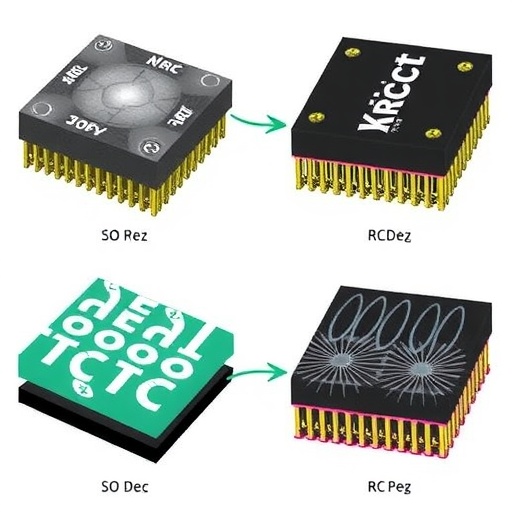
Previous strategies to tackle this dilemma involved employing advanced deposition techniques like physical vapor deposition (PVD) and pulsed laser deposition (PLD). These methods, although effective to a degree, incur substantial costs and face scalability challenges for commercial applications. The KRICT team’s innovation bypasses the need for such expensive machinery by introducing a composite ‘buffer cushion layer’ formed via dip-coating a blend of YSZ and GDC powders. This intermediate layer acts as a thermal deformation absorber, maintaining the electrolyte’s structural integrity throughout high-temperature operations.
From a materials science perspective, this composite layer forms a novel solid-solution structure that not only enhances oxygen-ion transport efficiency but also strengthens adhesion between the electrolyte layers. This dual functionality addresses the fragility often observed at the electrolyte interface and substantially improves overall cell performance and stability.
Performance metrics provide compelling evidence of this technology’s impact. Faradaic efficiency—a measure of how effectively electrical energy is converted into chemical products—is a pivotal benchmark for SOECs. Whereas conventional cells struggle to maintain efficiencies in the 80–90% range over extended operation, the newly engineered SOEC demonstrated an extraordinary retention of 91% efficiency after 80 hours of continuous operation under a demanding 1.6 V voltage. This longevity and energy utilization efficiency are unmatched in current nickel-based SOEC technologies.
Moreover, the current density—a critical indicator of how quickly CO₂ is processed per unit electrode area—saw an impressive escalation. The research team reported an increase from 0.59 to 2.14 A/cm², marking an approximately 3.6-fold improvement. Such advancements push the envelope on SOEC productivity, bringing commercial-scale applications into clearer view.
Scalability stands as a promising facet within this research. Initial validation using coin-sized cells has transitioned to explorations involving larger, smartphone-sized flat-tubular cells. The simplicity of the dip-coating process facilitates adaptation to large-area manufacturing without the need for prohibitive capital investments, making this approach a viable candidate for industrial-scale CO₂ electrolysis systems powered by renewable electricity.
Despite these optimistic developments, the journey towards commercialization remains ongoing. The team acknowledges the imperative for further exploration into fabricating large-scale SOEC stacks and integrating these systems with renewable energy sources. Addressing these challenges will be crucial to unlocking the full potential of electricity-driven, sustainable CO₂ utilization for industrial applications.
KRICT President Seok-Min Shin underscored the significance of this achievement, emphasizing that the research simultaneously resolves longstanding durability concerns and boosts the CO₂ conversion efficiency intrinsic to SOEC technologies. This dual improvement is not just a technical triumph but a strategic leap towards establishing a more sustainable chemical industry.
The findings appeared prominently as the back cover article in the March 2026 issue of Advanced Science, a journal recognized for its rigorous peer-review and high impact factor of 14.1. First author Rustam Yuldashev, a KRICT-UST student researcher, along with corresponding authors Drs. Min-Chul Kim, Ji Hoon Park, and Jin Hee Lee, cemented themselves as leading contributors to the advancement of sustainable electrochemical technologies.
This research, funded by KRICT’s institutional program and supported by the Korea Environment Industry & Technology Institute (KEITI), exemplifies the intersection of innovative science and practical application. As global industries continue to prioritize carbon management and sustainable production, such advances in SOEC technologies are poised to play a transformative role in reducing industrial carbon footprints and fostering a resilient, circular chemical economy.
The ease of manufacturing coupled with exceptional performance improvements presented here provides a blueprint for future electrochemical devices that combine efficiency, durability, and cost-effectiveness. With continuing research efforts focused on scaling and integration, the prospects for widespread adoption of this electrolyte interface engineering approach look promising.
The journey from laboratory innovation to real-world impact may still have hurdles to cross, but the pathway forged by this Korean research team marks a decisive stride towards harnessing CO₂ as a valuable resource rather than a pollutant—redefining the horizon for climate-positive technological solutions.
Subject of Research: Solid Oxide Electrolysis Cell (SOEC) durability enhancement and CO₂ electrolysis efficiency via interface-engineered composite electrolytes.
Article Title: High-Efficiency CO2 Electrolysis Enabled by Interface-Engineered Composite Electrolytes in Ni-Based SOEC
News Publication Date: 9-Mar-2026
Web References:
DOI: http://dx.doi.org/10.1002/advs.202518091
Image Credits: Korea Research Institute of Chemical Technology (KRICT)
Keywords
Solid oxide electrolysis cell, SOEC, carbon dioxide conversion, electrolyte interface engineering, yttria-stabilized zirconia, gadolinium-doped ceria, Faradaic efficiency, current density, composite electrolyte layer, dip-coating process, electrochemical CO₂ reduction, sustainable aviation fuel, nickel-based SOEC.
Tags: advanced SOEC materials innovationdip-coating technique for SOECselectrochemical CO2 conversionelectrolyte interface engineeringhigh-temperature electrolyte layer stabilizationindustrial chemical feedstock sustainabilityKorea Research Institute of Chemical Technology breakthroughsnickel-based solid oxide electrolysis cellssolid oxide electrolyte durabilitysustainable carbon monoxide productionsyngas production from CO2synthetic fuel feedstock generation