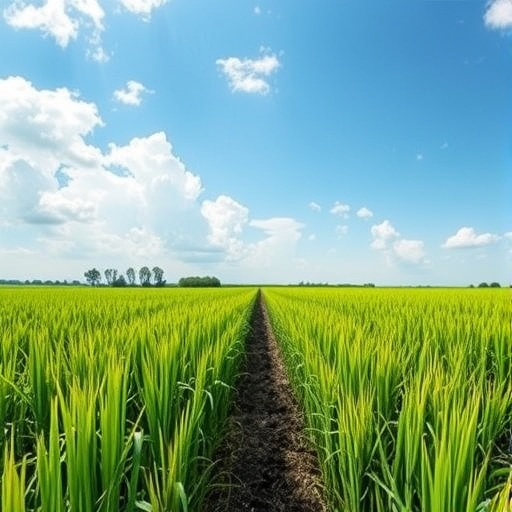
A groundbreaking five-year field study conducted in Heilongjiang Province, China, has uncovered crucial insights into the role of biochar application in mitigating methane emissions from rice paddies, a major source of agricultural greenhouse gases. While rice cultivation sustains billions worldwide, the flooded fields traditionally used for growing rice release significant amounts of methane, a greenhouse gas with a global warming potential many times greater than carbon dioxide over a century. This extensive study addresses whether the frequency and integration of biochar applications, paired with innovative water management techniques, could provide durable climate solutions for rice farming.
The research, recently published in the journal Biochar, reveals that sustained annual biochar amendments combined with water-saving irrigation strategies deliver the most effective long-term reduction in methane emissions from paddy fields. Contrarily, a solitary biochar application—although initially effective—diminishes in its mitigation capacity over several years, especially under controlled water management regimes. These findings underscore the complexity of soil chemistry and microbial dynamics influenced by biochar and suggest that repeated applications are essential to maintain the benefits over time.
Biochar, a carbon-enriched material derived from biomass pyrolysis, has attracted attention for its multifunctional properties in agriculture and environmental management. It enhances soil fertility, improves water retention, and influences microbial communities, particularly those involved in methane cycling. However, short-term studies have often reported promising methane reductions without evaluating how this promise holds up under real-world, long-term field conditions. This study addresses that critical gap by examining biochar’s efficacy over five full growing seasons.
The experimental design involved six treatment regimes: two contrasting irrigation methods—traditional flooding and controlled water-saving irrigation—each combined with three biochar application strategies: no biochar, a one-time biochar dose of 12.5 tons per hectare applied in the first year, and annual biochar doses of 2.5 tons per hectare. This setup permitted an intricate assessment of how biochar dose and irrigation techniques interplay to affect methane emission dynamics and rice productivity.
Initial observations in the first year indicated that a single large biochar application reduced cumulative methane emissions by up to approximately 36% compared to treatments without biochar, positioning it as a potent mitigation measure in the short term. Nonetheless, over the ensuing years, this single application’s efficacy waned significantly. The researchers attribute this attenuation to biochar aging accelerated by the repetitive wetting-drying cycles characteristic of water-saving irrigation methods, which likely degrade biochar’s active surface sites and alter soil habitat properties vital for methane suppression.
In stark contrast, continuous annual biochar amendments maintained and even enhanced methane mitigation across the five-year study. Under water-saving irrigation, cumulative methane emissions decreased by over 29% relative to no biochar treatment and almost 18% compared to the one-time application strategy. This result suggests that persistent replenishment of biochar’s reactive surfaces sustains its ability to modify soil redox conditions, reduce methanogenesis, and promote methane oxidation, thereby preserving its greenhouse gas mitigation potential.
Mechanistically, these improvements align with observed soil chemical shifts. Key soil parameters, including redox potential, ammonium nitrogen concentrations, and dissolved organic carbon levels, emerged as critical regulators of methane fluxes. The biochar-amended plots under controlled irrigation maintained higher redox potential and ammonium nitrogen, both of which inhibit methane-producing archaea, while showing reduced dissolved organic carbon, thereby limiting substrates available for methanogens. These biochemical shifts corresponded with a lower methane production potential and enhanced methane oxidation potential in the soil microbiome.
Furthermore, the study’s advanced statistical analyses, utilizing random forest modeling and structural equation modeling, delineated the relative contributions of these soil factors in modulating methane emissions. This holistic approach elucidates that the sustained benefits of biochar extend beyond simple carbon addition; they represent a dynamic modulation of soil ecology and biogeochemical cycles critical for long-term mitigation success.
Crucially, the climate advantages achieved did not compromise rice yields. In fact, the plots receiving annual biochar amendments under the water-saving irrigation regime delivered the highest average rice yields during the entire experimental period. This dual achievement of reducing greenhouse gas intensity while maintaining or enhancing food production highlights a promising pathway toward climate-resilient and sustainable rice agriculture.
These findings challenge the prevailing practice of one-off biochar applications and advocate for integrated management that combines continuous biochar input with strategic water-saving irrigation. Not only does this integrated approach curb methane emissions effectively, but it also bolsters soil carbon sequestration and stabilizes agronomic productivity. Therefore, it aligns with broader goals of climate change mitigation, ecosystem health, and global food security.
The study also serves as a clarion call for long-term agricultural research. Short-duration trials risk overestimating the durability of mitigation strategies that initially seem effective. By extending the observation window to five years, this research provides more reliable evidence for policymakers and farmers aiming to deploy biochar as a sustainable practice in paddy rice cultivation.
“Biochar’s role in methane mitigation is deeply intertwined with soil and water management practices,” said corresponding author Zhongxue Zhang. “Our results emphasize that continuous amendments are essential to maintain the active properties of biochar, especially under fluctuating moisture regimes prevalent in water-saving irrigation.”
Xiaoyuan Yan, another corresponding author, added, “The synergy between biochar application and irrigation management unlocks pathways for reducing the environmental footprint of rice farming without sacrificing yield. This study lays the foundation for developing scalable, practical mitigation strategies that can benefit both farmers and the planet.”
As global agricultural systems confront the dual challenges of feeding growing populations and reducing climate impacts, innovations like continuous biochar amendment integrated with optimized irrigation provide compelling tools. This research underscores the necessity of adopting long-term, systems-level approaches that harness soil amendments and water management to realize durable climate mitigation benefits.
In conclusion, incorporating annual biochar amendments within water-saving irrigation frameworks emerges as a robust strategy for significantly reducing methane emissions from paddy fields over multiple years. By sustaining favorable soil physicochemical conditions and bolstering methane oxidation processes, this approach offers a scalable, climate-smart avenue for rice cultivation that supports food security and environmental stewardship.
Subject of Research: Continuous biochar amendment and water-saving irrigation for long-term methane mitigation in paddy rice cultivation.
Article Title: Continuous biochar amendment to achieve long-term CH4 mitigation in paddy fields under water-saving irrigation: a 5-year experiment.
News Publication Date: 6-Mar-2026.
Web References:
Biochar Journal
DOI: 10.1007/s42773-026-00578-z
References:
Han, Y., Chen, P., Zhang, Z. et al. Continuous biochar amendment to achieve long-term CH4 mitigation in paddy fields under water-saving irrigation: a 5-year experiment. Biochar 8, 70 (2026). https://doi.org/10.1007/s42773-026-00578-z
Image Credits: Yu Han, Peng Chen, Zhongxue Zhang, Xiaoyuan Yan, Guangbin Zhang, Zuohe Zhang, Tiecheng Li, Tangzhe Nie & Sicheng Du
Keywords
biochar, methane mitigation, paddy fields, water-saving irrigation, rice cultivation, greenhouse gases, soil redox potential, dissolved organic carbon, ammonium nitrogen, methane oxidation, climate change mitigation, sustainable agriculture
Tags: biochar and greenhouse gas mitigationbiochar effects on soil microbial dynamicsbiochar soil fertility enhancementbiomass pyrolysis biochar benefitsclimate change solutions for rice agricultureintegrated water and biochar managementlong-term biochar application in rice fieldsmethane emission reduction in agriculturerepeated biochar application benefitsrice paddy methane managementsustainable rice farming practiceswater-saving irrigation in rice cultivation