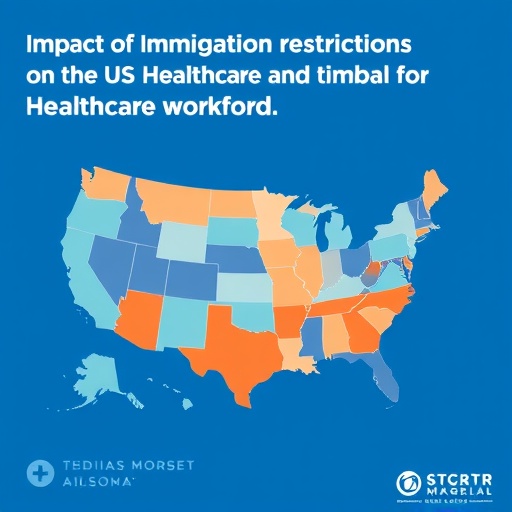
In recent years, the United States healthcare system has increasingly relied on immigrant healthcare professionals to address workforce demands. However, a groundbreaking study published in JAMA Network Open reveals a concerning trend that threatens this dynamic: the number of physicians and nurses immigrating from countries subjected to complete immigration bans has risen significantly over the last decade. In 2023 alone, these nations accounted for nearly 24,000 physicians and 56,000 nurses who contributed to the intricate fabric of the U.S. healthcare workforce. This surge, paradoxically, coincides with increasing immigration restrictions, presenting a complex challenge with far-reaching implications.
The detailed study delves into the demographic flux within the healthcare workforce, focusing specifically on foreign-trained medical professionals originating from countries facing rigorous immigration prohibitions. The researchers’ analysis demonstrates a critical link between these immigrant healthcare providers and the persistent healthcare shortages experienced in underserved regions of the United States. Communities hosting significant numbers of physicians and nurses from banned countries appear disproportionately affected by workforce deficits, exacerbating existing disparities in healthcare access.
These findings emerge against a backdrop of evolving immigration policies that impose blanket bans on entire nations. Such policies have the unintended consequence of undermining the replenishment of healthcare personnel in the U.S. by constricting the inflow of skilled medical workers. The study’s authors emphasize that workforce shortages are not merely academic concerns but translate directly into diminished healthcare delivery, especially in rural and socioeconomically disadvantaged areas where reliance on immigrant practitioners is often highest.
From a methodological perspective, the research utilized a comprehensive dataset spanning several years, cross-referencing immigration records with healthcare workforce registries to quantify the impact of bans on the physician and nursing populations. This approach allowed for granular insights into regional workforce composition and identified correlations between the presence of banned-origin healthcare workers and persistent shortages. Importantly, the study controlled for other variables such as population growth, healthcare infrastructure, and policy changes, strengthening its conclusions regarding causality.
The implications of this research extend beyond workforce statistics and policy debates, hinting at profound consequences for public health outcomes. With fewer professionals available to meet demand, delays in care, reduced patient-provider interaction times, and increased burnout among the remaining workforce are anticipated. Such conditions heighten the risk of medical errors and contribute to poorer health outcomes, particularly among vulnerable demographics who already face systemic barriers to care.
Moreover, the study’s insights should galvanize policymakers and healthcare administrators to critically reevaluate current immigration frameworks. Rather than blanket bans that strip the system of essential human resources, more nuanced approaches could preserve the integrity of the healthcare pipeline while addressing legitimate national security concerns. The authors underscore the potential benefits of targeted visa programs, expedited credential recognition, and bilateral agreements to facilitate the ethical recruitment of healthcare workers from affected regions.
The broader sociopolitical context is also salient. The healthcare profession has long been a path to economic and social integration for immigrants, fostering community stability and intercultural exchange. Removing these opportunities through stringent immigration controls risks eroding these benefits, compounding social inequities, and destabilizing local healthcare ecosystems. The study indirectly warns that exclusionary policies may inadvertently weaken the very communities they aim to protect.
Further technical analysis within the study examines the intricate relationships between immigration restrictions, workforce dynamics, and healthcare delivery metrics. Researchers employed advanced econometric models to simulate future scenarios under varying policy regimes. These models predict that ongoing bans could lead to a contraction of the healthcare workforce by several percentage points within the next decade, with disproportionately severe impacts in regions already struggling with provider shortages.
In terms of nursing, the findings highlight a particularly troubling trend. Nurses from banned countries constitute a sizable share of the U.S. nursing workforce, many serving in critical care, home health, and long-term care settings. Given the aging American population and increasing chronic disease burdens, the loss of these professionals would significantly impair capacity and quality of care, underscoring an urgent need for policy reassessment.
Corresponding author Hao Yu, PhD, advocates for evidence-based policy adjustments grounded in rigorous empirical research. He suggests that harmonizing immigration and healthcare strategies could create pathways to bolstered workforce resilience and improved access to care. Collaborative efforts involving government agencies, academic institutions, and healthcare organizations are essential to crafting sustainable solutions that protect public health while honoring international migration realities.
Presented at the 2026 AcademyHealth Annual Research Meeting, this study invites a critical discourse on the intersection of immigration policy and healthcare system sustainability. As the U.S. grapples with evolving demographic trends and healthcare needs, integrating findings like these into legislative and operational frameworks will be paramount. The healthcare community and policymakers must work in tandem to ensure that restrictive immigration policies do not inadvertently fuel shortages that compromise patient care and community health.
In conclusion, the rise in immigrant physicians and nurses from banned countries over the past decade underscores a paradox within U.S. immigration and healthcare policy. While these professionals provide vital services essential for the functioning of healthcare delivery, restrictive bans threaten to reverse progress and widen disparities. It is imperative that informed, balanced policy responses are crafted to safeguard both national security and the health of underserved populations across the country.
Subject of Research: The impact of complete immigration bans on the U.S. healthcare workforce, specifically the contribution of immigrant physicians and nurses from banned countries.
Article Title: Not provided.
News Publication Date: 2026.
Web References: Not provided.
References: doi:10.1001/jamanetworkopen.2026.18999
Image Credits: Not provided.
Keywords: Health care, United States population, Community stability, Nursing, Physician scientists, Legislation
Tags: challenges in recruiting foreign medical professionalscontribution of banned country immigrants to US healthcaredemographic changes in healthcare workforceeffects of immigration bans on healthcare qualityforeign-trained physicians and nurseshealthcare disparities in underserved US regionshealthcare workforce sustainability and immigrationimmigrant healthcare professionals in USimmigration bans and healthcare accessimmigration policy effects on medical staffingimpact of immigration restrictions on healthcare workforceUS healthcare worker shortages