Credit: ©2017 Stephen Chester. Published by the Royal Society under the terms of the Creative Commons Attribution License, which permits unrestricted use, provided the original author and source are credited.
New Haven, Conn. — Earth's earliest primates dwelled in treetops, not on the ground, according to an analysis of a 62-million-year-old partial skeleton discovered in New Mexico — the oldest-known primate skeleton.
The skeleton was discovered in the San Juan Basin by Thomas Williamson, curator of paleontology at the New Mexico Museum of Natural History & Science, and his twin sons, Taylor and Ryan.
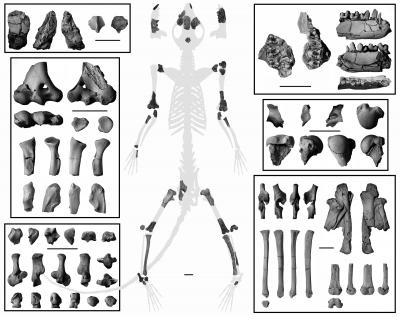
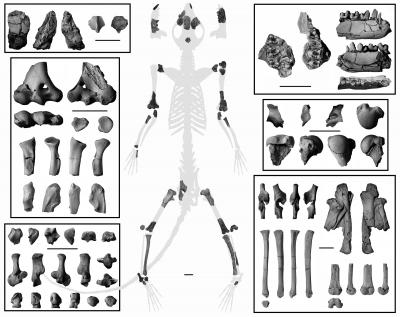
The study shows that Torrejonia, a small mammal from an extinct group of primates called plesiadapiforms, had skeletal features adapted to living in trees, such as flexible joints for climbing and clinging to branches. Previously, researchers had proposed that plesiadapiforms in Palaechthonidae, the family to which Torrejonia belongs, were terrestrial based on details from cranial and dental fossils consistent with animals that nose about on the ground for insects.
"This is the oldest partial skeleton of a plesiadapiform, and it shows that they undoubtedly lived in trees," said lead author Stephen Chester, an assistant professor at Brooklyn College, City University of New York, and curatorial affiliate of vertebrate paleontology at the Yale Peabody Museum, who began this collaborative research while at Yale University studying for his Ph.D. "We now have anatomical evidence from the shoulder, elbow, hip, knee, and ankle joints that allows us to assess where these animals lived in a way that was impossible when we only had their teeth and jaws."
The study, which will be published on May 31 in online edition of Royal Society Open Science, supports the hypothesis that plesiadapiforms, which first appear in the fossil record shortly after the extinction of non-avian dinosaurs, were the earliest primates. The researchers also contend that the new data provide additional evidence that all of the geologically oldest primates known from skeletal remains, encompassing several species, were arboreal.
The partial skeleton consists of over 20 separate bones, including parts of the cranium, jaws, teeth, and portions of the upper and lower limbs. The presence of associated teeth allowed Williamson, a co-author of the study, to identify the specimen as Torrejonia because the taxonomy of extinct mammals is based mostly on dental traits, said Eric Sargis, professor of anthropology at Yale University, and senior author of the study.
"To find a skeleton like this, even though it appears a little scrappy, is an exciting discovery that brings a lot of new data to bear on the study of the origin and early evolution of primates," said Sargis, a curator of vertebrate paleontology and vertebrate zoology at Yale's Peabody Museum of Natural History, where the partial skeleton was molded and casted for further study.
Palaechthonids, and other plesiadapiforms, had outward-facing eyes and relied on smell more than living primates do today — details suggesting that plesiadapiforms are transitional between other mammals and modern primates, Sargis said.
The site where the partial skeleton was discovered, known as the Torrejon Fossil Fauna Area, is a remote area in northwestern New Mexico administered by the federal Bureau of Land Management. These public lands are managed to protect the scientific value of the paleontological resources found there. The collection of the Torrejonia partial skeleton was done under a permit from the agency.
###
The paper's co-authors are Jonathan Bloch of the Florida Museum of Natural History at the University of Florida and Mary Silcox of the Department of Anthropology at the University of Toronto Scarborough.
The research was supported in part by grants from the National Science Foundation. An image of the partial skeleton is available upon request.
Media Contact
Michael Cummings
[email protected]
203-432-9548
@yale
http://www.yale.edu
############
Story Source: Materials provided by Scienmag