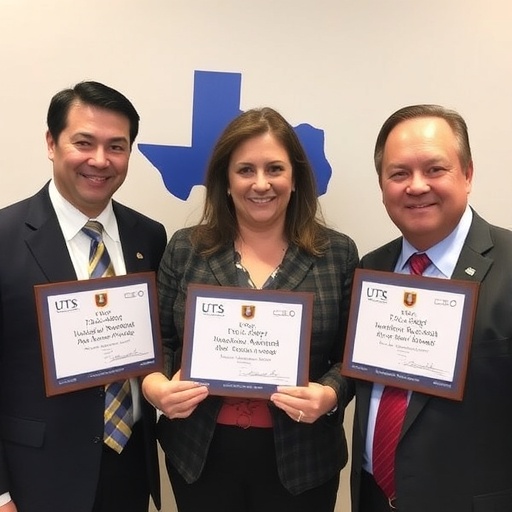
Three pioneering researchers from The University of Texas at San Antonio (UTSA) have been honored with the inaugural Texas Innovation Award, a prestigious statewide recognition that celebrates exceptional leadership in translating academic research into practical, impactful solutions for society and the economy. The awards ceremony took place during the renowned Texas Innovation Conference & Awards held on April 22–23 at Texas Christian University in Fort Worth, spotlighting groundbreaking innovations that drive technological and medical advancements across the state.
The Texas Innovation Conference & Awards serves as a vital platform for strengthening Texas’s innovation ecosystem by showcasing outstanding researchers whose work accelerates commercialization, fuels startup creation, and fosters meaningful partnerships between academia and industry. The University Innovator category specifically identifies individuals who have demonstrated measurable progress in bridging the gap between laboratory research and real-world applications, thereby contributing to regional and national economic growth and public welfare.
Among the esteemed UTSA honorees is Dr. Lyle Hood, an associate professor of mechanical engineering whose work has revolutionized airway management technologies in emergency and combat care environments. Through the Medical Design Innovations Laboratory under his leadership, Hood has engineered a suite of portable suction devices specifically designed for diverse prehospital and aeromedical evacuation scenarios. These innovations are characterized by their lightweight design and unwavering reliability, addressing critical challenges faced by first responders in the field.
Dr. Hood’s research portfolio also includes the design and development of next-generation endotracheal tubes aimed at improving intubation success under extreme and high-pressure conditions. His designs were guided by extensive early end-user engagement, encompassing hundreds of clinicians and medics to ensure that engineering solutions effectively meet practical needs encountered during emergency interventions. This collaborative approach has culminated in the launch of EmergenceMed LLC, a UTSA-backed startup devoted to commercializing these critically important medical technologies. His efforts have attracted over $3 million in competitive funding from federal and private sources, simultaneously mentoring a pipeline of more than 100 student innovators.
Equally transformative is the work of Dr. Amina Qutub, the Burzik Endowed Professor of Engineering Design and associate professor in biomedical engineering, whose research integrates artificial intelligence with precision medicine to enhance healthcare delivery. Dr. Qutub spearheads the MATRIX AI Consortium, a cutting-edge collaborative initiative dedicated to advancing AI applications in biomedical research. She also co-directs the Center for Precision Medicine, further consolidating UTSA’s leadership in this interdisciplinary frontier.
Dr. Qutub’s research is situated at the confluence of computer science, biology, and engineering, where she has co-founded two innovative biotech startups: PaloBio and Leah. PaloBio develops sophisticated digital advocates to assist individuals with atypical neurological disorders, while Leah leverages AI to improve trauma care outcomes. She leads the ambitious BEACON project, a state-level initiative aimed at transforming trauma and stroke care by providing real-time AI decision support and recovery tools. This project is a product of the iRemedyACT Consortium, which unites more than thirty clinicians, AI scientists, and biomedical engineers across seven university hospitals, enabling the development of AI-driven data infrastructure to reduce emergency care delays.
Additionally, Dr. Qutub directs the Quantu Project, a nationwide longitudinal study that combines biosensing technology with neurogenesis assays to optimize brain health throughout the human lifespan. Her innovative work has earned numerous accolades, including a fellowship in the American Institute for Medical and Biological Engineering, the National Academies Keck Future Initiatives award, and a National Science Foundation CAREER award. In 2025, she will represent U.S. scientific innovation as a Department of State Overseas Speaker on the “AI in Innovation” tour, further amplifying the international reach and impact of her research.
Addressing the burgeoning mental health crisis, Dr. David L. Roberts, associate professor of psychiatry, was recognized for his groundbreaking platform, Reflective Training (RT), which fundamentally reshapes psychotherapy training. Faced with a critical shortage of qualified behavioral health professionals, Dr. Roberts developed RT as an innovative web-based system that replaces traditional lecture models with dynamic and scalable experiential learning methods. RT employs structured role-playing exercises combined with actionable feedback, promoting a performance science approach that enables advanced trainees to become coaches, thereby mitigating the burden on scarce expert faculty.
RT has been integrated successfully into UTSA’s medical education programs, including a notable initiative where student leaders train peers to deliver counseling skills in residential substance use treatment centers. Research validating RT’s effectiveness found that counseling interns trained through this model perform on par with licensed clinicians in crisis intervention, resulting in significant cost savings—close to $300,000 over two years for Bexar County. To expand the platform’s reach, Dr. Roberts co-founded Reflective Learning Inc., which currently supports clinical onboarding and quality assurance across multiple UT clinics as well as community agencies throughout Texas.
The RT platform has also been adopted by Communities in Schools, where 60 school counselors use it to impart emotion regulation skills, and by the Haven for Hope homeless services campus, serving all Bexar County, to enhance crisis counseling staff training. Beyond RT, Dr. Roberts is renowned for developing Social Cognition and Interaction Training (SCIT), a therapeutic approach for individuals with schizophrenia that is implemented by over 3,000 clinicians in eight countries, further demonstrating his impact on mental health treatment paradigms.
Together, these three UTSA researchers exemplify the university’s commitment to harnessing academic excellence for societal benefit. Their interdisciplinary efforts span mechanical engineering, artificial intelligence, biomedical innovation, and psychiatric care—collectively addressing some of the most urgent healthcare challenges of our time. The successful commercialization of their technologies and their active engagement with industry and clinical partners exemplify the high-impact potential of academic research when coupled with entrepreneurial vision and community collaboration.
The inaugural Texas Innovation Award not only honors these researchers but also highlights the essential role of state-supported programs in fostering an ecosystem where scientific discovery translates into real-world improvements. Their work epitomizes the fusion of rigorous scientific inquiry with practical innovation, resulting in medical devices that save lives, AI systems that enhance critical decision-making, and scalable mental health platforms that expand access to quality care.
UTSA’s rapidly evolving research enterprise serves as a beacon of how universities can serve as powerhouses for technology transfer and innovation-driven economic development. The university’s holistic approach—from bench to bedside, and from prototype to startup—demonstrates how strategically supported translational research infrastructure can fuel breakthroughs that meet complex healthcare needs with scalable and sustainable solutions.
As the recipients continue to lead transformative projects, their collective impact is poised to elevate Texas as a global leader in health-related technological innovation. Advances such as portable airway management systems, AI-enabled trauma care, and scalable psychotherapy training platforms herald a new era of integrated, technology-powered healthcare solutions that hold promise for improving patient outcomes and system efficiencies worldwide.
In sum, the Texas Innovation Award shines a spotlight on the critical contributions of Drs. Hood, Qutub, and Roberts, who have successfully intertwined engineering, artificial intelligence, and psychiatry into innovative tools and platforms. Their pioneering work not only enhances lives in Texas but also charts pathways for future breakthroughs in emergency medicine, neurological disorders, trauma care, and mental health treatment on a national and international stage.
Subject of Research: Translational innovations in emergency medical devices, AI-driven healthcare solutions, and scalable mental health training platforms.
Article Title: UT San Antonio Researchers Earn Texas Innovation Award for Revolutionary Advances in Medical Technology and AI
News Publication Date: April 24, 2024
Web References:
UTSA Medical Design Innovations Laboratory
EmergenceMed LLC
MATRIX AI Consortium
Center for Precision Medicine
Reflective Training Platform
Image Credits: UT San Antonio
Keywords
Emergency Medicine, Artificial Intelligence, Biomedical Engineering, Mental Health, Medical Devices, Trauma Care, Translational Research, Innovation, Health Technology, Behavioral Health Training, Precision Medicine, Startup Ecosystem
Tags: academic research commercializationairway management technology developmentmedical device design innovationsmedical innovation in emergency careregional economic growth through innovationstartup creation in Texastechnological advancements in TexasTexas Innovation AwardsTexas Innovation Conference highlightstranslational research impactuniversity-industry partnershipsUT San Antonio research recognition