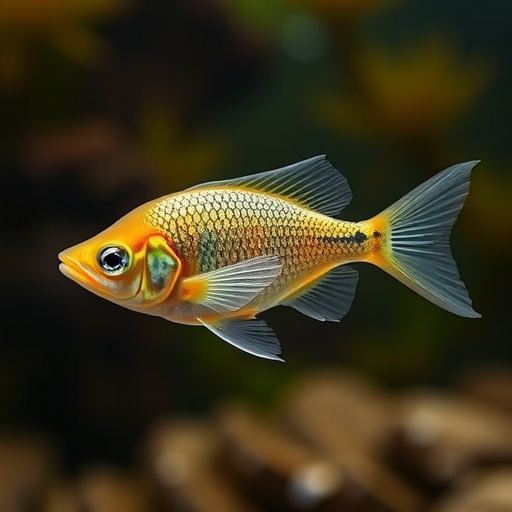
In a groundbreaking study challenging the reliability of laboratory conditions in biological research, scientists at Osaka Metropolitan University have revealed that the reproductive timing of medaka fish—an essential model organism—significantly differs when observed in semi-natural environments. This discovery sheds new light on how external environmental factors influence biological rhythms and raises critical questions about the translatability of laboratory findings to natural biological phenomena.
Medaka fish, scientifically known as Oryzias latipes, have long been favored by researchers due to their ease of maintenance and prolific spawning behaviors under controlled laboratory environments. These small freshwater fish serve as powerful models for a variety of genetic, developmental, and physiological studies. However, the controlled nature of laboratory settings, which eliminates many of the fluctuating environmental variables present in the wild, might inadvertently mask or alter key biological processes, particularly those sensitive to environmental cues.
Professor Satoshi Awata and Specially Appointed Assistant Professor Yuki Kondo led an investigation into the ovulation behavior of medaka, an essential reproductive event preceding spawning. In an innovative experimental design, genetically identical medaka strains were maintained in both conventional laboratory aquaria and outdoor tanks that mimicked more natural, dynamic environmental conditions. By carefully monitoring the timing of ovulation, the researchers discovered a marked temporal shift: fish in the outdoor tanks ovulated approximately 3.5 hours earlier than their laboratory counterparts.
This temporal variation is posited to result from multiple environmental factors absent or artificially regulated in laboratory settings. Unlike the abrupt on/off lighting cycles typical of indoor experiments, outdoor tanks experienced gradual diurnal changes in ambient light during dawn and dusk. Further, the water temperature in outdoor tanks fluctuated naturally with daily weather cycles, while laboratory temperatures remained constant. These subtle yet critical parameters point to the nuanced ways in which environmental stimuli entrain biological clocks governing reproductive physiology.
The implications of these findings are far-reaching. Reproductive timing not only affects individual fitness but also population dynamics and ecological interactions. If the reproductive clocks of model organisms like medaka are misaligned in laboratory conditions, this could cascade into misinterpretations of experimental data and models designed on lab-based observations. Circadian and circannual rhythms, already appreciated for their complexity, may require reconsideration in the context of fluctuating environmental inputs.
Importantly, this research underscores the necessity of integrating naturalistic variables into experimental frameworks to improve the ecological validity of biological studies. While laboratory control has historically been essential for reproducibility and precision, the findings advocate for a complementary approach employing semi-natural conditions or sophisticated environmental simulations. This hybrid methodology could enhance our understanding of how genes, physiology, and behavior interact with the environment in ways that laboratory settings alone cannot capture.
The study also invites a reevaluation of existing literature on medaka reproductive biology and other model organisms. Many established conclusions drawn from lab-bound experiments may warrant reexamination under more ecologically relevant conditions. This reexamination is vital for endocrinological research, particularly in relation to the neuroendocrine mechanisms orchestrating ovulation and spawning cycles, which are tightly regulated by circadian rhythms and environmental cues such as photoperiod and temperature.
Furthermore, the researchers stress that the identified differences in ovulation timing are not due to genetic variability, as the same strain was used across both environments. This controls for genotypic effects and highlights environmental modulation as the primary factor. Moreover, the gradual light changes and temperature variability present strong candidates for entrainment signals affecting the reproductive circadian clock, consistent with chronobiological theories predicting external zeitgebers (time-givers) as key regulators of periodic physiological processes.
Another layer this research adds involves the methodology for assessing reproductive events in aquatic organisms. Quantifying ovulation requires precise temporal resolution and careful handling to avoid stress-induced artifacts that can themselves alter reproductive timing. By tailoring observational techniques to semi-natural setups, the study demonstrates that nuanced behaviors and timings, potentially overlooked in controlled lab setups, can be accurately captured.
Looking forward, Awata and Kondo emphasize the importance of dissecting which specific environmental factors—light intensity gradients, temperature fluctuations, or other abiotic elements—drive these temporal shifts. Detailed mechanistic studies integrating chronobiology, endocrinology, and behavioral ecology will be essential to map the pathways by which the external environment synchronizes internal reproductive clocks. Such insights can illuminate the evolutionary pressures shaping timing mechanisms and potentially inform conservation efforts and aquaculture practices.
This research also invites parallel investigations into other model organisms and systems, prompting the scientific community to critically evaluate the ecological validity of laboratory data across disciplines. Understanding the interplay between natural environments and studied biological phenomena could enrich the robustness of scientific models, ensuring that findings translate effectively beyond the petri dish or aquarium.
The findings of this study open a compelling dialogue about the balance between control and environmental authenticity in scientific research. While the allure of highly controlled laboratory experiments remains, embracing complexity and variability inherent to natural habitats may prove crucial for unlocking a deeper, more accurate understanding of organismal biology.
Published in Royal Society Open Science, this research signifies a pivotal step toward refining experimental designs that integrate environmental realism. It highlights the dynamic nature of biological rhythms, driven not solely by internal genetic programs but profoundly influenced by external conditions. Recognizing and accounting for these factors is imperative to advancing biology in a way that mirrors the living world more faithfully.
Credit for this illuminating work goes to Osaka Metropolitan University, a leader in interdisciplinary and environmentally contextual biological research. Their commitment to bridging laboratory precision with ecological relevance promises to inspire further explorations that enhance our grasp of life’s intricacies under true-to-nature conditions.
Subject of Research: Animals
Article Title: Temporal shifts in ovulation between laboratory and semi-natural environments in the model fish medaka
News Publication Date: 4-Mar-2026
References:
Kondo, Y., & Awata, S. (2026). Temporal shifts in ovulation between laboratory and semi-natural environments in the model fish medaka. Royal Society Open Science. DOI: 10.1098/rsos.251946
Image Credits: Osaka Metropolitan University
Keywords
Medaka fish, ovulation timing, reproductive behavior, circadian rhythms, environmental influence, laboratory versus natural conditions, chronobiology, model organisms, light entrainment, temperature effects, ecological validity, biological rhythms
Tags: biological rhythms misalignmentchallenges in laboratory biological studiescircadian rhythms in medaka fishenvironmental influence on fish behaviorgenetic model organisms in researchimpact of semi-natural habitats on researchlaboratory vs natural environmentsmedaka fish circadian biologymedaka fish ovulation timingmedaka fish reproductive timingmedaka fish spawning behaviortranslating lab findings to natural settings