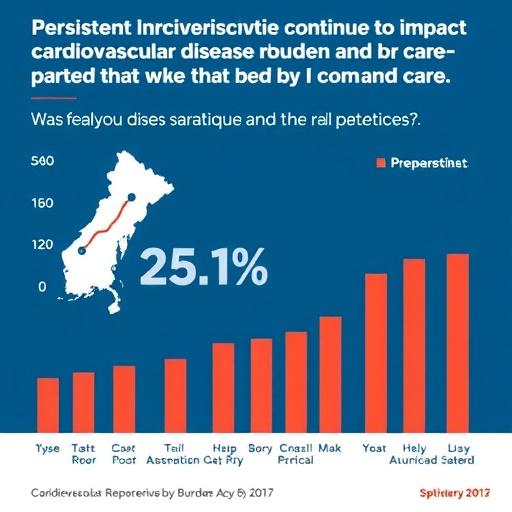
Cardiovascular disease (CVD) remains a formidable challenge across Europe, as revealed by the latest comprehensive data from the European Society of Cardiology (ESC) Atlas of Cardiology. Published in the prestigious European Heart Journal, the fifth edition of this landmark report marks a decade of illuminating the evolving landscape of cardiovascular health across more than 50 member countries. The findings underscore the somber reality that CVD continues to claim over three million lives annually and accounts for a staggering 68 million healthy life-years lost, reflecting both premature mortality and prolonged morbidity that strain individuals and health systems alike.
This extensive statistical analysis synthesizes epidemiological data to provide a clear snapshot of CVD prevalence, mortality, and risk factors, exposing enduring disparities that complicate the battle against cardiovascular conditions. While advancements in diagnostic and therapeutic modalities have propelled progress in some regions, the report conveys a crucial caveat: these gains risk being negated by the persistent, pervasive presence of modifiable risk factors such as hypertension, dyslipidemia, obesity, and diabetes. The interplay of these clinical conditions fuels a steady tide of CVD cases, necessitating renewed focus on early identification and preventive strategies to alleviate the burgeoning healthcare burden.
A particularly alarming insight from the ESC Atlas is the stark disparity between middle-income and high-income countries regarding cardiovascular mortality rates. Middle-income nations face nearly double the death rate compared to their affluent counterparts, highlighting inequities in healthcare infrastructure, access to specialized interventions, and public health investment. Such differences reinforce the need for tailored health system strengthening and equitable distribution of cardiovascular care resources to mitigate these imbalances. The data imply that financial and structural determinants — including access to advanced diagnostics, intervention techniques, and trained cardiologists — are pivotal factors influencing CVD outcomes.
Furthermore, environmental and behavioral determinants emerge prominently in the report’s multifaceted analysis. Air pollution, a well-established contributor to cardiovascular morbidity, is notably higher—often twice as much—in middle-income countries within the ESC membership compared to more prosperous nations. This environmental disparity compounds biological risk factors, accelerating vascular inflammation and promoting pathophysiological processes leading to cardiac events. Additionally, the increasing use of e-cigarettes, especially among the youth, challenges existing paradigms of smoking cessation. Contrary to earlier assumptions about their safety and efficacy, evidence now links vaping to heightened susceptibility to conventional cigarette smoking, raising critical questions about the regulatory frameworks and preventive policies required to shield younger populations from nicotine addiction.
The report also shines a light on gender-based inequities within cardiovascular healthcare delivery. Women face substantial disadvantages, not only in incidence and outcomes but also in access to interventions and specialist procedures. Despite comprising 40% of the cardiologist workforce, women remain underrepresented in subfields like interventional cardiology and cardiac surgery, where their presence drops to less than 12% and 9%, respectively. This disparity may reflect systemic barriers to training, career advancement, and institutional biases, all of which merit urgent redress to foster diversity and improve patient care outcomes through inclusive expertise.
Sophisticated data visualization tools accompany the publication, facilitating interactive exploration of cardiovascular health inequalities across countries. The ESC’s eAtlas platform offers an invaluable resource for researchers, policymakers, and clinicians, presenting granular data on disease burden, treatment gaps, and workforce distribution. Such digital innovation exemplifies the growing role of data science in public health, enabling evidence-based decision-making and targeted interventions that respond dynamically to region-specific challenges.
Importantly, the ESC Atlas does not limit itself to narrating problems; it firmly situates itself as a roadmap for change. By mapping disparities and deficits, the report lays groundwork for concerted policy action, sound investment in health infrastructure, and national strategies aimed at reducing inequities. This aligns with broader European initiatives like the Safe Hearts Plan, designed to elevate cardiovascular disease as a central tenet of public health agendas throughout Europe, committing resources to holistic prevention, early diagnosis, and equitable care.
The epidemiological trends highlighted reveal the dual burden confronting healthcare systems: gains achieved against CVD mortality are being substantially offset by lifestyle and metabolic risk factors that are increasing in prevalence. Obesity and diabetes, in particular, are emerging as significant drivers of cardiovascular disease progression, necessitating preventive measures that extend beyond clinical settings into community and population health paradigms. Early intervention, guideline adherence, and lifestyle modifications are critical levers to stem the tide of avoidable cardiovascular morbidity.
Moreover, the notion of “one cardiovascular reality” is critically dismantled by the ESC Atlas data. Instead, the European continent exhibits heterogeneity in disease epidemiology, risk factor prevalence, and healthcare capacity, underscoring the complexity of crafting universal policies. Customized approaches that respect socio-economic contexts and health system capabilities will be indispensable for achieving meaningful reductions in cardiovascular disease burden.
This decade-long endeavor by the European Society of Cardiology, bringing together national cardiac societies and clinical experts, represents a monumental collaborative effort to enhance transparency and accountability in cardiovascular health. It reinforces the indispensable role of rigorous data collection and analysis as foundations for impactful healthcare reform. By illuminating gaps and opportunities, the ESC Atlas acts as both a mirror and a compass, reflecting current realities while guiding future strategic directions.
In summary, the latest ESC Atlas of Cardiology emphatically confirms that cardiovascular disease remains Europe’s leading health threat with profound mortality and disability implications. The intricate interplay of clinical, environmental, socio-economic, and gender factors demands integrated, multi-level interventions. Advances in cardiovascular medicine, while significant, need to be matched by robust preventive efforts, equitable health system investments, and enlightened policy frameworks to avert the escalating human and economic costs of cardiovascular disease across the continent.
Subject of Research: People
Article Title: European Society of Cardiology: cardiovascular disease statistics 2025
News Publication Date: 19-May-2026
Web References:
European Heart Journal: https://academic.oup.com/eurheartj
ESC eAtlas of Cardiology: https://eatlas.escardio.org/Countries/Iceland
Safe Hearts Plan: https://health.ec.europa.eu/non-communicable-diseases/cardiovascular-health_en
References:
[1] Timmis A, Petersen SE, et al. European Society of Cardiology: Cardiovascular Disease Statistics 2025. Eur Heart J. 2026.
[2] Hammond D, Reid JL, Cole AG, et al. Electronic cigarette use and smoking initiation among youth: a longitudinal cohort study. CMAJ. 2017;189:E1328−E1336.
Keywords: Cardiovascular disease, Vascular diseases, Cardiovascular disorders, Hypertension, Dyslipidaemia, Obesity, Diabetes, Cardiovascular mortality, Health inequalities, E-cigarettes, Air pollution, Gender disparity
Tags: cardiovascular disease burden in Europecardiovascular disease morbidity and mortality trendsdiabetes as a cardiovascular risk factordisparities in cardiovascular healthcareepidemiology of cardiovascular diseasesEuropean Society of Cardiology datahealthcare system strain from CVDhypertension impact on cardiovascular healthmodifiable risk factors for heart diseaseobesity and cardiovascular disease riskpremature mortality from cardiovascular diseaseprevention strategies for heart disease