The landscape of severe asthma treatment has taken a significant leap forward with the latest clinical evidence demonstrating the efficacy of tezepelumab across a diverse and traditionally underrepresented patient population. This breakthrough emerges from the rigorous Phase 4 PASSAGE study, which was recently presented at the 2026 American Thoracic Society (ATS) International Conference in Orlando, Florida. The study emphatically highlights that tezepelumab, a monoclonal antibody therapy originally approved in 2021, maintains its robust safety profile and therapeutic benefits in real-world settings beyond the typical clinical trial cohorts.
Traditionally, clinical trials for asthma medications have skewed towards a narrow subset of patients who often do not reflect the complex realities of those suffering from severe asthma. Patients with overlapping conditions such as chronic obstructive pulmonary disease (COPD), smokers, adolescents, and Black/African American individuals have historically been excluded or underrepresented. By intentionally focusing on these groups, PASSAGE fills a critical gap, addressing the urgent need to understand how tezepelumab performs in populations where asthma management can be exceptionally challenging.
The underlying mechanism of tezepelumab involves the targeted inhibition of thymic stromal lymphopoietin (TSLP), an epithelial cytokine central to initiating multiple inflammatory pathways implicated in asthma pathogenesis. TSLP acts upstream in the inflammatory cascade, influencing both Type 2 and non-Type 2 inflammatory responses. This upstream blockade disrupts the activation of downstream effectors such as eosinophils, basophils, and T-helper type 2 (Th2) cells, which have been identified as key drivers of airway inflammation, hyperresponsiveness, and remodeling.
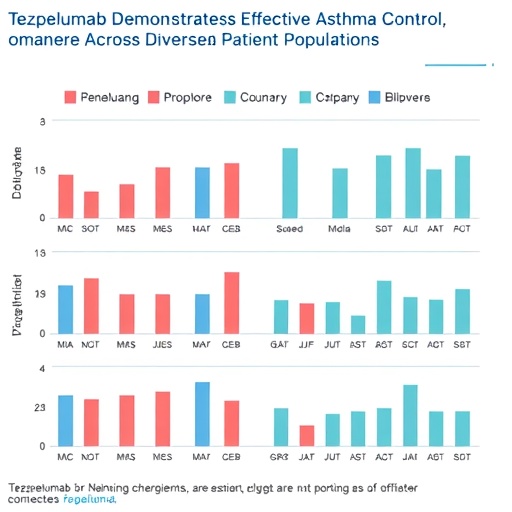
In the PASSAGE study, researchers enrolled a substantial cohort of 286 adults and adolescents with severe asthma, observing them over a one-year period to closely monitor safety, efficacy, and patient-reported outcomes. Notably, the frequency of asthma exacerbations dropped by an impressive 70% during tezepelumab treatment. This reduction was consistent across various phenotypes of asthma, underlining the therapy’s broad applicability. Lung function metrics, including forced expiratory volume in one second (FEV1), showed marked improvement, signalling better airway patency and reduced obstruction.
One of the study’s most salient findings is the effective management of severe asthma in smokers and those with concomitant COPD — groups that often present distinct diagnostic and therapeutic challenges due to overlapping symptoms and shared pathophysiological features. The amelioration in these patients’ respiratory health underscores tezepelumab’s versatility in targeting fundamental inflammatory pathways irrespective of these confounding factors, a feature that traditional corticosteroid therapies sometimes fail to address adequately.
Patient quality of life was another critical endpoint in PASSAGE. Through comprehensive qualitative interviews, treated individuals reported enhanced symptom control and greater satisfaction with their daily respiratory function. Reduced reliance on systemic corticosteroids, which are notorious for their adverse effect profile, was also documented, reflecting a shift towards safer long-term management strategies. This dimension of patient-centered outcomes reiterates the importance of incorporating real-world evidence to complement randomized controlled trial findings.
Safety data accrued during the PASSAGE trial reaffirmed tezepelumab’s reassuring profile. There were no novel or unexpected side effects observed over the course of treatment, alleviating concerns about its broader application in more vulnerable or multifaceted patient populations. The absence of severe adverse reactions supports tezepelumab’s position as a frontline biologic in severe asthma therapeutic regimens, particularly for those who have previously lacked suitable options due to coexisting conditions.
The success of tezepelumab in patients with Type 2 asthma, a subtype characterized by systemic eosinophilic inflammation, is of particular clinical significance. Type 2 asthma represents a substantial fraction of the severe asthma population, often marked by frequent exacerbations, chronic symptoms, and poor response to conventional inhaled corticosteroids alone. By mitigating TSLP-mediated inflammation upstream, tezepelumab offers a novel mechanism that circumvents some of the limitations associated with targeting single downstream cytokines, thus potentially translating into more durable control.
Beyond the immunological intricacies, the PASSAGE study extrapolates the critical role of real-world trials in complementing traditional research paradigms. While placebo-controlled, double-blind trials remain the gold standard, they often exclude the very patients clinicians encounter daily. PASSAGE bridges this divide by validating the drug’s efficacy and safety outside controlled environments, lending confidence to healthcare providers when prescribing tezepelumab to complex cases presenting in routine clinical practice.
Dr. Njira Lugogo, the study’s lead investigator and a clinical professor specializing in Pulmonary and Critical Care Medicine at the University of Michigan, emphasized the transformative potential of these findings. Highlighting the underrepresentation in prior studies, Dr. Lugogo expressed optimism that the inclusive design of PASSAGE and its compelling results will expedite more equitable asthma care. This approach not only advocates for diversity in clinical research but also signals a paradigm shift towards personalized medicine tailored to patient heterogeneity.
The implications of PASSAGE for asthma management guidelines and insurance frameworks cannot be understated. Demonstrating tezepelumab’s effectiveness in smoking populations and those with asthma-COPD overlap may prompt revisions in eligibility criteria and reimbursement policies, ensuring broader patient access to this life-altering therapy. As severe asthma continues to impose substantial morbidity and healthcare costs, such advances are pivotal in mitigating the global disease burden.
In summary, the PASSAGE study represents a landmark contribution to respiratory medicine, confirming that tezepelumab is a safe and efficacious option for severe asthma patients across diverse phenotypes and demographic groups. The study’s inclusion of underrepresented populations marks a crucial step toward closing the gap between clinical trial evidence and real-world clinical practice, providing hope for improved outcomes in patients who have historically been neglected in therapeutic research.
Subject of Research: Severe asthma treatment efficacy and safety of tezepelumab in diverse, underrepresented populations.
Article Title: Tezepelumab Demonstrates Broad Efficacy and Safety in Real-World Severe Asthma Across Underrepresented Populations: Insights from the PASSAGE Study.
News Publication Date: May 18, 2026.
Web References: https://academic.oup.com/ajrccm and https://ats2026.d365.events/education/sessions/6b19ba34-91df-4f14-8603-925bf88d033d
Image Credits: ATS
Keywords: Severe asthma, Tezepelumab, Biologics, Phase 4 clinical trial, PASSAGE study, TSLP inhibition, Underrepresented populations, Asthma-COPD overlap, Type 2 asthma, Real-world evidence, Lung function, Safety profile.
Tags: asthma and COPD overlapasthma in adolescentsasthma in Black and African American patientsasthma in diverse populationsasthma in smokersmonoclonal antibody therapy for asthmaPhase 4 PASSAGE studyreal-world asthma therapy effectivenesssevere asthma managementtezepelumab asthma treatmenttezepelumab safety profileTSLP inhibition mechanism