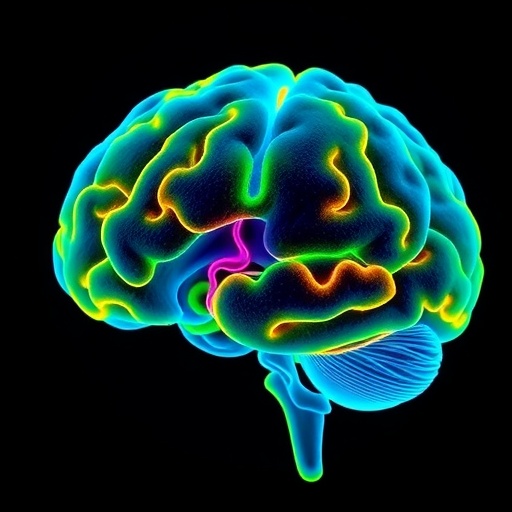
In a groundbreaking study recently published in Nature Communications, a team of neuroscientists has unveiled compelling evidence linking cerebellar growth to domain-specific maturation in the cerebral cortex, coupled intricately with socio-linguistic behavior. This research not only challenges traditional views that primarily assign motor coordination roles to the cerebellum but also expands our understanding of its involvement in higher cognitive functions, particularly in language acquisition and social interaction.
The cerebellum, historically regarded as a structure predominantly responsible for fine-tuning motor activity, has gradually emerged as a significant player in cognitive and affective processing. The present study conducted by Manoli, Magielse, Hoffstaedter, and colleagues harnessed advanced neuroimaging techniques combined with socio-linguistic assessments across developmental stages to trace cerebellar volumetric changes and their functional correlations with cerebral cortical areas engaged in language and social cognition.
Employing a longitudinal cohort design, the researchers recruited a large sample of participants spanning from early childhood into late adolescence. This developmental window represents a critical period for brain maturation and behavioral adaptation. Through structural magnetic resonance imaging (MRI), they tracked cerebellar volume fluctuations and assessed corresponding grey matter maturation in distinct cerebral domains. Their approach allowed for a domain-specific mapping strategy, linking cerebellar subregions with particular cerebral networks known to subserve socio-linguistic competencies.
The study’s findings elucidate a nuanced pattern of cerebellar growth that parallels the evolution of domain-specific cortical maturation. Specifically, volumes of certain cerebellar lobules exhibited significant associations with cortical expansion and myelination in areas implicated in language processing, such as the inferior frontal gyrus and superior temporal sulcus. These correlations underscore a coordinated developmental trajectory, suggesting that cerebellar growth is not uniform but instead finely tuned to the maturation of cerebral networks supporting complex socio-linguistic functions.
Behaviorally, participants demonstrated progressive growth in socio-linguistic skills, measured through standardized assessments of vocabulary, syntax, pragmatic language usage, and social communication. Intriguingly, the magnitude of cerebellar-cerebral maturation coupling was predictive of individual differences in these socio-linguistic abilities. For instance, stronger cerebellar growth aligning with cerebral maturation corresponded to superior socio-pragmatic understanding and more refined verbal communication.
The research introduces an innovative conceptual framework describing the cerebellum’s role in shaping social language development. The cerebellum’s contributions transcend basic motor functions, acting instead as a dynamic modulator of cerebral maturation pathways that scaffold critical behavioral capacities. This positions the cerebellum as a key integrative hub where sensorimotor, cognitive, and affective processes intertwine to facilitate the emergence of socio-linguistic competence.
One of the technical strengths of this study lies in its use of high-resolution structural MRI combined with quantitative morphometric analyses, allowing detailed evaluation of cerebellar substructures. The team leveraged sophisticated statistical modeling to account for developmental confounds such as age, sex, and total brain volume, thereby isolating specific cerebellar-cerebral associations relevant to socio-linguistic maturation.
Moreover, the multifaceted behavioral battery administered in tandem with imaging provided a comprehensive profile of linguistic and social capacities, ranging from basic phonological processing to nuanced pragmatic interactions. This multidimensional assessment framework enabled the authors to draw precise links between neuroanatomical development and behavioral outcomes, advancing the field’s grasp of brain-behavior relationships during critical developmental windows.
The implications of this research extend far beyond fundamental neuroscience. Understanding how cerebellar growth dynamically interacts with cerebral maturation to influence socio-linguistic behavior has profound relevance for neurodevelopmental disorders characterized by deficits in communication and social functioning, such as autism spectrum disorders (ASD) and developmental language disorder (DLD). This framework could pave the way for novel diagnostic biomarkers and targeted interventions designed to modulate cerebellar-cerebral pathways.
Additionally, the findings challenge conventional neurobiological models that isolate cerebellar function from higher cognitive processes. Instead, they advocate for integrative brain models that recognize the cerebellum as a crucial architect in cognitive and socio-emotional development. Future research avenues may explore mechanistic pathways through which cerebellar signals influence cerebral plasticity, possibly via cerebro-cerebellar loops involving thalamic relay nuclei.
The study also raises fascinating questions about the temporal dynamics of cerebellar growth and their interactions with environmental inputs such as language exposure and social experiences. Given that brain plasticity is highly experience-dependent, subsequent investigations may examine how early life enrichment or deprivation differentially modulate these cerebellar-cerebral developmental trajectories, ultimately impacting socio-linguistic competencies.
Furthermore, the team notes the importance of dissecting cerebellar contributions across different linguistic domains, such as syntax versus pragmatics, and socio-communicative aspects like gesture and affective prosody. This domain-specific view of cerebellar maturation opens possibilities for tailored cognitive therapies addressing discrete language and social deficits, potentially revolutionizing rehabilitative approaches for affected populations.
Technological advancements in neuroimaging, including diffusion tensor imaging and functional connectivity analyses, could complement the current morphometric approach, offering insights into the white matter pathways and dynamic functional interactions underpinning cerebellar-cerebral maturation. These complementary methodologies may elucidate network-level mechanisms, shedding further light on the cerebellum’s integrative role.
In sum, the research by Manoli et al. constitutes a seminal contribution to developmental neuroscience. It redefines the cerebellum’s function by anchoring its growth to domain-specific cerebral maturation patterns that underlie socio-linguistic behavior. This integrated view emphasizes the cerebellum as a pivotal substrate for neurocognitive development, with broad-ranging implications for understanding and treating communication disorders.
As the field moves forward, embracing this holistic cerebellar perspective promises to transform how we conceptualize brain development, language acquisition, and social cognition. The discovery that cerebellar maturation is intricately linked with the cerebral growth of language and social networks not only enriches our scientific knowledge but also holds promise for innovative clinical translations aimed at improving human communicative and social health.
Subject of Research: Neurodevelopmental maturation linking cerebellar growth with cerebral cortical development and socio-linguistic behavior.
Article Title: Cerebellar growth is associated with domain-specific cerebral maturation and socio-linguistic behavior.
Article References:
Manoli, A., Magielse, N., Hoffstaedter, F. et al. Cerebellar growth is associated with domain-specific cerebral maturation and socio-linguistic behavior. Nat Commun 17, 4338 (2026). https://doi.org/10.1038/s41467-026-72940-5
Image Credits: AI Generated
DOI: https://doi.org/10.1038/s41467-026-72940-5
Tags: brain maturation in adolescencecerebellar contribution to social cognitioncerebellar growth and brain maturationcerebellar volumetric changes in childhoodcerebellum and socio-linguistic behaviorcerebellum role in language acquisitioncerebral cortex and language networkscognitive functions of the cerebellumdevelopmental neurobiology of languagelongitudinal brain development studyMRI studies of brain developmentneuroimaging of cerebellar development