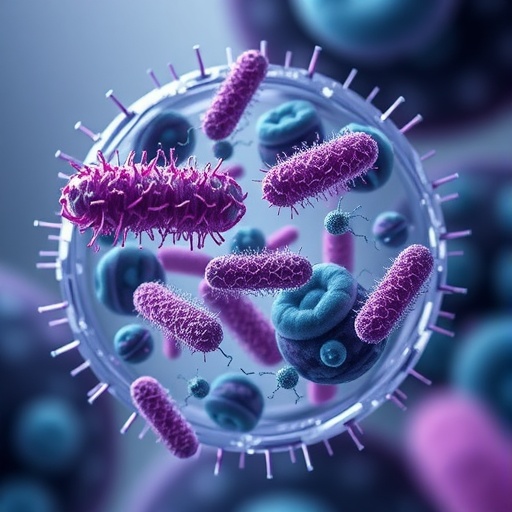
In a groundbreaking advancement that promises to reshape the future landscape of biomedical therapeutics, researchers have engineered an innovative implantable living material (ILM) that integrates genetically programmed bacteria within a robust and carefully structured hydrogel matrix. This novel system addresses a critical challenge in the emerging field of living therapeutics by providing a durable and safe platform for bacteria-based drug delivery, capable of autonomously sensing infections and releasing therapeutic agents precisely when needed. This development marks a significant departure from conventional passive drug delivery methods, heralding an era where implanted living systems can actively interact with and respond to pathological signals in vivo over extended periods.
Living therapeutics harness the unique ability of engineered cells, particularly bacteria, to detect disease-specific molecular cues and secrete bioactive substances such as proteins with high specificity and temporal control. Unlike traditional pharmacological agents, these living systems can sustain themselves within complex biological milieus—ranging from cancerous tumors to inflamed or infected tissues—and exert localized therapeutic effects without systemic distribution. However, the clinical translation of these technologies has been hampered by a paramount safety concern: the risk of bacterial escape from the implantation site, which could trigger severe infections or systemic toxicity.
Previous attempts to physically confine therapeutic bacteria within biomaterials have utilized hydrogels or capsule enclosures, but these have only demonstrated containment over relatively short periods, generally limited to around two weeks. This temporal limitation falls short of clinical needs for chronic disease management, where therapeutic action may be required over months to years. Addressing this challenge, the multidisciplinary team led by Tetsuhiro Harimoto employed a materials engineering approach rooted in understanding the mechanical interplay between living cells and their surrounding matrix.
The team discovered that bacterial proliferation exerts internal pressure against the encapsulating material, and if the matrix fails to resist this pressure through sufficient stiffness and toughness, the bacteria can breach the matrix leading to potential leakage. By carefully designing an implantable living material that reaches an optimized threshold of stiffness, bacterial expansion is mechanically arrested, preventing overgrowth-induced rupture. Simultaneously, the material must maintain mechanical integrity under the dynamic stresses imposed by host tissues, which include continuous movement, compression, and shear forces.
To achieve these stringent requirements, Harimoto and colleagues fabricated a hierarchical hydrogel composite. This ILM incorporates gelatin microgels densely loaded with engineered bacteria, which are embedded within a reinforced polyvinyl alcohol (PVA) framework. The gelatin microgels provide a cell-friendly niche supporting bacterial viability and function, while the PVA framework imparts remarkable mechanical fortitude and elasticity, preventing crack formation under physiological mechanical loading. In vitro simulations mimicking long-term physiological stress revealed that this ILM maintained structural integrity and showed zero detectable bacterial leakage for a remarkable duration of six months.
The transformative potential of this material was demonstrated by programming the bacteria within the ILM to detect quorum-sensing molecules secreted by Pseudomonas aeruginosa, an opportunistic pathogen frequently implicated in device-associated infections. Upon sensing these chemical signals indicative of infection, the bacteria responded by self-destructing—a mechanism known as programmed cell death or autolysis—thereby releasing a potent antibacterial protein designed to eliminate the pathogenic bacteria. This self-regulated therapeutic release creates a closed-loop feedback system, enabling autonomous and on-demand treatment localized to the site of infection without external intervention.
Animal model experiments further validated the efficacy of this living therapeutic scaffold. In a mouse model of joint infection, implantation of the ILM significantly reduced bacterial load, evidencing the system’s capability to mitigate infection in vivo effectively. These findings herald a new paradigm for living therapeutics, where the immobilizing scaffold is no longer a passive substrate but an active determinant of therapeutic success, ensuring both biosafety and functional longevity of the embedded bacteria.
Experts in the field have highlighted the significance of this work, emphasizing how reframing scaffolds from passive vehicles to active enablers alters the design criteria for future biomedical implants. The technology points toward implantable living materials that provide durable, programmable, and responsive therapeutic functions in situ, potentially eliminating the need for repeated drug dosing and reducing systemic side effects often caused by conventional treatments.
The implications for chronic disease management and implant-related infections are profound. Such living materials could be designed to sense and counteract various pathological conditions, from bacterial infections to inflammatory diseases and even cancer, by tailoring the genetically encoded bacterial responses to specific molecular signatures. Furthermore, by physically restraining bacterial proliferation, the ILM platform addresses the critical biosafety concerns, thus accelerating the clinical acceptability of living therapeutics.
Integral to the success of this approach is the meticulous engineering of the hydrogel’s mechanical properties. Future developments may explore the tuning of stiffness and toughness by varying the cross-linking density and polymer composition, optimizing cell viability alongside containment. Moreover, expanding the scope of detectable signals and therapeutic outputs could enhance the system’s versatility, enabling treatment of multifactorial diseases through multiplexed sensing and multimodal therapeutic release.
This pioneering research underscores the power of materials science and synthetic biology converging to create hybrid living devices that perform active medical functions with unprecedented precision and durability. By embedding therapeutic bacteria within a mechanically resilient matrix, the ILM serves as a platform where living cells and synthetic materials synergize to tackle some of the most critical challenges in infectious disease treatment and regenerative medicine.
Looking ahead, the focus will be on translating this technology to human clinical trials, where long-term safety and efficacy must be meticulously evaluated. Ensuring immune compatibility, preventing biofilm formation, and integrating real-time monitoring capabilities represent exciting avenues for further refinement. Success in these areas could revolutionize the way medicines are delivered, offering patients living implants that maintain health integrity autonomously over months or years.
In conclusion, the development of an implantable living material that contains and controls engineered bacteria for autonomous therapeutic release is a landmark achievement in biomedical engineering. It opens a new frontier in medicine, where therapeutics are not just delivered but actively produced and regulated in response to disease states within the body. This technology paves the way toward safer, smarter, and more effective treatments that integrate seamlessly with the biological complexity of the human body.
Subject of Research: Development of an implantable living material integrating engineered bacteria for autonomous, controlled therapeutic delivery to treat infections.
Article Title: Implantable living materials autonomously deliver therapeutics using contained engineered bacteria
News Publication Date: 14-May-2026
Web References:
10.1126/science.aec2071
Keywords:
Living therapeutics, implantable biomaterials, engineered bacteria, hydrogel composites, bacterial containment, autonomous drug delivery, synthetic biology, infection sensing, programmable therapeutics, Pseudomonas aeruginosa, implant-associated infections, biomedical engineering
Tags: autonomous bacterial therapeutic systemsbacterial containment in implantable devicesbioengineered bacteria for infection treatmentengineered bacteria for drug deliverygenetically programmed bacterial implantshydrogel-encapsulated living therapeuticsimplantable living materials for therapeuticsin vivo bacterial drug releaseliving bacteria sensing infectionsafety in living bacterial therapeuticssustained bacterial therapy in tumorstargeted bacterial protein secretion