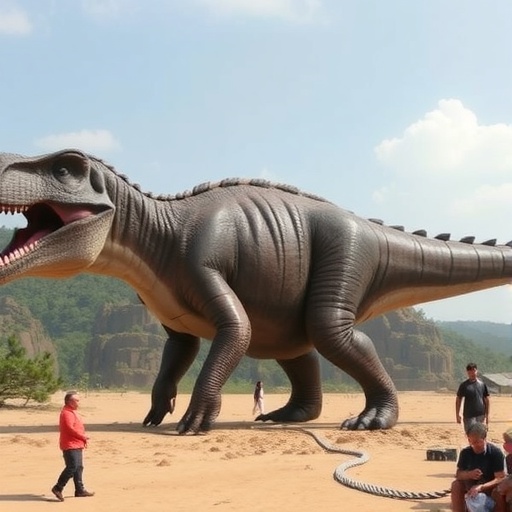
A groundbreaking discovery in the field of paleontology has unveiled a new species of colossal long-necked herbivorous dinosaur, marking the largest sauropod ever identified in Southeast Asia. This monumental find emerges from a decade-old excavation at the periphery of a pond in northeastern Thailand, shedding unprecedented light on the region’s prehistoric ecosystem during the Early Cretaceous period, roughly between 100 and 120 million years ago. The study, a collaborative effort spanning institutions including University College London (UCL), Mahasarakham University, Suranaree University of Technology, and the Sirindhorn Museum, culminates in the formal description of a new dinosaur species named Nagatitan chaiyaphumensis.
The specimen’s fossilized remains, comprising vertebrae, ribs, pelvic bones, and notably a gigantic front leg bone measuring an astonishing 1.78 meters—comparable to the height of an average human—allow researchers to extrapolate the massive scale of this creature. Estimated to have measured approximately 27 meters in length and weighed an extraordinary 27 tonnes, Nagatitan rivals the size of nine adult Asian elephants. This data fundamentally reshapes our understanding of the sauropod diversification in Asia, particularly within the unique paleoenvironmental context of ancient Thailand.
The etymology of Nagatitan chaiyaphumensis reflects a rich cultural and mythological tapestry. “Naga” evokes the mythic aquatic serpent deeply rooted in Southeast Asian folklore, while “Titan” alludes to the giants of Greek mythology, emphasizing the dinosaur’s monumental size. “Chaiyaphumensis” denotes the province of Chaiyaphum, the locality where the fossils were unearthed. This discovery marks the 14th dinosaur species named in Thailand, underscoring the country’s growing prominence in paleontological research.
Taxonomically, Nagatitan belongs to the Sauropoda clade—herbivorous dinosaurs distinguished by their elongated necks and tails, with famous relatives including Diplodocus and Brontosaurus. More specifically, Nagatitan is classified within Somphospondylan sauropods, a subgroup that emerged nearly 120 million years ago and exhibited a wide geographical spread in the Cretaceous. Further phylogenetic analysis positions Nagatitan within the Euhelopodidae family, an exclusive Asian lineage of somphospondylan sauropods, highlighting regional evolutionary pathways divergent from their North American and European counterparts.
The paleoecological context in which Nagatitan thrived was characterized by an arid to semi-arid climate, favoring sauropods adept at thermoregulation. Their extensive surface area—owing to long necks and tails—likely facilitated heat dissipation, allowing these giants to maintain homeostasis in challenging environmental conditions. The fossil site itself was part of a dynamic meandering river system, supporting a diverse biotic community including freshwater sharks, fishes, and crocodilians, further enriching the ecological framework these sauropods inhabited.
Nagatitan’s contemporaneous fauna included smaller herbivores such as iguanodontians and early ceratopsians—relatives of the well-known Triceratops—and formidable carnivores including carcharodontosaurians and spinosaurids. The presence of pterosaurs, aerial reptiles feeding on riverine fish, paints a vivid picture of a complex Cretaceous ecosystem with intricate food webs, dominated by both gigantic herbivores and apex predators.
Morphologically, Nagatitan is distinct from other sauropods due to unique anatomical features observed across its vertebral column, pelvis, and limb bones. These autapomorphies not only justify its classification as a new genus and species but also provide critical data on sauropod diversity and morphofunctional adaptations in Southeast Asia. A life-sized reconstruction of Nagatitan is currently exhibited at the Thainosaur Museum located in Asiatique, Bangkok, allowing both scientists and the public to engage with the tangible legacy of this prehistoric titan.
The lead author, a PhD student at UCL Earth Sciences, emphasized the significance of Nagatitan as “the last titan” of Thailand, attributed to its discovery within the youngest dinosaur-bearing geological stratum in the country. This boundary likely represents the final era before regional sedimentation transitioned to shallow marine environments, effectively ending dinosaur habitation and fossil deposition. Hence, Nagatitan might represent the most recent large sauropod species expected to be discovered in Southeast Asia, establishing an important temporal benchmark in paleobiogeography.
This discovery emerged from a robust international collaboration, leveraging cutting-edge techniques such as 3D scanning and digital modeling, enabling detailed morphological studies with reduced necessity for physical specimen transport—a practice beneficial both logistically and environmentally by mitigating carbon emissions. Such technological integration exemplifies modern paleontological methodology, facilitating comprehensive comparative analyses among global sauropod samples and enhancing our understanding of their evolutionary trajectories.
The research team’s commitment extends beyond this single discovery. A substantial collection of sauropod fossils from the region remains undescribed, hinting at the potential for numerous new species yet to be unveiled. Continued international cooperation, compounded with increasing investment in Southeast Asian paleontology, promises to illuminate unexplored evolutionary dynamics and pave the way for a paradigm shift in how dinosaur biodiversity is understood on a global scale.
This initiative aligns with the broader objectives of Thai paleontologists striving to elevate Southeast Asian dinosaur research onto the international stage. Despite Thailand’s relatively modest geographic size, its dinosaur fossil diversity ranks among the highest in Asia, positioning the country as a focal point for future paleobiological exploration and scientific discovery. The surge in active, younger researchers and burgeoning institutional capacities signal a vibrant future for dinosaur science within the region.
The new findings were published in the prestigious journal Scientific Reports and received vital funding from the National Geographic Society. The publication highlights the critical role of interdisciplinary partnerships and advanced technological applications in pushing the boundaries of our knowledge about prehistoric life and the complex interplay of environmental and evolutionary forces that shaped it.
Subject of Research: New species discovery of a giant sauropod dinosaur in Southeast Asia
Article Title: New Giant Long-Necked Dinosaur Unveiled from Thailand’s Early Cretaceous Deposits
News Publication Date: Not explicitly provided in the text
Web References: Not explicitly provided in the text
References: Original research article published in the journal Scientific Reports
Image Credits: Patchanop Boonsai
Keywords: Dinosaurs, Sauropods, Paleontology, Southeast Asia, Early Cretaceous, Fossils, Megafauna, Herbivores, Vertebrates, Dinosaur Evolution
Tags: colossal sauropod fossilsdinosaur fossils northeastern ThailandEarly Cretaceous sauropods Thailandlargest dinosaur in Southeast Asialong-necked herbivorous dinosaursMahasarakham University paleontologyNagatitan chaiyaphumensis discoverypaleontological excavation Thailandprehistoric ecosystem Early Cretaceoussauropod diversification AsiaSoutheast Asian paleontology breakthroughsUniversity College London dinosaur research