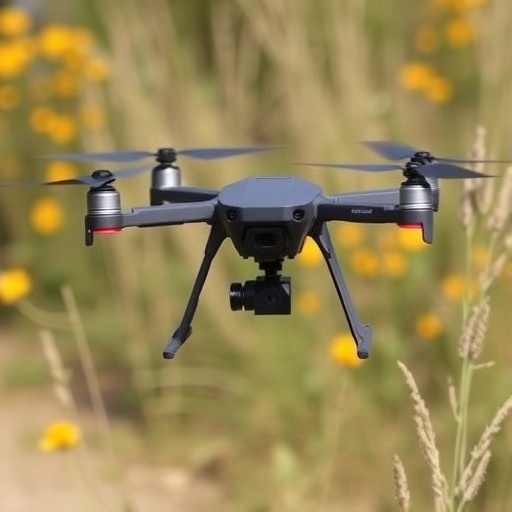
In an era where the potential of autonomous drones is rapidly expanding across various sectors, a groundbreaking advancement inspired by nature is reshaping how these flying robots navigate. Researchers led by Delft University of Technology have unveiled a novel navigation strategy for small drones that’s modeled on the sophisticated yet efficient homing abilities of honeybees. Published recently in Nature, this breakthrough addresses fundamental challenges in drone navigation, presenting a lightweight, efficient system that drastically reduces computational demands without sacrificing navigational accuracy.
Current autonomous drone systems often rely heavily on GPS or intricate environmental mapping to find their way. These methods, while effective, necessitate significant computational power and memory, leading to heavier, more expensive drones with shorter battery lives. The challenge has been particularly pronounced for small drones intended for applications like greenhouse monitoring or industrial site inspections, where weight and energy consumption are critical constraints. The team from Delft University of Technology, in collaboration with Wageningen University and the Carl von Ossietzky University of Oldenburg, turned to nature’s time-tested navigator for inspiration: the honeybee.
Honeybees, despite their diminutive brains and simple neural structures, perform astonishing navigational feats. They engage in what’s known as learning flights—careful, short excursions taken around their hives when they first venture out. These flights allow bees to build a visual memory of their surroundings, enabling them to navigate complex environments when foraging and reliably return home. Unlike robots, bees do not construct detailed maps of their environment; instead, they combine odometry—an internal estimate of distance and direction traveled derived from visual motion cues—with a form of panoramic visual memory centered around their hive.
Odometry, while a useful tool, is prone to cumulative errors or drifts over time, which reduces its reliability for long-distance navigation. Honeybees compensate for this drift through their visual memories, recognizing familiar landmarks around critical points like their hive, but until now, translating this strategy to robotics has been a significant challenge. The integration of odometry with dynamic visual memory in a compact computational framework had remained elusive, especially for lightweight drones with minimal processing capacity.
The “Bee-Nav” system introduced by the researchers ingeniously replicates this dual-natured strategy. When a drone equipped with Bee-Nav embarks on its first flight, it performs a brief learning sortie surrounding its home location, capturing panoramic images of the environment. These images are processed through a diminutive neural network, consuming a mere 42 kilobytes of memory, which extracts crucial visual cues to estimate the drone’s relative direction and distance from home during subsequent flights. The neural architecture is deliberately streamlined but powerful enough to interpret imagery in real-time, enabling precise homing capabilities despite minimal computational load.
One of the ingenious adaptions in Bee-Nav lies in its training regimen. Recognizing that odometric estimates inherently suffer from drift, the researchers employed these imperfect labels to train the neural network to recognize visual signatures indicative of true home direction and distance. This counterintuitive approach leverages the discrepancy in odometric data to encourage the network to focus on stable visual cues, achieving robust navigation despite noisy training signals. Experimental flights demonstrated that even with these odometric imperfections, the visual memory could reliably guide the drone back to its origin.
The research team extended their experiments beyond controlled indoor environments to more challenging settings, notably testing at the Unmanned Valley drone research field-lab in Valkenburg. Here, drones successfully navigated over distances exceeding 600 meters and returned autonomously using this minimalist neural strategy. While the system performed impeccably in vast indoor spaces like hangars and greenhouses, external factors such as wind introduced complexities. Wind-induced drone tilting altered visual inputs, slightly diminishing success rates to approximately 70% outdoors, highlighting avenues for further refinement in real-world conditions.
The implications of Bee-Nav extend far beyond proving a concept. By drastically reducing the computational demands needed for reliable navigation, this approach paves the way for the deployment of ultra-light drones capable of complex autonomous tasks. In greenhouses, for example, lightweight drones equipped with Bee-Nav could continuously monitor crops with minimal disturbance, detecting disease outbreaks or pest infestations early and thus improving agricultural yield while curbing waste. These drones would be safer for workers and more energy-efficient, owing to their reduced mechanical and computational burdens.
Furthermore, the research provides fresh insight into insect navigation itself, illuminating how honeybees might dynamically blend odometry with visual learning in a neural framework sufficiently compact to fit their tiny brains. This biological inspiration not only advances robotic design but also enriches the scientific understanding of natural navigation strategies in flying insects, opening new interdisciplinary dialogues between robotics and neuroethology.
Professor Guido de Croon, leading bio-inspired AI research at Delft University of Technology, emphasizes the dual value of the Bee-Nav system. It’s not only a leap forward in the robotics field but also a testament to the elegance of evolutionary design, translating millions of years of natural navigation refinement into human technological innovation. This synergy of biology and artificial intelligence exemplifies a promising direction for future autonomous systems that demand efficiency, reliability, and adaptability.
Despite the promising results, the team acknowledges that additional work is needed to optimize robustness for various operational conditions, including adverse weather and dynamic environments. Future developments aim to enhance the system’s tolerance to drone tilt and motion disturbances, integrate multi-sensor data, and test in increasingly complex outdoor terrains. The researchers anticipate that these improvements will solidify Bee-Nav’s role in practical, commercial drone applications.
In an age where drones are poised to become ubiquitous, mastering efficient and reliable navigation is paramount. Bee-Nav’s naturalistic yet technologically innovative approach signifies a significant stride toward making small, autonomous drones practical and widespread. This harmonious blend of nature’s wisdom and cutting-edge AI could unlock unprecedented capabilities, transforming how we interact with and harness autonomous aerial vehicles across industries.
The research not only exemplifies an impressive engineering feat but also reminds us that sometimes, the most advanced solutions are those quietly perfected in the natural world. As Bee-Nav demonstrates, by observing and emulating nature’s navigators like the honeybee, we can bring a new era of nimble, efficient robotics closer to reality.
Subject of Research: Not applicable
Article Title: Efficient robot navigation inspired by honeybee learning flights
News Publication Date: 13-May-2026
Web References: 10.1038/s41586-026-10461-3
Image Credits: Delft University of Technology – Micro Aerial Vehicles Lab
Keywords
Drone navigation, honeybee-inspired robotics, autonomous drones, visual homing, odometry, neural networks, bio-inspired AI, greenhouse monitoring, lightweight drones, robot navigation strategy
Tags: autonomous drone navigation inspired by honeybeesbioinspired drone flight controlcomputationally efficient drone algorithmsDelft University drone researchdrone applications in greenhouse monitoringdrone navigation without GPSenergy-efficient drone technologyhoneybee homing behaviorindustrial site drone inspectionslightweight drone navigation systemsnature-inspired roboticssmall drone navigation challenges