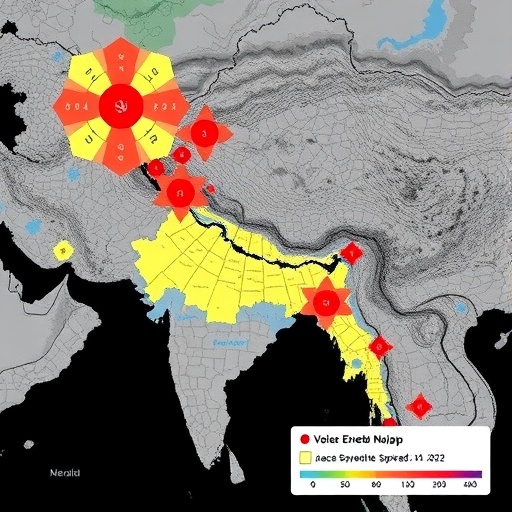
In the ever-evolving landscape of infectious diseases, Nipah virus (NiV) continues to emerge as a formidable zoonotic threat, defying containment efforts and challenging scientific understanding. A recent groundbreaking study published in npj Viruses by Patil, Sahay, Mohandas, and colleagues illuminates the complex epidemiology of NiV spillover events within India, a nation marked by diverse ecological and geographical zones. Their research painstakingly dissects the recurring instances of Nipah virus transmission from its natural reservoir to humans, offering key insights into viral persistence across two distinct regions.
Nipah virus is a member of the Henipavirus genus, part of the Paramyxoviridae family, renowned for its high pathogenicity and fatality rates in humans. The primary reservoir hosts are fruit bats belonging to the genus Pteropus, which harbor the virus asymptomatically. The transmission pathway to humans typically involves indirect contact through intermediate animal hosts or exposure to bat secretions contaminating food or the environment. Understanding the dynamics of spillover requires comprehensive ecological, virological, and epidemiological scrutiny, precisely what Patil et al. achieved by focusing on India’s unique biogeographical settings.
The study’s hallmark revelation is the identification and comparison of recurrent Nipah spillover incidents in two geographically separate regions within India, namely the northeastern states and the southern state of Kerala. Despite the substantial distance and differing ecological characteristics, the virus maintains its endemic presence, underscoring the virus’s ability to persist and adapt within diverse environmental reservoirs. This finding challenges the conventional wisdom that zoonotic spillover is restricted by strict geographical or ecological boundaries.
To elucidate the nuances of viral maintenance and spillover, the researchers utilized a multi-disciplinary approach combining phylogenetic analysis, viral genome sequencing, and detailed field surveillance of bat populations. Phylogenetic mapping of Nipah virus isolates from human and wildlife samples revealed a shared viral lineage between the two regions, suggesting either historical connectivity or parallel spillover from a genetically similar bat population. This molecular evidence bridges the gap in understanding how the virus negotiates spatial barriers to persist.
Another pivotal technical aspect discussed in the paper concerns the mechanisms of viral shedding and transmission among Pteropus bats. The authors report on seasonal variations in viral load and shedding patterns, which correlate with ecological factors such as fruiting periods and bat breeding cycles. This synchronicity hints at environmental triggers underlying increased spillover risk, emphasizing the link between anthro-ecological changes and viral emergence.
The paper also addresses human behavioral and socio-economic variables contributing to recurrent exposure. In both regions, traditional practices such as consumption of raw date palm sap and the interface of humans with bat habitats emerge as critical risk factors. The authors use epidemiological modeling to predict periods of heightened spillover probability, advocating for targeted public health interventions matched with the ecological pulse of the bat reservoir.
In dissecting the viral pathogenesis, Patil et al. delve into the Nipah virus’s unique ability to cause severe encephalitis and respiratory illness. They highlight the genetic determinants of virulence encoded in the viral fusion and attachment glycoproteins, which facilitate host cell entry and immune evasion. The recurrent outbreaks in India offer an unprecedented natural laboratory to study how these molecular features manifest in diverse human populations, with implications for vaccine and therapeutic development.
The study’s integration of field data and laboratory experiments also sheds light on virus-host interactions critical for spillover success. Bat immune tolerance mechanisms that allow chronic infection without disease are juxtaposed with the acute and fatal disease presentation in humans, emphasizing a complex evolutionary equilibrium. Understanding this interplay augments our capacity to predict and potentially disrupt zoonotic spillovers.
Crucially, the research spotlights the role of ecological disturbances, including deforestation and habitat fragmentation, in amplifying Nipah virus risk. As bat populations are forced into closer proximity with human settlements, the natural barrier minimizing spillover weakens. The authors advocate for ecological conservation as a pivotal component of zoonotic disease prevention, placing viral emergence firmly within the context of environmental health.
Recognition is also given to the challenges of surveillance and diagnostics in resource-limited settings. The authors discuss advances in molecular detection methods, such as real-time RT-PCR and serological assays, which were instrumental in identifying and confirming recurrent Nipah infections. Despite technological progress, timely diagnosis remains hindered by logistical difficulties and overlapping clinical presentations with other febrile illnesses.
Patil and colleagues emphasize the necessity of a One Health approach, integrating veterinary, human health, and environmental disciplines to combat NiV. This transdisciplinary framework is fundamental for developing context-specific strategies to mitigate spillover risks and manage outbreaks effectively. Their work exemplifies the synergy achievable when diverse scientific fields converge on a shared public health threat.
The implications of this study extend beyond regional borders, serving as an emblematic case of how zoonotic pathogens adapt and persist in heterogeneous landscapes. It underscores the pressing need for global vigilance and coordination in surveillance and response frameworks, especially as climate change and urbanization reconfigure disease ecologies worldwide.
Mathematical models of Nipah spillover elucidated in the paper simulate scenarios under variable ecological and socio-economic parameters. These predictive tools are invaluable for public health planning, allowing policymakers to anticipate outbreak trajectories and allocate resources proactively. The authors advocate integrating such models with real-time surveillance data to enhance outbreak preparedness.
On a molecular frontier, the genetic sequence data obtained provide an important repository for future research on Nipah virus evolution. Monitoring genetic drift and emergence of potentially more virulent strains remains critical, particularly in light of the frequent human-bat interactions documented. Continuous genomic surveillance will play a pivotal role in early detection of strains with pandemic potential.
To conclude, the research by Patil et al. profoundly advances our understanding of Nipah virus ecology, host interactions, and spillover dynamics in India. Their comprehensive investigation into recurrent outbreaks across two disparate regions reveals the intricate web of biological and environmental factors facilitating this deadly virus’s persistence. It is a clarion call for integrated surveillance, environmental conservation, and tailored public health strategies to stem the tide of Nipah virus spillovers.
As the scientific community continues to grapple with emerging zoonoses, this study stands out as a vital contribution, charting pathways for future interdisciplinary investigations and global health interventions. It underscores that solutions to viral emergence lie at the intersection of virology, ecology, and socio-cultural realities—a complexity that must be embraced to safeguard human populations.
Subject of Research: Recurrent spillover and epidemiology of Nipah virus in distinct geographical regions of India.
Article Title: Two geographies, one virus: What recurrent Nipah spillover in India reveals.
Article References:
Patil, D.Y., Sahay, R.R., Mohandas, S. et al. Two geographies, one virus: What recurrent Nipah spillover in India reveals. npj Viruses 4, 25 (2026). https://doi.org/10.1038/s44298-026-00195-4
Image Credits: AI Generated
DOI: https://doi.org/10.1038/s44298-026-00195-4
Tags: biogeographical influence on virus transmissionecological factors in Nipah virus spreadepidemiological study of Nipah virusHenipavirus family characteristicsintermediate hosts in Nipah virus spreadNipah virus epidemiology in IndiaNipah virus outbreak comparisonNipah virus pathogenicity and fatalityNipah virus spillover eventsPteropus fruit bats as Nipah reservoirsviral persistence in diverse ecological zoneszoonotic transmission of Nipah virus