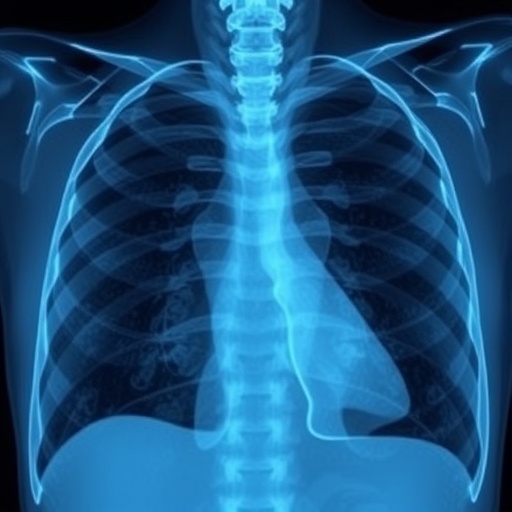
A groundbreaking study emerging from Japan has unveiled a simple yet powerful prognostic indicator derived from routine chest radiographs that could revolutionize the preoperative evaluation of lung cancer patients suffering from obstructive ventilatory disorder (OVD). Conducted by researchers at Kindai University, this research identifies diaphragmatic dome height (DDH) measurement as a robust predictor of long-term survival outcomes following lung cancer surgery, potentially transforming clinical practice through the utilization of accessible imaging data.
Lung cancer continues to represent a colossal global health burden, ranking among the foremost causes of cancer mortality worldwide. Surgical intervention remains the primary curative approach for early-stage lung cancer. However, patient outcomes post-lobectomy—a common surgical procedure to remove a lung lobe—vary widely, complicated further in individuals with OVD. OVD is characterized by airflow limitation that impedes respiratory efficiency, escalating postoperative complication risks and clouding prognostication. Existing methods to predict surgical risk in this demographic often rely on comprehensive pulmonary function tests and invasive procedures, which impose logistical and financial constraints on healthcare systems.
In a departure from convention, the Kindai University team spearheaded by physical therapist Mr. Masaya Noguchi hypothesized that a morphometric measurement of the diaphragm’s position relative to a reference baseline in chest X-rays could provide prognostic insight without straining clinical resources. The diaphragmatic dome height, representative of diaphragmatic mobility and function, can be quantified by calculating the vertical distance from a baseline on frontal chest radiographs to the apex of the diaphragm dome. This metric ostensibly correlates with the respiratory muscle’s integrity, strength, and responsiveness—key factors influencing pulmonary mechanics.
The retrospective observational study involved 302 patients diagnosed with lung cancer complicated by OVD who underwent lobectomy at Kindai University Hospital between 2017 and 2024. Preoperative chest X-rays obtained within one month before surgery were analyzed to calculate DDH. Patients were stratified into low and high DDH groups based on established cutoffs. Subsequent survival tracking over several years enabled the team to evaluate the association between DDH levels and postoperative outcomes, including overall survival, disease-specific survival, and respiratory-related mortality.
Results from the comprehensive data analysis were striking. Individuals presenting with lower DDH values exhibited significantly diminished survival rates; their three-year overall survival stood at 70%, markedly lower than the 85% observed in patients with higher DDH. Disease-specific mortality paralleled this trend, underscoring the predictive power of diaphragmatic displacement. Moreover, respiratory failure and pneumonia – dominant causes of morbidity in post-lobectomy patients with compromised lung function – were notably more prevalent among the low DDH cohort, suggesting that diaphragmatic dysfunction portends poorer respiratory resilience.
Crucially, when factoring in established prognostic variables such as tumor staging and baseline pulmonary function metrics, DDH remained independently correlated with survival outcomes. This is noteworthy because conventional pulmonary function tests, like forced expiratory volume assessments, did not demonstrate as strong an association with long-term prognosis in this particular setting, highlighting DDH’s clinical value. The findings imply that DDH captures aspects of diaphragmatic mechanics and respiratory drive that are not fully encompassed by standard spirometric evaluations.
This study’s implications are both profound and practical. Chest radiography is ubiquitously employed in thoracic preoperative assessment, yielding a noninvasive, cost-effective, and readily available modality for risk stratification. By harnessing DDH as a prognostic biomarker, clinicians can seamlessly integrate an additional layer of evaluation without incurring extra procedural costs or requiring specialized equipment. This capability paves the way for early identification of high-risk patients who may benefit from targeted perioperative interventions such as rigorous respiratory rehabilitation, tailored anesthetic management, and bespoke surgical planning.
Mr. Noguchi emphasized the transformative potential of this diagnostic approach: “By evaluating diaphragmatic dome height through routine chest radiographs, we can preemptively predict postoperative prognosis in lung cancer patients with obstructive ventilatory disorder. This eliminates the necessity for complex additional tests and empowers clinicians to implement timely and individualized treatment strategies.” This novel perspective sheds light on the diaphragm’s crucial yet underappreciated role in surgical outcomes, positioning DDH as a key biomarker in thoracic surgery.
The broader clinical landscape stands to benefit significantly from adopting DDH measurement. Surgical decision-making for lung cancer patients, historically challenged by the heterogeneity of cardiopulmonary risk profiles, could be substantially refined. Resource-limited settings, which often lack access to advanced pulmonary function laboratories, could particularly exploit this innovation to optimize care delivery and improve prognostication. Additionally, the integration of DDH into routine assessment promises to advance precision medicine by facilitating patient-specific risk assessment and tailoring preoperative optimization.
As the research community moves forward, Mr. Noguchi and colleagues advocate for multisite validation studies to corroborate these findings across diverse populations and healthcare systems. Given the encouraging initial data, prospective clinical trials evaluating interventional protocols customized to DDH stratification could further elucidate its utility in enhancing survival and quality of life. The ease of adoption and inherent cost-effectiveness of DDH measurement underscores its attractiveness as a standard prognostic tool.
This breakthrough aligns with an evolving paradigm in oncologic surgery that prioritizes minimally invasive assessments, functional metrics, and personalized medicine. The discovery that a straightforward radiographic parameter can yield nuanced insight into diaphragmatic function and, by extension, patient survival equips clinicians with a potent adjunct in their prognostic arsenal. It exemplifies how routine imaging can be re-envisioned beyond structural visualization to encompass functional evaluation.
In conclusion, diaphragmatic dome height emerges from this landmark study as a clinically relevant, accessible, and independent predictor of survival in lung cancer patients with obstructive ventilatory disorder undergoing lobectomy. Its measurement from standard chest X-rays represents an elegant, low-cost innovation poised to enhance perioperative risk assessment, optimize treatment stratification, and ultimately improve outcomes for a vulnerable patient population. As this field progresses, DDH may soon become a staple in thoracic clinical protocols, embodying the intersection of radiologic simplicity and prognostic sophistication.
Subject of Research: People
Article Title: Association between preoperative diaphragmatic dome height for overall survival in patients with lung cancer and obstructive ventilatory disorder
News Publication Date: 21-Apr-2026
References:
DOI: 10.1007/s10147-026-03022-1
Image Credits: Mr. Masaya Noguchi from Kindai University, Japan
Keywords: Lung cancer, Obstructive ventilatory disorder, Diaphragmatic dome height, Chest X-ray, Prognostic marker, Lobectomy, Pulmonary function, Respiratory rehabilitation, Thoracic surgery, Survival prediction, Respiratory failure, Clinical oncology
Tags: chest X-ray prognostic indicatorsdiaphragmatic dome height measurementKindai University lung cancer studylung cancer surgery survival predictionlung lobectomy outcome predictionnon-invasive lung cancer assessmentobstructive ventilatory disorder prognosispreoperative evaluation lung cancerpulmonary surgery risk stratificationradiographic predictors of survivalrespiratory function imaging biomarkerssimple imaging metrics in oncology