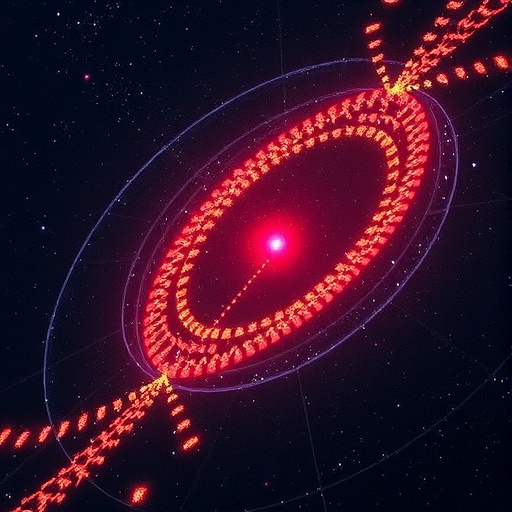
In the vast expanse of the cosmos, dark matter remains one of the most enigmatic components, silently shaping the structure and evolution of the universe. Despite constituting approximately 85 percent of all matter, dark matter evades direct detection because it neither emits nor absorbs electromagnetic radiation, which effectively cloaks it from conventional astronomical instruments. Its presence is inferred solely through gravitational effects, notably the bending and lensing of light around galaxies and galaxy clusters. These gravitational interactions suggest a pervasive, invisible substance that influences the motion and distribution of visible matter, yet the fundamental nature and composition of dark matter continue to elude scientists worldwide.
A recent breakthrough by physicists at the Massachusetts Institute of Technology (MIT) and several European institutions offers an innovative approach to probing dark matter’s elusive characteristics through the lens of gravitational waves. Gravitational waves—the ripples in spacetime generated by cataclysmic cosmic events—offer an unprecedented window into extreme astrophysical phenomena. The new theoretical model predicts how gravitational waves emanating from merging black holes could carry subtle imprints of dark matter if these pairs of black holes spiral through dense dark matter environments prior to coalescence.
The research team devised comprehensive numerical simulations that meticulously calculate the gravitational waveform signatures expected when two black holes collide within a dark matter medium versus the well-studied scenario of a vacuum merger. This approach accounts for variables such as black hole mass, spin, the density and properties of the surrounding dark matter, and the dynamical amplification of dark matter waves in the black holes’ gravitational fields. Their model predicts distinctive modulations in the gravitational wave signals, resulting from interactions with so-called “light scalar” dark matter particles—hypothetical particles whose wave-like nature becomes crucial near the intense gravitational fields of spinning black holes.
These light scalar particles, significantly lighter than electrons, can form coherent wave patterns. As theoretical physicists suggest, in the vicinity of a rapidly rotating black hole, a phenomenon known as superradiance can transfer rotational energy from the black hole to the surrounding dark matter field. This interaction not only amplifies dark matter density around the black hole but generates wave patterns intense enough to influence the gravitational waves emitted during black hole mergers. The gravitational wave signals, therefore, could encode information about the ambient dark matter field, an insight that could revolutionize our understanding of both black holes and dark matter.
In pursuit of empirical evidence, the researchers applied their predictive model to data from the LIGO-Virgo-KAGRA (LVK) collaboration—a global network of gravitational wave detectors that has cataloged hundreds of detected events. Concentrating on the 28 clearest black hole merger signals from the first three observing runs, they rigorously compared each observed gravitational waveform to both the standard vacuum merger waveform and their novel dark matter-imbued waveform. The overwhelming majority of these events (27 out of 28) aligned with expectations of vacuum mergers, validating their analytical methods and reinforcing the consistency of existing gravitational wave interpretations.
However, one event stood out: GW190728, detected on July 28, 2019, displayed subtle but intriguing characteristics consistent with the presence of a dark matter imprint. The gravitational wave’s morphology suggested it originated from a merger that may have occurred within a dense dark matter cloud. Given the system’s total mass—approximately 20 times that of our sun—such a merger traveling through a high-density dark matter environment would produce a gravitational wave signature closely matching the one recorded. While this finding is tantalizing, the researchers emphasize that its statistical significance falls short of a definitive detection, necessitating independent verification and further data collection.
This pioneering methodology for identifying dark matter signatures within gravitational wave data marks an important advancement in astrophysics and particle physics. It underscores the untapped potential of gravitational wave astronomy as a tool for probing fundamental physics beyond the capabilities of electromagnetic observations alone. By integrating detailed waveform modeling with high-precision gravitational wave measurements, scientists may soon be able to detect the presence of light scalar dark matter or rule out certain dark matter candidates entirely.
The implications for cosmology and fundamental physics are profound. If light scalar dark matter fields do influence gravitational wave signals as proposed, they could unlock hidden aspects of particle physics, quantum field theory, and the dynamics of black hole systems. Moreover, this method provides a novel probe of dark matter structures on spatial scales inaccessible to other detection strategies, which often focus on galactic or cosmological scales rather than the compact, extreme environments surrounding black holes.
According to Josu Aurrekoetxea, a postdoctoral researcher leading the MIT effort, black holes act as natural amplifiers for dark matter density, concentrating and enhancing otherwise diffuse fields to detectable levels. “This phenomenon gives us a unique observational window to study the dark matter’s elusive properties by analyzing the gravitational waves emitted by merging black holes,” Aurrekoetxea explained. His team’s work, published in the prestigious journal Physical Review Letters, highlights the synergy between theoretical predictions and experimental gravitational wave astrophysics.
As the LVK network upgrades its detectors and increases its sensitivity in the coming years, the opportunity to discover or constrain dark matter around black holes will improve dramatically. Soumen Roy, a collaborator from Université Catholique de Louvain, noted, “With more precise data and expanded event catalogs, our ability to discern subtle deviations from vacuum mergers will enhance, potentially unveiling new facets of the universe’s fundamental composition.” This development heralds an exciting era where gravitational wave observatories not only chronicle black hole mergers but also contribute to the quest for new physics beyond the Standard Model.
Rodrigo Vicente of the University of Amsterdam, a co-author of the study, emphasized that unlocking dark matter’s secrets via gravitational wave imprints could grant access to scales suppressed in other detection methods. “Exploring dark matter through black holes brings experimental reach to quantum scales and dark sector parameters previously unattainable,” he said. The convergence of black hole astrophysics with particle physics could redefine the frontiers of scientific inquiry, integrating cosmic phenomena into the search for fundamental particles and forces.
Despite the promising theoretical framework and preliminary evidence, the scientific community remains cautious. The team acknowledges that their detection of GW190728’s possible dark matter imprint lacks the certainty required for a discovery claim. Cross-validation by independent teams and further scrutiny through complementary observations, such as electromagnetic counterparts or alternative gravitational wave analyses, will be vital. Continued refinement of waveform models and enhanced computational simulations will also bolster future search sensitivity.
In sum, this groundbreaking work exemplifies how innovative modeling and cutting-edge observational data can converge to open new vistas in understanding the universe’s most inscrutable substances. By leveraging gravitational waves as cosmic messengers, physicists edge closer to solving the century-old riddle of dark matter, moving beyond indirect evidence toward potential direct astrophysical detection.
Subject of Research: Investigation of dark matter imprints in gravitational waves emitted by merging black hole binaries
Article Title: “Scalar fields around black hole binaries in LIGO-Virgo-KAGRA”
News Publication Date: Not specified in the provided content
Web References:
http://dx.doi.org/10.1103/fv9z-zkxx
Image Credits: Courtesy of Josu Aurrekoetxea, et al
Keywords
Dark matter, gravitational waves, black holes, scalar fields, LIGO, Virgo, KAGRA, astrophysics, superradiance, numerical simulations, particle physics, cosmology
Tags: advanced cosmic detection techniquesastrophysical probes of dark matterblack hole mergers and dark matterdark matter and spacetime ripplesdark matter composition theoriesdark matter detection methodsdark matter gravitational effectsdark matter influence on black hole dynamicsgravitational lensing and dark mattergravitational wave astronomyinvisible matter in the universenumerical simulations in astrophysics