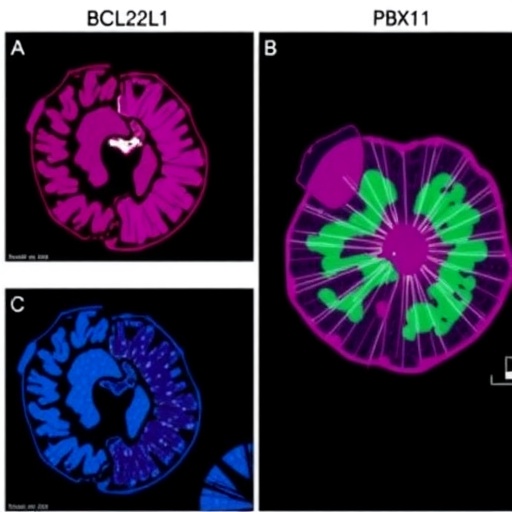
In the relentless pursuit of innovative cancer therapies, scientists have unveiled a groundbreaking strategy targeting the PBX1–BCL2L1 axis as a novel therapeutic approach for colorectal cancer. This finding marks a significant stride in oncology, promising to redefine how this prevalent and often deadly malignancy is treated. The study, spearheaded by Lin, H., Su, T., Liu, Y., and colleagues, delivers compelling evidence that disrupting this molecular pathway can effectively combat tumor growth and resistance, heralding a new era of precision medicine in colorectal cancer management.
Colorectal cancer remains a global health challenge, ranking among the top causes of cancer-related mortality worldwide. Despite advances in surgical techniques, chemotherapy, and immunotherapy, the prognosis for many patients remains grim due to tumor heterogeneity and therapeutic resistance. The quest for targeted interventions that can selectively impede cancer cell survival without inflicting collateral damage on healthy tissues is thus of paramount importance. The identification of the PBX1–BCL2L1 axis as a pivotal regulatory mechanism in colorectal cancer progression offers a promising avenue to develop such refined therapies.
PBX1, a pre-B-cell leukemia homeobox transcription factor, has been implicated in numerous cellular processes, including differentiation, proliferation, and oncogenesis. Meanwhile, BCL2L1 (B-cell lymphoma-extra-large, or Bcl-xL) is renowned for its anti-apoptotic role, often conferring survival advantages to cancer cells by inhibiting programmed cell death. The intricate interplay between PBX1 and BCL2L1 creates a survival nexus exploited by colorectal cancer cells to evade apoptosis and thrive under adverse conditions such as chemotherapy-induced stress.
The research team employed a multifaceted experimental approach combining transcriptomic analyses, protein interaction assays, and in vivo modeling to dissect the functional significance of the PBX1–BCL2L1 interaction. Their findings illustrated that PBX1 directly upregulates BCL2L1 expression, thereby bolstering cellular defenses against apoptotic signals. This axis not only facilitates tumor survival but also contributes to the development of chemoresistance, which is a notorious barrier to effective treatment outcomes.
Intriguingly, the study revealed that pharmacological inhibition or genetic silencing of PBX1 led to a marked reduction in BCL2L1 levels, effectively sensitizing colorectal cancer cells to apoptosis. This was evidenced by increased caspase activation and DNA fragmentation in treated cells, hallmarks of programmed cell death. The therapeutic ramifications are profound, suggesting that targeting PBX1 could indirectly diminish the protective shield of BCL2L1, disarming cancer cells and making them more vulnerable to conventional therapies.
Further, the researchers substantiated their findings in murine xenograft models, where administration of PBX1 inhibitors produced significant tumor regression without apparent toxicity. This highlights the potential for translational applications, reinforcing the promise of PBX1 as a druggable target. Importantly, combination treatments integrating PBX1 blockade with chemotherapy exhibited synergistic effects, amplifying tumor suppression beyond what either strategy could achieve alone.
One of the critical challenges in targeting transcription factors like PBX1 has historically been their “undruggable” nature due to lack of suitable binding pockets for small molecules. However, advances in drug design and the advent of novel modalities such as proteolysis-targeting chimeras (PROTACs) have revitalized interest in such targets. The current work leverages these innovations, employing cutting-edge inhibitors tailored to disrupt PBX1 function with high specificity and efficacy.
The elucidation of the PBX1–BCL2L1 axis also provides valuable insights into the molecular circuitry underpinning colorectal cancer’s resilience. Understanding how cancer cells rewire their apoptotic machinery underscores the complexity and adaptability of tumor biology. This knowledge not only informs therapeutic design but might also enable the development of predictive biomarkers to identify patients most likely to benefit from PBX1-targeted interventions.
From a clinical perspective, integrating PBX1 axis inhibitors could transform existing treatment paradigms. Patients with refractory or metastatic colorectal cancer, who currently face limited options, stand to gain considerably from such targeted therapies. Moreover, early intervention targeting this pathway might impede disease progression, enhancing survival rates and quality of life. As such, clinical trials evaluating the safety, dosage optimization, and efficacy of PBX1 inhibitors are eagerly anticipated.
The broader implications of this research extend beyond colorectal cancer. Given that the PBX1–BCL2L1 axis may operate similarly in various malignancies, these findings could catalyze analogous therapeutic strategies in other cancers where apoptosis evasion is a hallmark. This cross-cancer relevance bolsters the strategy’s translational potential, positioning PBX1 as a linchpin in oncological drug development.
Scientifically, this study exemplifies the power of integrative research, where molecular biology, pharmacology, and in vivo modeling converge to unravel complex disease mechanisms and foster novel treatments. The meticulous delineation of the PBX1–BCL2L1 pathway not only enriches our understanding of colorectal cancer pathophysiology but also paves the way for innovation in drug discovery platforms.
Moreover, the identification of this survival axis underscores the dynamic interplay between transcription factors and apoptosis regulators in cancer cells. This synergy orchestrates a robust defense against cell death, enabling malignancies to persist despite aggressive treatment regimens. Therapeutically dismantling such networks is essential to overcoming resistance and achieving durable remissions.
Importantly, the study addresses an urgent clinical need: circumventing therapeutic resistance, a formidable obstacle in oncology. By revealing a novel vulnerability in colorectal cancer cells, the PBX1–BCL2L1 axis emerges as a beacon of hope that could ultimately alter treatment landscapes and improve patient prognoses in a disease notorious for its recalcitrance.
Looking forward, researchers emphasize the necessity of refining PBX1-targeted compounds to maximize potency and minimize off-target effects. They also advocate for investigations into combination regimens integrating immune checkpoint inhibitors, exploring whether disrupting this axis could enhance anti-tumor immunity. Such multimodal approaches may usher in a new era of personalized, effective cancer therapy.
As this research propels from bench to bedside, it embodies the quintessential promise of precision oncology: exploiting specific molecular aberrations to selectively eradicate cancer cells while sparing normal tissues. The PBX1–BCL2L1 axis not only exemplifies this precision but also exemplifies hope for millions battling colorectal cancer worldwide.
In conclusion, the unveiling of the PBX1–BCL2L1 axis as a therapeutic target represents a landmark achievement in cancer research. This discovery not only broadens our molecular repertoire against colorectal cancer but also sets a precedent for the development of next-generation therapeutics. Lin and colleagues’ pioneering work thus illuminates a promising pathway towards more effective, targeted, and patient-centric cancer care.
Subject of Research: Therapeutic targeting of the PBX1–BCL2L1 molecular axis in colorectal cancer.
Article Title: Targeting the PBX1–BCL2L1 axis as a therapeutic strategy in colorectal cancer.
Article References:
Lin, H., Su, T., Liu, Y. et al. Targeting the PBX1–BCL2L1 axis as a therapeutic strategy in colorectal cancer. Cell Death Discov. (2026). https://doi.org/10.1038/s41420-026-03139-2
Image Credits: AI Generated
DOI: https://doi.org/10.1038/s41420-026-03139-2
Tags: BCL2L1 anti-apoptotic functioncolorectal cancer tumor growth inhibitioninnovative oncology treatmentsmolecular targets for colorectal cancernovel cancer treatment strategiesovercoming therapeutic resistance in colorectal cancerPBX1 BCL2L1 axis colorectal cancer therapyPBX1 role in cancer progressionprecision medicine for colorectal cancertargeted cancer cell survival mechanismstargeted molecular pathways in colorectal cancertranscription factors in cancer therapy