In a groundbreaking study unveiled in Nature Neuroscience, researchers have illuminated the intricate biological mechanisms that sculpt the precise, stereotyped dendritic arbors integral to neuronal function. Challenging the previously dominant paradigm that neural branching follows deterministic genetic blueprints alone, this new work reveals that a sophisticated interplay between stochastic dendritic growth and ligand–receptor mediated stabilization governs the formation of these elaborate neural structures.
Neurons communicate through dendrites, which extend complex arbors to establish synaptic connections essential for processing information. While it has long been established that dendritic morphology is critical for neural network connectivity and brain function, the biological processes dictating the precise shape and patterning of these arbors remained elusive. The new research spearheaded by Shi, Ho, Tao, and colleagues dissects this mystery through a combination of empirical data and probabilistic modeling.
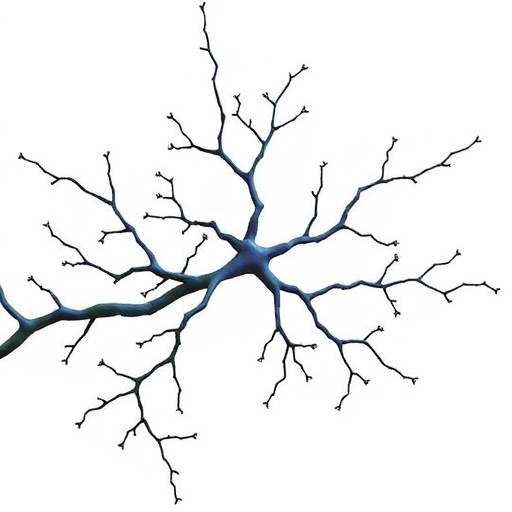
At the heart of the study is the recognition that dendritic branching is not purely deterministic. Initial growth is stochastic, with dendrites extending and retracting branches in varied, seemingly random patterns. However, this randomness alone cannot explain the consistent, reproducible architecture observed across individual neurons of the same type. The researchers propose and verify a model in which ligand–receptor interactions play a pivotal role in stabilizing specific branches during this stochastic exploratory phase.
Specifically, the study identifies molecular signaling pathways where ligands present in the neural microenvironment bind to receptors on growing dendrites, acting as molecular ‘anchors.’ These interactions selectively stabilize some dendritic branches over others, leading to the emergence of the stereotyped arbor shapes characteristic of particular neuronal classes. This ligand–receptor stabilization effectively filters the stochastic growth, ensuring reliable, reproducible dendritic patterns.
Methodologically, the research combined in vivo imaging of developing neurons in model organisms with sophisticated mathematical modeling of dendritic growth dynamics. This dual approach allowed the authors to simulate the underlying probabilistic branching processes and to manipulate ligand–receptor interactions experimentally. These manipulations corroborated the hypothesis that interrupting the ligand signaling pathways increased dendritic arbor variability, further supporting their proposed model.
An exciting implication of this work lies in the reconciliation of genetic determinism and stochastic biological processes in neurodevelopment. Instead of purely genetically pre-programmed dendritic forms, neuronal morphogenesis emerges as a dynamic balance of randomness and molecular cues. This nuanced understanding sheds light on how genetically identical neurons develop unique yet reproducible structures vital for functional neural circuits.
Moreover, the findings hint at broader principles of tissue self-organization where stochastic morphogenetic events are refined by localized signaling. Such mechanisms might be conserved across various biological systems beyond the nervous system, suggesting a universal developmental strategy balancing flexibility and fidelity.
From a clinical perspective, delineating the mechanisms governing dendritic stabilization opens new avenues for understanding neurodevelopmental disorders characterized by aberrant dendritic morphology. Conditions such as autism spectrum disorders, intellectual disability, and schizophrenia have been linked to dendritic abnormalities, and targeting ligand–receptor interactions might offer novel therapeutic strategies.
The study also advances technological frontiers by employing real-time, high-resolution live imaging coupled with computational models that capture both deterministic and probabilistic elements of cellular morphogenesis. This integrative approach exemplifies the future of developmental neuroscience, blending experimental and theoretical frameworks.
Furthermore, the research underscores the importance of microenvironmental context in shaping neuronal form. The local distribution of ligands that stabilize dendritic branches depends on spatial patterning in the extracellular matrix and neighboring cells, emphasizing that neurons develop not in isolation but within a dynamic, interactive milieu.
This discovery also revises our understanding of neuronal plasticity during development. The stochastic growth phase indicates a window of heightened structural variability when neurons sample multiple potential wiring patterns before molecular stabilization locks in the mature arbor. Such plasticity may be critical for adaptive network formation and learning during critical periods.
Intriguingly, the stochastic-plus-stabilization model offers a plausible explanation for the remarkable balance between robustness and flexibility in brain wiring. Neurons reliably form functional circuits despite inherent biological noise, ensuring developmental fidelity while allowing subtle individual variations that may confer computational advantages.
The research team plans to extend their work by identifying additional molecular players involved in ligand-mediated stabilization and exploring how external stimuli might modulate these pathways during neuronal development and during plasticity in adulthood. Such investigations hold promise for unraveling how experience interfaces with intrinsic growth programs to shape neural circuits.
By revealing the stochastic and receptor-mediated underpinnings of dendritic arborization, this study sets a foundational framework for neurodevelopmental biology. It highlights the elegant complexity of nervous system formation, where randomness is harnessed and refined by molecular signals to create the exquisite architectures underlying cognition and behavior.
As we continue to decipher the code of brain wiring, recognizing the dual roles of chance and molecular guidance will be paramount. This transformative insight not only enriches basic neuroscience but also challenges us to rethink intervention strategies in neurodevelopmental disorders rooted in morphological deviations.
Subject of Research: Neural development; dendritic morphogenesis; ligand–receptor interactions; stochastic biological processes.
Article Title: Stochastic growth and ligand–receptor interaction-mediated stabilization generate stereotyped dendritic arbors.
Article References:
Shi, R., Ho, X.Y., Tao, L. et al. Stochastic growth and ligand–receptor interaction-mediated stabilization generate stereotyped dendritic arbors. Nat Neurosci (2026). https://doi.org/10.1038/s41593-026-02278-0
DOI: https://doi.org/10.1038/s41593-026-02278-0
Tags: dendritic arbor formation mechanismsdendritic pattern reproducibilityligand mediated dendrite stabilizationligand-receptor signaling in neuronsNature Neuroscience dendrite studyneural network formation biologyneuron morphology and connectivityneuronal branching patternsprobabilistic modeling of dendritesstochastic dendritic growthstochastic processes in neural developmentsynaptic connection development