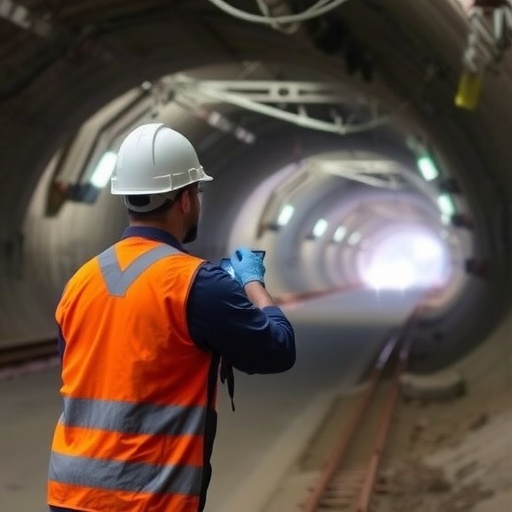
A newly published national survey has exposed alarming occupational health risks faced by tunnel construction workers across Australia, shedding light on their significant exposure to respirable crystalline silica dust—a pervasive hazard known to cause debilitating and irreversible diseases such as silicosis, lung cancer, and chronic bronchitis. The findings, emerging from a University of Sydney-led investigation and published in the Australian and New Zealand Journal of Public Health, underscore persistent gaps between workers’ knowledge of these hazards and the inadequate safety measures implemented on the ground.
Silica dust consists of microscopic particles released during the cutting, drilling, or blasting of rock and concrete, common activities in tunnelling projects. These fine airborne particles penetrate deep into the lungs when inhaled, causing inflammation and scarring that progressively impair respiratory function. Despite decades of evidence linking silica exposure to severe pulmonary diseases, enforcement of protective standards within Australian tunnel construction appears alarmingly inconsistent, as revealed by a comprehensive survey conducted between September 2024 and June 2025 involving 290 industry workers and health professionals.
Lead researcher Kate Cole, whose extensive background spans over twenty years in major infrastructure and construction projects, emphasized that this issue transcends mere awareness. “The problem is not a lack of knowledge about silica hazards,” Cole asserts, “It is a failure of leadership, accountability, and regulatory enforcement that leaves vulnerable workers paying the ultimate price.” The survey reveals that most workers possess an acute understanding of the risks but remain inadequately shielded due to systemic failures in safety culture and operational oversight.
Strikingly, over 62 percent of participants reported substantial barriers to implementing effective dust control practices. Workers frequently cited relentless time pressures imposed by project deadlines, poor management commitment to health protocols, and insufficient regulatory monitoring as root causes undermining protective efforts. This toxic environment fosters conditions where exposure becomes normalized and workers feel compelled to prioritize production metrics over their own safety.
The consequences of such structural failings are tangible and grave. According to the survey, 14.2 percent of respondents reported having been diagnosed with silica-related conditions, including chronic bronchitis, silicosis, and rheumatoid arthritis—diseases known to severely compromise quality of life and life expectancy. In addition to self-reports, expert assessments indicated that workplace exposure levels across multiple job groups routinely exceeded legal workplace exposure limits, underscoring the systemic nature of hazardous conditions.
Furthermore, a pervasive mistrust permeates the industry concerning the efficacy of regulatory oversight. Nearly half of those surveyed expressed skepticism about regulators’ ability to enforce dust control and maintain workplace safety standards. An insidious practice highlighted by respondents involves advance warnings of unannounced inspections, prompting superficial clean-ups or operational modifications designed solely to feign compliance. One participant described such deceptive tactics, stating that inspection visits often fail to capture true working conditions, thereby permitting hazardous practices to continue unchecked.
Underlying these failures is a workplace culture where safety is often subjugated to deadline-driven production goals. Workers reported atmospheres in which raising concerns about dust exposure risked damaging their job security or undermining their standing with supervisors. Reports of hazardous visibility conditions due to excessive dust—where visibility was limited to mere meters—reflect a dire disregard for safety protocols. This culture not only jeopardizes individual health but perpetuates a climate in which systemic under-reporting and safety compromises thrive unchallenged.
Despite these grim realities, the survey does note incremental advancements in dust control technologies over the past decade. Enhanced ventilation systems, the deployment of enclosed vehicle cabins, and increased availability of respiratory protective equipment represent technological strides aimed at mitigating silica exposure. Nonetheless, researchers caution that these innovations are sporadically applied and often relied upon as the primary defense rather than integrating comprehensive hazard control strategies that eliminate or reduce risks at the source.
Transparency deficits compound these issues. Although most respondents acknowledged the presence of air monitoring systems on worksites, few trusted the authenticity or completeness of the data collected. The manipulation or selective reporting of air quality results raises critical questions about accountability within project management and regulatory bodies tasked with safeguarding worker health. Without rigorous, unbiased data and open communication, real risks remain obscured and unaddressed.
These findings arrive at a pivotal moment as Australia embarks on an unprecedented infrastructure expansion. With tunnelling and underground construction projects poised to multiply, the potential for widespread silica exposure heightens dramatically. Without systemic reform, including robust leadership commitment, strict enforcement of exposure limits, and transformative cultural shifts prioritizing worker health above expediency, preventable occupational diseases will continue to afflict thousands of workers, imposing severe socioeconomic and human costs.
The survey, encompassing a broad array of industry stakeholders—including contractors, occupational hygienists, and clients—provides innovative insight into the complex dynamics facing the tunnelling sector. It exemplifies the critical role of stakeholder feedback in illuminating on-the-ground realities often concealed within official statistics, thereby serving as an early warning system for occupational health crises.
Moving forward, the research team advocates for strengthening regulatory frameworks with enhanced inspection rigor, eliminating advance notice that enables site-stage compliance charades, and fostering a workplace culture conducive to transparent risk reporting and proactive hazard management. Support from unions and industry bodies must be harnessed effectively to champion these changes, as their currently inconsistent roles reflect broader systemic dissonance.
Ultimately, this research underscores an urgent call to action: bridging the chasm between knowledge and practice to safeguard Australia’s tunnelling workforce demands comprehensive systemic reform. Only through committed leadership, empowered regulatory agencies, and genuine cultural change can the profound risks posed by silica dust be mitigated, securing healthier futures for those who labor beneath the surface.
Subject of Research: People
Article Title: Perceptions of respirable crystalline silica exposure in the Australian tunnelling industry: A survey of stakeholders’ attitudes to occupational health protections
News Publication Date: 30-Apr-2026
Web References: http://dx.doi.org/10.1016/j.anzjph.2026.100323
Keywords: Underground construction, Respiratory disorders, Lungs, Occupational diseases, Environmental illness, Public health, Human health, Civil engineering, Air pollution, Pollution
Tags: Australian tunnel workers health surveychronic bronchitis in construction industryconstruction industry occupational health challengesenforcement of silica exposure standardsoccupational health risks for tunnel workersprotective measures for silica dustrespirable crystalline silica hazardsrespiratory diseases from silica dustsilica dust exposure in tunnel constructionsilica dust inhalation effectssilicosis and lung disease in construction workersworkplace safety in tunnel construction