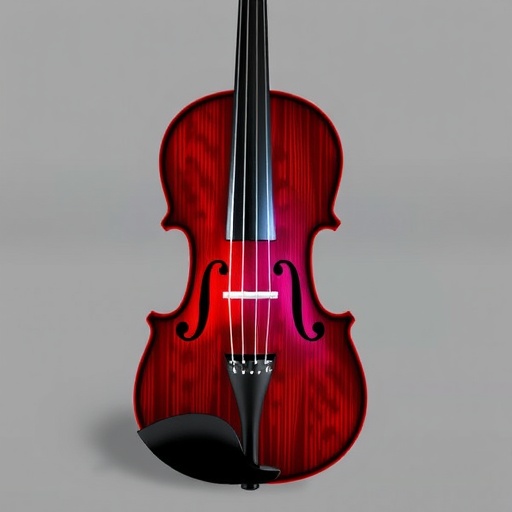
Violin-making stands as a pinnacle of artistic craftsmanship, intertwining the nuanced ears of musicians, the dexterous hands of artisans, and a deep historical knowledge inherited across centuries. Traditionally, the process has required luthiers—expert violin makers—to painstakingly carve and assemble each part with precision, only to discover the sonic outcome once the instrument is complete. This approach demands immense patience and invites a fair share of trial and error, as subtle changes in design can lead to significant variations in sound.
In a groundbreaking development, engineers at MIT have unveiled a revolutionary computational model—a virtual violin—that simulates the musical instrument’s sound production even before the physical instrument is carved. This digital innovation heralds a paradigm shift in violin design, allowing luthiers to experiment and refine sound qualities through manipulation of various design parameters in a completely virtual environment without immediate material commitment or expense.
Unlike conventional software or plug-ins, which generate violin sounds through extensive sampling of real instruments, the MIT computational violin is uniquely physics-based. It models the physical dynamics of both the violin structure and its interaction with the surrounding air to generate authentic sound waves. This method ensures that the virtual instrument’s acoustics emerge directly from the laws governing elastic materials and fluid mechanics, offering a faithful representation of how sound is produced by a real violin.
The research team demonstrated the model by virtually performing two distinct musical pieces: the intricate “Fugue in G Minor” by Bach and the historically significant “Daisy Bell,” known as the first song synthesized by a computer voice. These performances were executed using the “pizzicato” playing technique, where strings are plucked rather than bowed—an important simplification for the initial modeling phase, as bowing involves highly complex frictional interactions that are challenging to replicate computationally.
To create this computational marvel, the team leveraged detailed computed tomography (CT) scans of a rare Stradivarius violin crafted by Antonio Stradivari around 1715, during the golden age of violin-making. The high-resolution scans provided hundreds of cross-sectional images that were integrated into advanced 3D modeling software to reconstruct an extraordinarily precise digital representation of the instrument’s geometry and internal structure.
This digital violin was then subdivided into millions of tiny volumetric elements through finite element analysis (FEA), a method that discretizes the structure into small “cubes” for complex simulations. Each element was assigned specific mechanical properties—discriminating between regions such as maple back plates, spruce top plates, and steel or gut strings. The equations of motion and elasticity were then solved numerically to predict how each segment vibrated relative to the whole instrument under string excitation.
Equally crucial was the modeling of the surrounding air as a three-dimensional acoustic medium. By partitioning the air volume around the violin into thousands of small cells, the model calculated the propagation of sound waves generated by vibrations traveling through and emanating from the instrument. This coupling between solid mechanics and acoustics captures the intricate feedback loop critical for rendering realistic violin sound.
The operational aspect of the virtual violin involved simulating the pluck of a string by imposing initial lateral displacement and subsequent release, mimicking the physical act of pizzicato playing. This action triggered a cascade of vibrations throughout the violin’s body and strings, culminating in simulated acoustic emissions faithfully reflecting how a real violin would resonate in response to such excitation.
Further complexity was added by incorporating the effect of fingers pressing on the fingerboard to modulate pitch. By constraining the motion of a string segment in the model to replicate finger placement, the team was able to produce a range of notes consistent with realistic playability. These virtual notes were then sequenced to reproduce coherent melodic passages, highlighting the model’s versatility and sound fidelity.
Beyond producing sound, the computational violin represents a powerful tool for iterative design. The researchers explored modifications such as altering the thickness of the violin’s back plate and switching between wood types, unveiling perceptible changes in tonal quality and resonance. Such parametric control offers luthiers unprecedented insight into how structural variations influence acoustic performance, potentially accelerating innovation while preserving traditional artistry.
Despite these advances, the team acknowledges limitations in their current work—namely, the absence of bowing simulation, which involves complex stick-slip phenomena and nonlinear forces difficult to capture. However, the foundational physics embedded in this model pave the way for future enhancements that may ultimately encompass bowed sound synthesis, offering a complete physics-based violin emulator.
The significance of this project extends beyond mere virtual sound generation. It bridges the realms of classical craftsmanship and contemporary computational science, deepening our understanding of violin acoustics rooted in physical theory rather than experiential knowledge alone. As co-investigator Nicholas Makris noted, while the artisan’s magic remains irreplaceable, physics-based modeling can augment and illuminate the design process, empowering violin makers with data-driven feedback and novel creative possibilities.
Supported by the MIT Bose Research Fellowship, the study titled “Exploring the behavior of a strung computational Stradivarius violin” marks a pivotal step in musical acoustics research. By combining meticulous historical resource use, cutting-edge engineering techniques, and acoustic science, the MIT team has crafted a new realm where tradition meets simulation, offering a glimpse into the future of musical instrument design and sonic exploration.
Subject of Research: Computational modeling of violin acoustics and musical instrument design.
Article Title: “Exploring the behavior of a strung computational Stradivarius violin”
Web References: https://doi.org/10.1038/s44384-026-00049-6
Keywords
Violin-making, Computational violin, Musical acoustics, Physics-based sound synthesis, Finite element analysis, Stradivarius, Acoustic modeling, Pizzicato simulation, 3D modeling, Sound wave propagation, String vibration, Instrument design
Tags: computational musical instrumentsdigital violin designluthier craftsmanship enhancementMIT engineering innovationmusic technology advancementsphysics-based sound modelingphysics-driven audio synthesisrealistic virtual instrument soundssound simulation in musicviolin acoustics modelingvirtual instrument prototypingvirtual violin technology