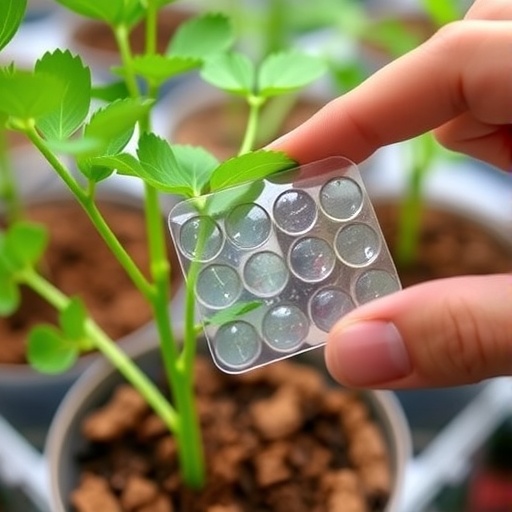
In a groundbreaking advancement that merges plant science with nanotechnology, researchers at the University of California San Diego have engineered a novel adhesive gel designed explicitly for application on plant surfaces. This innovative biopolymer-based gel represents a significant stride in precise plant treatment and human-plant interfacing, promising to revolutionize agricultural practices, environmental monitoring, and potentially, bioenergy harvesting. Through the synergy of chemical engineering and nanotechnology, this adhesive gel accomplishes what traditional substances have struggled with: strong yet reversible adhesion to a wide variety of plant anatomies.
Plants present one of the most challenging substrates for adhesives due to their diverse textures and dynamic surface chemistry. Their exterior layers, often waxy and hydrophobic, serve as natural barriers against external agents. Furthermore, the constant growth and shedding of layers create a moving target for sustained adhesion. To overcome this, the research team employed a dual-polymer formulation comprising polyacrylamide, known for its elasticity and mechanical robustness, alongside chitosan, a biopolymer famed for its bioadhesive properties originating from its ability to form reversible chemical bonds with biological tissues.
The resulting gel exhibits remarkable conformability, adapting to the microtopography of leaves, stems, and even the fine hairs covering certain plants. Unlike conventional adhesives, which typically fail under outdoor environmental stressors, this gel maintains strong adhesion even under rainfall conditions. Its adhesion is also reversible, enabling removal and reapplication without damage to the plant. The transparent nature of the gel ensures that critical processes like photosynthesis are not impeded when the gel is applied, preserving plant vitality during treatment.
Beyond merely affixing to plant surfaces, the adhesive gel functions as a sophisticated delivery system capable of transporting active agents into the plant’s vascular tissues. To validate this unique ability, researchers incorporated quantum dots—nano-sized fluorescent markers—into the gel matrix and applied it to leaves. Observations confirmed that these particles migrated through the plant’s veins within hours, illustrating systemic movement far beyond the application point. Such systemic delivery heralds a new era of localized yet whole-plant treatments, dramatically reducing wastage common in methods like spraying or soil drenching.
This method’s targeted delivery has tangible applications, notably in combating plant diseases. The researchers effectively treated a bacterial infection within 48 hours by loading the gel with specific antibiotics. The controlled local release ensures high therapeutic concentrations right where they are needed, minimizing off-target effects and reducing the environmental footprint of chemical use in agriculture. This precision could transform plant pathology and pest management, offering sustainable and reduced-risk alternatives to broad-spectrum pesticides.
The adhesive gel also intrigues scientists interested in creating interactive interfaces between humans and plants. In a pioneering experiment, the team embedded conductive ions within the gel to establish an electrical connection with a Venus flytrap. Coupled with a wearable device capable of generating mild electrical stimuli upon human touch, the gel transmitted signals that caused the plant to react by snapping shut. This innovative demonstration serves as a proof-of-concept for remote communication pathways across species lines, paving the way for bioelectronic interfaces that could modulate plant behavior or monitor physiological states in real time.
Such an interface opens a myriad of possibilities, from early detection of biotic stressors like pathogens and pests to abiotic ones such as drought or nutrient deficiencies. By transforming plants into active nodes within a sensing network, farmers and environmentalists could receive instantaneous alerts and adapt their practices responsively. Moreover, the concept of harvesting bioelectric energy directly from plants and integrating it into energy grids offers an entirely novel dimension to sustainable energy research.
Looking ahead, the scientific team aims to expand the repertoire of cargoes deliverable through this gel, including genetic material and living cells. This direction taps into the burgeoning field of plant synthetic biology, where modified plants act as bioreactors to synthesize valuable compounds—from pharmaceuticals to biofuels—at low cost and scalable volumes. With a gel matrix capable of conserving the viability of these biological cargoes on diverse plant surfaces, this technology could facilitate more sophisticated plant engineering and production platforms.
The materials science underpinning this gel involves intricate optimization. Polyacrylamide contributes flexibility and mechanical strength necessary for durability on dynamic plant surfaces, while chitosan’s cationic charge enables electrostatic interactions with negatively charged plant leaf surfaces. These reversible interactions allow adhesion without permanent modification or damage, a key ethical and practical consideration when applying technology in natural ecosystems. The gel’s water content and porosity also ensure permeability, allowing gaseous exchange essential for plant health.
As an added benefit, this gel delivery platform reduces chemical runoff and environmental contamination. With targeted dosing, fewer chemicals are required, decreasing the risk of ecosystem imbalances and cross-contamination of non-target organisms. This eco-friendly profile aligns with global sustainability efforts in agricultural science and environmental stewardship, underscoring the gel’s potential beyond its immediate technical merits.
The research, led by Professors Nicole Steinmetz and Jinhye Bae, integrates expertise from chemical and nano engineering fields, showcasing the interdisciplinary approach necessary to solve complex biological problems. Published in the esteemed journal Science Advances, the study was supported by national science foundations and specialized fellowships emphasizing space health research, hinting at potential applications in extraterrestrial agriculture where resource optimization and plant health are paramount.
Notably, the research team has filed a patent safeguarding the underlying technology, reflecting the practical and commercial potential of this innovation. Beyond the lab, the gel’s applications could range from everyday gardening to large-scale crop management, signaling a versatile tool for the future of plant biotechnology.
This transformative adhesive gel offers a glimpse into a future where plants are not mere passive organisms but active participants in a digital and sustainable ecosystem. By marrying material science with botanical biology, researchers have unlocked a platform that could redefine how we nurture, protect, and communicate with the plant kingdom, fostering innovations that resonate well beyond the fields and greenhouses.
Subject of Research: Development of a strong, reversible, and conformal adhesive gel for diverse plant surfaces enabling targeted delivery of agents and human-plant electrical interfacing.
Article Title: A strong, reversible, and conformal adhesive gel for diverse plants
News Publication Date: 24-Apr-2026
Web References: https://www.science.org/doi/10.1126/sciadv.adz6379
References: Steinmetz, N., Bae, J., et al. (2026). A strong, reversible, and conformal adhesive gel for diverse plants. Science Advances. DOI: 10.1126/sciadv.adz6379
Image Credits: David Baillot/UC San Diego Jacobs School of Engineering
Keywords
Plant adhesive gel, targeted delivery, nanotechnology, polyacrylamide, chitosan, plant disease treatment, quantum dots, plant bioelectronics, sustainable agriculture, biointeraction, plant synthetic biology, bioenergy harvesting
Tags: advanced plant-environment interfacesbioadhesive polymers for plantsbiopolymer adhesive for plantseco-friendly plant treatment materialsinnovative plant monitoring methodsnanotechnology in agricultureplant growth monitoring solutionsplant nanotechnology applicationsplant surface treatment gelpolyacrylamide chitosan gelreversible plant adhesion technologysustainable agricultural adhesives