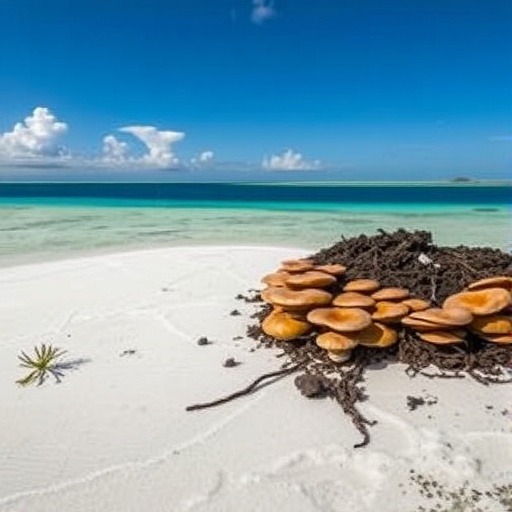
Amid the vast expanse of the Pacific, Palmyra Atoll stands as a fragile bastion of ecological complexity, a pristine island ecosystem long celebrated for its intactness amid mounting global environmental degradation. This remote atoll, positioned equidistant between Hawaiʻi and American Samoa, is a natural laboratory for conservationists and evolutionary biologists alike. Recent groundbreaking research, soon to be unveiled in the prestigious journal Current Biology, illuminates the critical yet unseen role of symbiotic fungi in underpinning the regeneration capacities of Palmyra’s native Pisonia grandis rainforest—a keystone tree species whose survival intricately links to the health of the entire ecosystem.
Palmyra Atoll’s ecological narrative is one of resilience tempered by vulnerability. Historically, its native forests were systematically cleared, giving way to non-native coconut palm plantations introduced in the mid-19th century. These palms, once dominant, displaced indigenous flora, reshaping habitat structures and compromising ecosystem function. The U.S. military’s interrupted stewardship in World War II compounded these pressures, introducing invasive species like black rats which devastated native seedlings and bird populations. Not until recent collaborative conservation efforts, particularly those undertaken by The Nature Conservancy and its partners, did the atoll witness the eradication of invasive mammals and large-scale palm removal, setting the stage for ecological recovery.
Yet, in a compelling departure from traditional conservation paradigms that focus primarily on visible flora and fauna, this new study reveals a subterranean dimension essential to forest regeneration: the symbiotic fungi inhabiting Pisonia roots. These fungi, primarily mycorrhizal in nature, form mutualistic networks that facilitate nutrient exchanges vital for plant health and growth. Through an extensive sampling regime spanning 27 islands of Palmyra, researchers consistently identified the presence of these fungal partners intimately associated with Pisonia roots, regardless of the soil’s perceived thinness or quality. Remarkably, some fungi were even found on root systems suspended well above ground level, challenging existing notions of soil dependence.
The ecological significance of these fungal symbionts extends far beyond simple nutrient transfer. Through mycorrhizal networks, Pisonia trees gain access to essential elements such as phosphorus, nitrogen, and water, enabling them to thrive in nutrient-poor island soils. In exchange, the fungi obtain carbon compounds synthesized by the tree through photosynthesis. This bidirectional flow constitutes a biological currency fundamental to ecosystem productivity. Moreover, the fungi may act as conduits linking terrestrial and marine nutrient cycles, a hypothesis substantiated by the presence of seabird guano enriching the soil and subsequently nourishing coral reef systems offshore.
This intricate web of interdependencies underscores the fragile tightrope on which island ecosystems like Palmyra exist. Seabirds, including red-footed boobies and great frigatebirds, nest predominantly in the dense canopies formed by mature Pisonia. The copious guano deposits from these birds fertilize soils and adjacent marine environments, stimulating plankton blooms that support vibrant coral populations and healthy fish communities. Simultaneously, terrestrial land crabs foster fungal diversity by aerating the soil and facilitating organic matter turnover through their burrowing activities. The study’s comparative analyses revealed measurable elevations in fungal diversity proximal to crab burrows, highlighting an often-overlooked link between invertebrate ecosystem engineers and fungal communities.
The discovery of fungal “hot spots” with dense populations of native symbionts opens new avenues for enhancing restoration strategies. Traditional reforestation efforts have predominantly targeted the reintroduction of native plants, often neglecting the microbial communities indispensable to plant establishment and survival. The researchers propose soil transplantation methods that include inoculation with native fungi to boost seedling vigor and survivability. This microbial metric introduces a paradigm shift in ecological restoration science, emphasizing biotic interactions at microscopic scales as a criterion for success.
Leading figures spearheading this research, such as evolutionary biologist Toby Kiers, bring a transformative vision that integrates fungal ecology into conservation policy. Kiers’ recognition—highlighted by prestigious honors like the Tyler Prize and MacArthur Fellowship—reflects a growing acknowledgment of subterranean biodiversity’s role in ecosystem function. Her work with the Society for the Protection of Underground Networks (SPUN), University of Oxford, and global conservation entities heralds a new era in which microbiomes are factored into ecosystem management and climate resilience frameworks.
The study’s methodology combined rigorous fieldwork with advanced molecular genetics and bioinformatics, allowing scientists to catalog fungal taxa with unprecedented precision. Novel fungal species, some endemic to Palmyra and previously undocumented anywhere on the planet, were identified, illuminating the island’s unique evolutionary pathways. This richness of species, coupled with localized fungal populations tethered closely to Pisonia distribution, suggests co-evolutionary dynamics typical of ancient island systems. Proximity analyses further delineated fungal abundance gradients, illustrating a clear decline away from the tree’s root zones—underscoring their tight biological interconnection.
Importantly, the findings extend their relevance beyond Palmyra’s shores. Given that Pisonia species exist on hundreds of global atolls, this fungal symbiosis may represent a universal principle underpinning island forest resilience. The research thereby challenges conservationists to rethink one-dimensional approaches that overlook the subterranean biota’s contributions. It also signals cautionary implications for ecosystem management globally, where disruption of fungal networks through invasive species, land use changes, or climate perturbations could precipitate cascading failures.
In light of this research, the role of marine conservation is also interwoven into the forest’s fate. Palmyra’s protection under multiple designations—including the U.S. Fish and Wildlife Service’s Palmyra Atoll National Wildlife Refuge and the expansive Pacific Islands Heritage Marine National Monument—exemplifies integrated ecosystem stewardship. Protecting terrestrial fungal communities indirectly safeguards coral reefs and marine biodiversity, encapsulating a holistic view of island ecosystem interconnectedness rarely attained elsewhere.
This study dramatically elevates our understanding of island ecology, rendering visible the invisible agents critical to ecosystem regeneration. It implores the scientific community and policymakers to incorporate fungal ecology into global restoration initiatives actively. Only through such integrative, multi-trophic conservation efforts can the delicate balance sustaining island biodiversity be preserved in an era of accelerating environmental change.
Subject of Research: Not applicable
Article Title: Symbiotic fungi underlie the regeneration potential of island rainforests
News Publication Date: 28-Apr-2026
Web References: http://dx.doi.org/10.1016/j.cub.2026.03.087, https://www.spun.earth/, https://www.nature.org/en-us/get-involved/how-to-help/places-we-protect/palmyra-atoll/?tab_q=tab_container-tab_element
References: Cornwallis et al., Current Biology, 2026
Image Credits: Maddy North / SPUN
Keywords: Palmyra Atoll, Pisonia grandis, symbiotic fungi, mycorrhizal networks, ecosystem restoration, coral reefs, seabirds, island ecology, fungal biodiversity, soil transplantation, invasive species removal, ecological resilience
Tags: coconut palm plantation effectsconservation biology of Pacific atollsecological role of soil fungi in tropical forestsinvasive mammal eradication on islandsinvasive species impact on islandsisland biodiversity and fungal relationshipsnative forest recovery strategiesPalmyra Atoll ecosystem restorationPisonia grandis conservationremote island ecological resiliencesoil fungi and island regenerationsymbiotic fungi in rainforest health