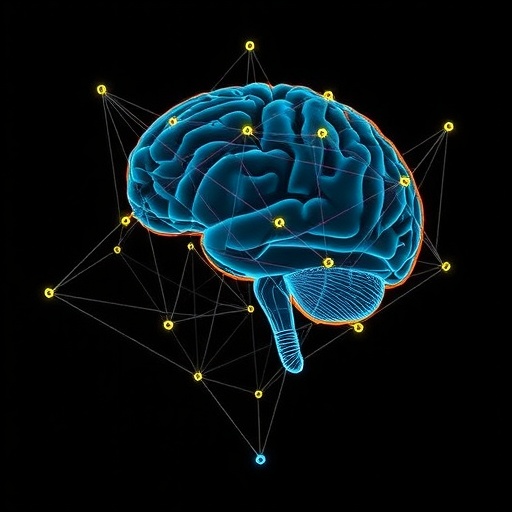
In an unprecedented advance for the field of neuroimaging, researchers have unveiled a breakthrough methodology that promises to revolutionize non-invasive mapping of whole-brain dynamics. Traditional electroencephalography (EEG) and magnetoencephalography (MEG) techniques have long grappled with the challenge of accurately reconstructing spatiotemporal brain activity due to the inherently ill-posed inverse problem. This is compounded by the limitations in existing source imaging approaches, which often rely on simplistic or biologically implausible priors that fail to fully capture the complex geometry of individual brains. The novel framework introduced by Wang et al. in Nature Biomedical Engineering harnesses patient-specific geometric basis functions derived from unique cortical surface eigenmodes, thereby embedding anatomy directly into the source reconstruction process with striking precision.
This geometry-aware framework represents a fundamental departure from existing models by integrating each individual’s cortical architecture into the core of the inverse problem solution. Using eigenmodes—mathematical constructs that characterize the cortical surface geometry—allows the researchers to encode neural activity as combinations of geometric patterns. This approach markedly enhances the anatomical fidelity of reconstructed brain dynamics and yields a compact yet highly descriptive representation of underlying neural sources. The capacity to link physical structure and electrophysiological signals opens a new chapter in accurately deciphering the spatiotemporal complexity of whole-brain activity non-invasively.
The cornerstone of this methodology lies in the concept of geometric basis functions (GBFs), a mathematically robust way of capturing individual cortical surfaces. Unlike conventional priors that often impose generalized or oversimplified assumptions, GBFs tailor the source space to the unique geometry of each patient’s cortex. The cortical eigenmodes derive their underlying principles from spectral decompositions of the cortical mesh, resulting in natural, spatially distributed basis functions that align with intrinsic cortical folding and connectivity patterns. This assures that source reconstructions are not merely computational predictions but are anchored deeply in neuroanatomical reality.
To validate their framework, Wang and colleagues employed a rigorous series of benchmarks spanning multiple experimental paradigms and clinical scenarios. They first tested GBF-based reconstruction on meta-source benchmarks designed to simulate realistic neural source distributions. The results revealed superior localization accuracy compared to state-of-the-art source imaging techniques, which frequently suffer from spatial distortions or ambiguous source profiles. These promising findings established a strong foundation for application to real-world neurophysiology.
The researchers then extended their validation to task-evoked brain activity, tapping into well-studied cognitive paradigms. GBF demonstrated remarkable consistency and anatomical precision in reconstructing the dynamic signatures arising from stimulus-driven cortical responses. This is especially noteworthy because task-evoked potentials and oscillations are crucial for understanding normal brain function and cognitive processes, yet have remained challenging to localize with high confidence non-invasively.
Resting-state networks, a cornerstone of contemporary functional neuroimaging research, were also reconstructed with unprecedented spatiotemporal detail. The framework revealed that resting-state dynamics could be effectively captured by a relatively limited number of geometric modes, suggesting that spontaneous brain activity intrinsically reflects the structural constraints imposed by individual cortical geometry. This finding has profound implications for both basic neuroscience and clinical applications involving altered brain states such as neuropsychiatric disorders.
Further demonstrating the clinical utility of their approach, the authors applied the GBF framework to data from intracranial stimulation and epilepsy patients. In these contexts, accurate source localization is not only a research imperative but a critical clinical necessity. By embedding patient-specific cortical geometry, the framework improved localization precision, potentially informing surgical planning, and highlighting its potential to transform diagnostic and treatment strategies for neurological disease.
One of the most remarkable aspects of this framework is its ability to reconcile fast electrophysiological dynamics with anatomically plausible pathways. Neural activity unfolds across complex spatial and temporal scales, yet existing models often fail to link these scales coherently. The GBF method affords a resolution of this mismatch by providing a compact, eigenmode-based representation that respects both temporal dynamics and individual cortical anatomy. This synthesis of spatially distributed eigenmodes with time-varying activity offers an insightful window into brain function.
The implications for scientific inquiry are profound. By formulating neural source activity as linear combinations of geometric basis functions, the framework proffers a principled means to decompose complex brain dynamics into interpretable spatial components. This could redefine how we analyze electrophysiological data, facilitating new hypotheses and discoveries about brain organization, connectivity, and functional specialization without the confounds imposed by less biologically grounded priors.
Clinically, the ability to non-invasively reconstruct whole-brain dynamics with high spatial and temporal fidelity opens new horizons for diagnosis, monitoring, and intervention across a spectrum of neurological and psychiatric conditions. The framework’s precision in source localization could enable tailored therapies, more accurate mapping of epileptogenic zones, and enhanced brain-computer interface applications by refining neural signal interpretation at an individual level.
Moreover, the methodological novelty sets a new standard for integrating multimodal data. Although this study focuses primarily on EEG and MEG, the geometric basis function approach potentially synergizes with anatomical imaging modalities such as MRI, further enriching source reconstructions by coupling electrophysiological data with detailed structural information. This alliance of modalities holds promise for a holistic characterization of brain dynamics.
The introduction of GBF also addresses a fundamental bottleneck in current neuroimaging: data dimensionality and interpretability. Large-scale brain dynamics are notoriously difficult to summarize meaningfully due to the immense volume of multivariate signals recorded. Eigenmode-based decompositions reduce this complexity by capturing essential geometric-organizational features, enabling more efficient data analysis pipelines and potentially real-time monitoring of brain states.
Importantly, the framework aligns with contemporary trends in computational neuroscience emphasizing biologically grounded modeling and personalized medicine. By moving beyond generic priors and embracing individual cortical complexity, GBF reflects a paradigm shift towards precision neuroengineering that respects human neuroanatomical variability.
Future research directions suggested by this work are wide-ranging. Extensions could involve expanding GBF to subcortical structures, exploring developmental and aging-related changes in cortical eigenmodes, and integrating the framework with neuromodulation techniques to precisely target functionally and structurally relevant neural circuits.
In conclusion, the geometry-aware framework presented by Wang and colleagues represents a pivotal advance in the field of non-invasive electrophysiology. By embedding patient-specific cortical geometry through eigenmode decomposition into source reconstruction, this work transcends the limitations of conventional EEG/MEG imaging methods. The approach provides a robust, anatomically faithful, and computationally efficient pathway to mapping whole-brain dynamics with unrivaled fidelity. Its broad validation on synthetic, task, resting-state, and clinical data underscores its versatility, making it a powerful tool poised to reshape both neuroscience research and clinical practice.
Subject of Research: Non-invasive electrophysiology; EEG/MEG source imaging; brain dynamics reconstruction; cortical geometry.
Article Title: A geometry aware framework enhances noninvasive mapping of whole human brain dynamics.
Article References:
Wang, S., Lou, K., Wei, C. et al. A geometry aware framework enhances noninvasive mapping of whole human brain dynamics. Nat. Biomed. Eng (2026). https://doi.org/10.1038/s41551-026-01664-0
Image Credits: AI Generated
DOI: https://doi.org/10.1038/s41551-026-01664-0
Tags: advanced brain signal processinganatomical fidelity in neuroimagingcortical surface eigenmodesEEG source localizationgeometry-aware brain mappingMEG source imagingneural source reconstruction techniquesneuroimaging inverse problemnon-invasive brain activity mappingpatient-specific brain geometryspatiotemporal brain activity analysiswhole-brain dynamics reconstruction