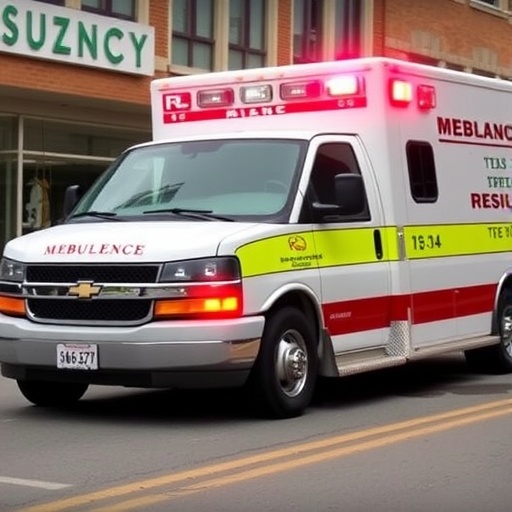
A groundbreaking study from the University of Cincinnati College of Medicine is reshaping how emergency medical services (EMS) collaborate nationwide to investigate the elusive triggers of sudden cardiac arrest (SCA). By bridging the gap between prehospital emergency care and clinical research, this initiative pioneers a novel approach to unraveling the intricate causes underlying one of the most urgent medical crises encountered by EMS providers.
Titled “Cincinnati Biorepository to Enhance the Acute Resuscitation of Cardiac Arrest Patients (Cincy BEARCATS): A Feasibility and Pilot Study,” the research has been published in the esteemed journal Prehospital Emergency Care, which serves as the official publication for the National Association of EMS Physicians. The study represents an innovative pilot project that incorporates real-world emergency settings into the realm of biomedical research, an area traditionally challenged by the chaotic nature of cardiac arrest scenarios.
Sudden cardiac arrest manifests as an unexpected collapse outside of hospital facilities, often occurring without warning and leaving minimal time for effective intervention. Dr. Justin Benoit, the study’s lead author and an associate professor of clinical emergency medicine, emphasizes the critical timeframe involved: “We only have about 30 minutes to attempt to revive the patient, often before any hospital-level care can even begin.” This compressed window underscores the imperative for on-site treatment advancements.
Conventional clinical research methods fall short in such urgent prehospital contexts due to logistical and ethical constraints. Recognizing this gap, Dr. Benoit and his colleagues forged a partnership with the Cincinnati Fire Department (CFD) in 2022, adopting a paradigm where paramedics become frontline researchers. The team developed specialized kits enabling paramedics to collect blood samples from SCA patients during resuscitation efforts. These samples are then transported swiftly to the University of Cincinnati Medical Center, where they are preserved in a biorepository for subsequent molecular and biochemical analysis.
The pilot enrolled eighteen patients and successfully demonstrated the operational feasibility of integrating biosample collection into emergency response workflows. Crucially, the initial data revealed no standardized pathological fingerprint across patients, illustrating the heterogeneity of sudden cardiac arrest as a clinical entity. This heterogeneity highlights the need for larger-scale studies to elucidate the distinct physiological and molecular pathways implicated in different SCA cases.
Dr. Benoit elucidates the implications of these varied samples: “This study confirms that cardiac arrest is not a monolithic disease but rather a syndrome with multiple potential etiologies. It affects a broad spectrum of patients, not only the elderly or clinically frail. Our mission is to decode the different biological signatures to tailor treatment accordingly.”
Building on the pilot’s success, the research team is now seeking federal grant funding to expand the project nationally, targeting EMS systems in cities such as Seattle, Detroit, Minneapolis, and Irving, Texas. The ambitious goal is to amass biospecimens from up to 700 patients, enabling statistically robust analyses and biomarker discovery that could revolutionize acute cardiac arrest management.
The long-range vision is to engineer a rapid, point-of-care diagnostic platform deployable by EMS personnel in the field. By analyzing a small blood sample, this technology would identify the specific subtype of cardiac arrest at hand instantaneously, guiding paramedics toward the most effective, personalized resuscitation protocols. “Our aspiration is pragmatic,” says Dr. Benoit. “Within two decades, EMS teams will utilize a handheld device to swiftly classify cardiac arrest type and optimize treatment, transforming survival rates and neurological outcomes.”
Despite these research ambitions, bystander intervention remains an indispensable determinant of survival. Layperson cardiopulmonary resuscitation (CPR) and use of automated external defibrillators (AEDs) sustain critical blood flow and electrical cardiac activity until EMS responders can initiate advanced cardiovascular life support measures. Dr. Benoit poignantly notes, “When you perform CPR, you literally become that patient’s beating heart, buying precious time for definitive interventions.”
Current treatments are stratified by cardiac rhythm type. Shockable arrhythmias such as ventricular fibrillation and pulseless ventricular tachycardia, which compromise effective circulation, respond well to prompt defibrillation combined with high-quality CPR, yielding about a 29% survival rate nationally. Unfortunately, these rhythms constitute only a minority of SCA cases, accounting for 17-18% of incidents in the U.S. and Cincinnati.
Non-shockable rhythms, including asystole and pulseless electrical activity, present a particularly daunting challenge. While the heart may display electrical impulses, it fails to generate sufficient mechanical contractions to sustain circulation. Treatment relies primarily on continuous CPR and intravenous epinephrine administration to attempt cardiac stimulation. Unfortunately, survival rates remain dismally low for these arrhythmias, underscoring the urgent necessity for refined diagnostic and therapeutic tools.
Return of spontaneous circulation, defined as the restoration of autonomous cardiac activity, serves as a key resuscitative milestone signaling transient recovery. However, patients frequently remain physiologically unstable, underscoring the necessity for ongoing research to optimize post-resuscitation care and long-term neurological outcomes.
Sudden cardiac arrest remains a pervasive public health crisis: in Ohio alone, approximately thirty cases occur daily, summing to roughly 300,000 incidents annually across the United States. The condition’s lethality is reflected by its modest 10% survival rate, despite advances in emergency response systems. The devastating human toll is compounded by an estimated $11.3 billion in lost economic productivity annually, highlighting the necessity for systemic improvements in cardiac arrest prevention, detection, and treatment.
The University of Cincinnati’s pioneering biorepository initiative exemplifies how integrating biomedical research with operational EMS protocols can unlock new frontiers in emergency medicine. By characterizing the molecular heterogeneity of sudden cardiac arrest, researchers aspire to transcend generalized resuscitation algorithms, laying the foundation for precision medicine approaches tailored to individual physiological profiles. As this visionary project scales nationwide, it promises to revolutionize cardiac arrest management, transforming what has long been a fatal event into a survivable, treatable emergency with personalized interventions.
Subject of Research: People
Article Title: Cincinnati Biorepository to Enhance the Acute Resuscitation of Cardiac Arrest Patients (Cincy BEARCATS): A Feasibility and Pilot Study
News Publication Date: 23-Mar-2026
Web References: https://www.tandfonline.com/doi/full/10.1080/10903127.2026.2631182
Keywords: Emergency medicine, Sudden cardiac arrest, Cardiovascular disorders, Cardiac arrhythmias, Ventricular fibrillation, Emergency medical services, Prehospital care, Resuscitation, Biorepository, Precision medicine, Point-of-care diagnostics, CPR
Tags: acute resuscitation biorepositorycardiac arrest emergency responseCincy BEARCATS pilot studyemergency medical services collaborationemergency medicine innovationEMS clinical research integrationEMS provider medical crisesNational Association of EMS Physicians publicationprehospital emergency care studyreal-world emergency biomedical researchsudden cardiac arrest triggersUniversity of Cincinnati cardiac arrest research