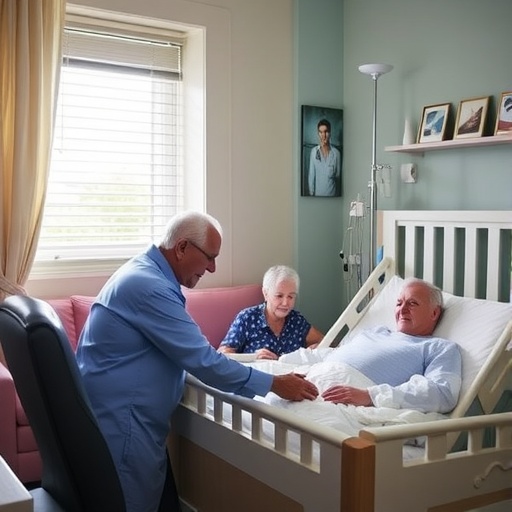
In the ever-evolving landscape of oncology care, a remarkable study has emerged, pushing the boundaries of palliative treatment for patients suffering from advanced gastrointestinal cancers. The ALLAN trial, recently published in the British Journal of Cancer, offers groundbreaking insights into how early, home-based palliative care can dramatically reduce the frequency of emergency visits and hospitalizations in this vulnerable patient population. This study not only challenges traditional paradigms but also sets a new precedent for integrating palliative interventions in the home setting from the earliest stages of diagnosis.
Gastrointestinal cancers represent a category of malignancies with notoriously poor prognoses and complex symptom burdens that intensify as the disease progresses. Patients often experience severe pain, nutritional challenges, and psychological distress that severely impact quality of life. Historically, these patients have faced repeated emergency department visits and hospital admissions, reflecting inadequacies in symptom management and continuity of care. The ALLAN trial confronts this issue head-on by testing an innovative model designed to keep patients comfortably at home while maintaining rigorous clinical oversight.
The trial enrolled a substantial cohort of patients diagnosed with advanced gastrointestinal cancers, randomizing them into two groups: standard oncological care versus early integration of home-based palliative services. These services included symptom monitoring, psychosocial support, medication management, and proactive crisis intervention facilitated by trained palliative care professionals visiting patients in their homes. This approach diverged considerably from standard protocols that often initiate palliative care only in late disease stages or following multiple clinical crises.
Meticulous data collection over the course of the trial allowed researchers to track emergency care visits and hospital stays, presenting a quantifiable measure of the intervention’s efficacy. The results were striking: patients receiving early home-based palliative care demonstrated significantly fewer emergency department consultations and hospital admissions. This statistically significant reduction underscores the potential of proactive symptom control and continuous support in mitigating crises that typically precipitate hospital visits.
From a mechanistic standpoint, the ALLAN trial emphasizes the pivotal role of closely monitored symptom management. Common distressing symptoms—such as intractable pain, nausea, and fatigue—were attended to with higher frequency and greater expertise at home, preventing escalation. The ability to adapt therapeutic regimens in real-time, tailored to evolving patient needs, is one of the core strengths of this early intervention model. Moreover, the enhanced psychosocial support helped alleviate anxiety and depression, integral components contributing to emergency healthcare utilization.
One of the most compelling aspects of the ALLAN trial lies in its demonstration that early palliative care does not compromise oncological treatments or patient survival. Instead, it complements life-prolonging interventions by maintaining functional status and well-being, thereby improving patients’ ability to tolerate cancer therapies. This synergy challenges outdated notions that palliative care is synonymous with end-of-life withdrawal and reinforces its identity as an essential component of comprehensive cancer treatment.
Economically, the implications of the ALLAN trial are profound. Hospitalizations and emergency visits represent some of the highest expenditures in cancer care. Reducing these not only alleviates financial burdens on healthcare systems but also diminishes indirect costs such as patient and caregiver distress, loss of productivity, and additional transportation needs. The trial suggests that reallocating resources toward early home-based palliative care may be a cost-effective strategy with wide-reaching health economic benefits.
The findings also bear significant implications for healthcare policy and the structuring of oncology and palliative care services. Integrating palliative care into standard treatment pathways from the point of diagnosis requires systemic changes, including appropriate training of healthcare providers, development of home care infrastructure, and novel reimbursement models to incentivize this care paradigm shift.
Technological advancements further facilitated the implementation of the ALLAN trial protocol. Remote monitoring tools, telehealth consultations, and electronic symptom tracking enabled continuous patient surveillance without overburdening clinical staff. These digital health innovations played a crucial role in enhancing care coordination and rapid response to changing patient conditions, demonstrating how modern healthcare technologies can synergize with traditional care models.
From an ethical perspective, the trial foregrounds the importance of honoring patient autonomy and preferences. Many patients expressed a strong desire to remain in the comfort of their homes as illness advanced, a preference often ignored due to fears of symptom mismanagement. The success of early home-based palliative care validates these preferences and promotes patient-centered approaches, fostering dignity and quality of life.
The ALLAN trial’s research design, a randomized controlled trial with robust methodology, enhances the credibility and generalizability of its findings. Multidisciplinary collaboration among oncologists, palliative care specialists, nurses, social workers, and technological experts was crucial to the trial’s success, illustrating the multifaceted nature of optimal cancer care.
Looking forward, the implications for future research are expansive. The ALLAN trial opens pathways for studies investigating specific symptom management techniques, patient subgroups who may benefit the most, and integration of artificial intelligence for predictive analytics in home care. Moreover, exploring cross-cultural adaptations and the feasibility in various healthcare contexts will help tailor and maximize the impact of early palliative interventions globally.
In conclusion, the ALLAN trial marks a transformative step in oncology care philosophy. By demonstrating that early initiation of home-based palliative care significantly reduces emergency healthcare utilization in patients with advanced gastrointestinal cancers, it offers a compelling blueprint for reshaping how care is delivered to those facing life-limiting disease. This paradigm not only promises enhanced quality of life but also poses a meaningful solution to the mounting pressures on healthcare systems worldwide.
As the medical community continues to grapple with the complexities of cancer care, the ALLAN trial provides a beacon illustrating the power of anticipatory, patient-centered care models. It underscores that timely, compassionate interventions at home can profoundly alter disease trajectories and patient experiences, turning what was once a reactive process into a proactive, holistic endeavor.
For patients, families, clinicians, and policymakers alike, this landmark investigation heralds a future where care transcends settings and is defined by responsiveness, humanity, and scientific rigor. The integration of early home-based palliative care is no longer a concept of the future but a validated, evidence-backed strategy ready to revolutionize cancer care today.
Subject of Research: Early home-based palliative care in advanced gastrointestinal cancer patients
Article Title: The ALLAN trial: impact of early home-based palliative care on emergency care and hospitalisation in advanced gastrointestinal cancer patients
Article References:
Bojesson, A., Brun, E., Eberhard, J. et al. The ALLAN trial: impact of early home-based palliative care on emergency care and hospitalisation in advanced gastrointestinal cancer patients. Br J Cancer (2026). https://doi.org/10.1038/s41416-026-03444-8
Image Credits: AI Generated
DOI: 10.1038/s41416-026-03444-8
Tags: advanced gastrointestinal cancer symptom managementALLAN trial oncology studyearly home palliative care for gastrointestinal cancerhome-based palliative care benefitshospital stay reduction through palliative careimproving quality of life in advanced cancerinnovative cancer care delivery systemsintegrating palliative care early in cancer treatmentoncology home care modelspsychological support in cancer palliative carereducing emergency room visits in cancer patientssymptom monitoring in home palliative care