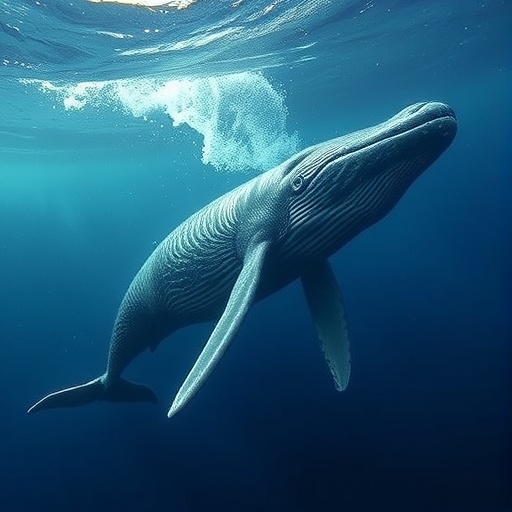
In the vast, enigmatic expanse of the world’s oceans, detecting the haunting melodies of blue whales has long been a daunting challenge for marine biologists and ecologists alike. The elusive nature of these leviathans, combined with the immense scale of the oceanic environment, makes the task akin to finding a needle in a haystack. Recently, scientists from UNSW Sydney have pioneered a groundbreaking approach that redefines how we search for and understand blue whale soundscapes. This transformative research leverages a deep learning model trained on merely a single blue whale call to unlock decades of acoustic data, spanning across ocean basins and years, with unprecedented accuracy.
At the heart of this innovation lies the power of neural networks, a sophisticated subset of artificial intelligence inspired by the brain’s own network of neurons. These deep learning frameworks excel at parsing complex patterns in data, enabling machines to recognize intricate signals such as whale songs. Conventionally, training such models demands enormous datasets comprising thousands of labeled examples; a requirement that is impractical for rare marine species like the blue whale. The UNSW team’s work shatters this limitation by demonstrating that an intelligently augmented single recording can serve as an effective training corpus, catalyzing a paradigm shift in ecological acoustic monitoring.
The significance of this advancement cannot be overstated for the field of marine ecology, where the consistent monitoring of species over extended periods is critical for assessing environmental changes and conservation status. Historically, audio archives amassed from passive acoustic monitoring—using hydrophones deployed underwater—have been a goldmine of information but remained largely untapped due to the monumental manual labor required to isolate individual animal calls. Traditional analysis methods rely heavily on painstakingly hand-labeled datasets which are both time-consuming and costly, hence underutilizing vast troves of data collected over decades.
The model developed by lead researcher Ben Jancovich is notable for its ingenious use of data augmentation techniques to synthetically expand a solitary blue whale vocalization into a diverse training set. By manipulating the original call through pitch shifting, stretching in time, and embedding realistic ambient ocean noises, the researchers mimic the natural variability found in whale songs and their acoustic propagation through different marine environments. This augmentation not only ameliorates the sparsity of training data but also equips the model to robustly identify whale calls within noisy, real-world recordings.
Evaluation of the detector’s performance against actual datasets has yielded results that rival those achieved with models trained on thousands of exemplars. For instance, when tested on calls from a pygmy blue whale population, the model demonstrated an astonishing 99.4% detection accuracy. This success underscores the algorithm’s skill in generalizing from limited input, capitalizing on the highly stereotyped nature of blue whale calls. Unlike animals with widely variable vocalizations—such as dolphins with individual-specific whistles—the uniformity in blue whale songs provides a fertile foundation for this minimalist yet potent training strategy.
Blue whales, the largest creatures to ever inhabit our planet, pose unique research challenges. Their wide dispersion, endangered status, and the vastness of their underwater habitats contribute to an elusive profile difficult to capture through conventional tracking methods. Their calls, however, are distinguished by consistent structure within regional populations, an attribute that the UNSW team harnessed ingeniously. The methodological adaptation exploits these predictable vocal patterns, enabling reliable detection despite the scarcity of labeled data, and opening new avenues for studying species with similarly standardized acoustic behaviors.
Beyond the biological implications, this research makes a crucial stride toward sustainable AI applications in ecology. Deep learning models are notorious for their heavy computational demands and associated energy consumption. Recognizing these constraints, Jancovich’s team crafted a smaller, more efficient neural network fine-tuned from a model originally trained in human speech recognition. This design enables the entire training process to be completed on a standard laptop within hours, vastly democratizing access to powerful AI tools for researchers who might otherwise be hindered by limited computational resources.
The practical benefits of this technology are enormous, offering marine scientists a robust, accessible toolkit to preserve and expand knowledge about whale populations worldwide. The ability to efficiently scan through decades of marine acoustic recordings holds the promise of uncovering long-term trends in blue whale song characteristics, enabling scientists to infer shifts in population dynamics, migration patterns, and even the effects of climate change on marine ecosystems. Such insights are invaluable for formulating informed conservation strategies in an era where oceanic environments are increasingly pressured.
Moreover, the implications extend beyond blue whales to other species within the ecological spectrum. Acoustic signals are a vital communication mode for myriad animals, from forest birds to nocturnal insects. The approach demonstrated here—training accurate detectors from minimal starting data—could revolutionize biodiversity monitoring in diverse habitats where field recordings accumulate but remain underexplored due to the lack of efficient analytical tools. Ecologists are now empowered to harness machine learning for species that have evaded detailed study due to logistical or technical constraints.
This research dovetails intriguingly with the study of animal culture, where vocalizations serve not just as communication signals but also as vehicles for learning and social transmission across generations. Understanding whale song variations over time could reveal patterns of cultural inheritance and adaptation, illuminating the cognitive and social complexities of these majestic creatures. Integrating AI in this context facilitates systematic, large-scale analysis of acoustic data that would be otherwise infeasible, thereby enriching behavioral and ecological scholarship.
In sum, the UNSW Sydney team’s work stands at the confluence of artificial intelligence, marine biology, and conservation science, offering a beacon of hope for extracting meaningful, high-fidelity insights from the acoustic shadows beneath the waves. Through innovative use of neural networks, they have transformed a single recording into a gateway for decades-spanning discovery—proving that sometimes, less is more when it comes to technological ingenuity in scientific research.
Subject of Research: Blue whale acoustic detection using neural networks and data augmentation
Article Title: Accurately detecting blue whale calls from single-case training using deep learning
Web References:
– https://www.nature.com/articles/s41598-026-48308-6
– http://dx.doi.org/10.1038/s41598-026-48308-6
References:
Jancovich, B., et al. (2024). Deep learning model trained on single blue whale call detects calls across decades and ocean basins. Scientific Reports, DOI: 10.1038/s41598-026-48308-6.
Keywords
Ecology, Deep Learning, Blue Whales, Acoustic Monitoring, Neural Networks, Marine Mammals, Passive Acoustic Monitoring, Environmental Conservation, Data Augmentation, Machine Learning, Animal Behavior, Species Detection
Tags: artificial intelligence in oceanographyblue whale song analysisdeep learning in marine biologymachine learning for endangered speciesmarine ecology data miningneural networks for wildlife detectionocean acoustic dataocean basin acoustic datasetsrare species sound recognitionsingle-call training modelunderwater bioacoustics researchwhale population monitoring techniques