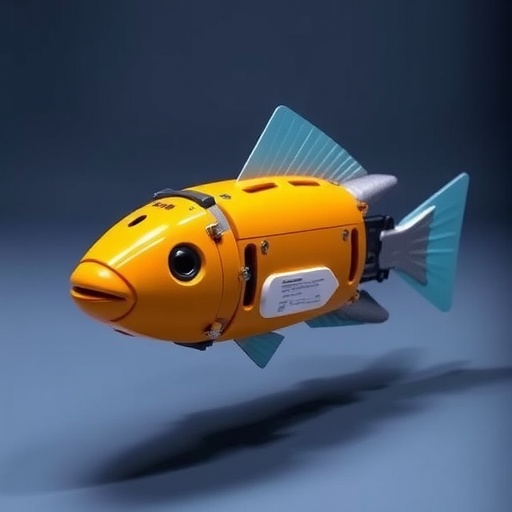
In the quest to revolutionize aquaculture with cutting-edge technology, researchers at the Centre for Research in Robotics and Underwater Technologies (CIRTESU) at Universitat Jaume I in Castelló have taken a bold step forward by creating UJIFISH-I, a modular and bio-inspired robotic fish designed specifically for inspection, hybrid teleoperation, and sensor deployment within fish farming environments. This pioneering effort showcases a unique approach that eliminates common stress-inducing factors such as high-intensity lights and noisy propellers, thereby significantly reducing the disturbance to aquatic life while maintaining top-tier functionality and adaptability.
UJIFISH-I integrates biomimicry into its propulsion system, employing bio-inspired undulatory movement patterns that mimic the natural swimming of fish. This approach minimizes mechanical noise and hydraulic turbulence—two key contributors to environmental disturbance and stress on fish. Unlike conventional underwater robots that rely on propellers, UJIFISH’s propulsion generates smooth, wave-like motion, enabling it to glide more seamlessly through water and blend into the aquatic ecosystem unobtrusively.
The robotics platform is not only a marvel of fluid mechanics and biomimetic engineering but also a testament to intelligent modularity. The system’s designed modular architecture supports a wide range of sensor integrations geared toward real-time environmental monitoring. Capable of both cable and acoustic communication, UJIFISH employs hybrid teleoperation techniques that allow operators to steer it and collect data efficiently even across considerable distances—up to 150 meters vertically and 500 meters horizontally—while diving down to depths of 20 meters.
Equipped with an advanced panoramic vision system, UJIFISH offers a 180-degree field of view, enabling comprehensive net inspections and habitat surveillance around fish farms. This capability is vital for maintaining the structural integrity of aquaculture pens and detecting threats like breaches or environmental anomalies promptly. The robotic fish’s streamlined form and movement have been specifically scaled to mirror adult fish, enhancing hydrodynamics and decreasing the acoustic footprint that normally frightens farmed fish, resulting in minimal behavioral disruption.
The sensor suite aboard UJIFISH-I includes continuous monitoring of fundamental water quality parameters such as temperature and depth. Importantly, its flexible framework allows integration of additional sensors to measure critical environmental variables like salinity, pH levels, dissolved oxygen concentrations, and the presence of gases. This comprehensive environmental sensing toolkit supports precise ecosystem monitoring and management, empowering fish farmers and environmentalists with data-driven insights for health and productivity optimization.
Another core innovation is UJIFISH’s deployment system, which enables the transport and targeted release of auxiliary components—such as sensor nodes or sampling devices—directly into specific locations within the aquaculture environment. This feature is invaluable for customized monitoring and performing localized interventions without manual handling, reducing human exposure to underwater hazards and labor costs.
Extensive experimental studies conducted within CIRTESU’s water tank facilities and Port Castelló’s real-world environment have validated UJIFISH’s performance. Tests confirmed its exceptional maneuverability and reliable detection accuracy in diverse tasks including net inspection, teleoperation, data collection, and deploying sensors. These promising results validate the potential of UJIFISH to meet the dynamic and species-specific challenges faced by modern aquaculture.
The research team underscores the importance of flexibility in robotic platforms like UJIFISH-I for aquaculture, highlighting that monitoring and operational requirements differ greatly according to fish species, infrastructure complexity, and environmental conditions. UJIFISH’s modularity and hybrid communication systems offer an adaptable platform, capable of evolving alongside technological advances and shifting industry needs.
UJIFISH-I marks a significant stride toward environmentally responsible aquaculture by enabling precision monitoring and intervention without unduly stressing aquatic life or exposing humans to hazardous underwater conditions. The reduction in human intervention and the sophistication of robotic operations create safer, more sustainable working environments while promoting optimal fish welfare.
Looking ahead, researchers are focused on elevating UJIFISH-I’s autonomy and endurance, aiming to extend operational periods without human control. Enhancements in sensing capabilities are on the horizon, particularly through the integration of next-generation advanced sensors providing richer data complexity and resolution. A notable future development is the addition of an artificial swim bladder system to actively control buoyancy, a game changer expected to significantly increase the robot’s depth capabilities and energy efficiency, optimizing underwater navigation and inspection tasks.
This innovative robotic solution forms part of the ThinkInAzul initiative, a project collaboratively supported by the Spanish Ministry of Science and Innovation, the European Union’s NextGenerationEU fund, and Generalitat Valenciana. This multi-institutional backing fosters an environment conducive to sustainable aquaculture innovations that promise to redefine underwater robotics applications.
By coupling state-of-the-art robotics, biomimetic engineering, and environmental stewardship, UJIFISH-I exemplifies how technology can harmonize with nature’s rhythms to protect aquatic life and ensure food security. Its development is an inspiring testament to human ingenuity, striving to enhance the interface between artificial machinery and living ecosystems with minimal ecological footprint.
As aquaculture continues to gain prominence globally as a sustainable protein source, innovations like UJIFISH-I serve as pivotal enablers for smarter, safer, and more responsible management of underwater farming environments. This robot not only bridges the gap between monitoring and action but also showcases a promising blueprint for future aquatic robotic platforms designed to coexist with their watery surroundings.
Subject of Research: Animals
Article Title: UJIFISH-I: A modular and bioinspired robotic fish for inspection, hybrid teleoperation and sensor deployment in aquaculture
News Publication Date: 1-May-2026
Web References: DOI: 10.1016/j.oceaneng.2026.124917
References: Andrea Pino, Alejandro Solís, Max Puig, Sergio Balaguer, Rosario Vidal, Pedro J. Sanz, Raúl Marín. UJIFISH-I: A modular and bioinspired robotic fish for inspection, hybrid teleoperation and sensor deployment in aquaculture, Ocean Engineering, Volume 354, Part 2, 2026, 124917
Image Credits: CIRTESU Universitat Jaume I of Castellón
Keywords: Robotic fish, biomimetic propulsion, aquaculture inspection, underwater robotics, modular sensor systems, teleoperation, environmental monitoring, bio-inspired design, hybrid communication, precision aquaculture, artificial swim bladder, underwater automation
Tags: aquatic ecosystem monitoring robotsbio-inspired robotic fish designbiomimetic underwater propulsion systemfluid mechanics in robotic fishhybrid teleoperation in aquacultureintelligent modular robotics for aquaculturemodular robotic fish for aquaculturenoise-free aquatic roboticsstress reduction in fish farmingsustainable fish farming technologyunderwater acoustic communication in roboticsunderwater sensor deployment technology