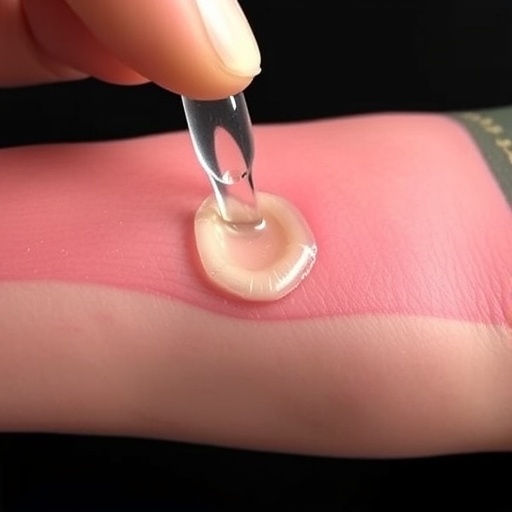
In a groundbreaking advancement destined to revolutionize emergency medicine and surgical procedures, researchers have engineered a quinone-mediated, tissue-adaptive double-network hydrogel capable of achieving near-instant hemostasis and robust wet-tissue adhesion. This novel biomaterial, recently reported in Nature Communications, offers a promising solution to the longstanding challenges in controlling bleeding and securing wound closure in dynamic biological environments where traditional methods often fall short.
The innovation hinges on the integration of quinone chemistry into a double-network hydrogel framework, conferring it with exceptional adhesive properties and rapid solidification upon contact with tissue. Hemostasis—the process of stopping bleeding—remains a critical hurdle in trauma care and surgical interventions, especially when dealing with complex wounds exposed to blood and moisture. Conventional hemostatic agents either lack sufficient adhesion in wet conditions or do not solidify rapidly enough to prevent blood loss. The hydrogel developed by Kim, Son, Moon, and colleagues elegantly addresses these limitations by combining chemical and mechanical sophistication.
At the core of this biocompatible hydrogel is a double-network structure that features interpenetrating polymer chains. Double-network hydrogels are renowned for their enhanced mechanical strength and elasticity, but their application in medical adhesives has been limited. By incorporating quinone groups into the polymer matrix, the team has unlocked tissue-adaptive functionality, enabling the hydrogel to form covalent bonds with amino groups present on tissue surfaces. Quinones, known for their role in natural biological adhesion processes such as those used by mussels, facilitate fast and stable crosslinking, which is essential in the chaotic environment of a bleeding wound.
When applied to an open wound, the hydrogel instantly interlaces with the moist tissue, creating an adhesive barrier that halts bleeding almost immediately. This fast response time arises from the rapid quinone-mediated crosslinking reaction, which proceeds efficiently even in the presence of blood and body fluids. The design cleverly exploits the tissue environment by adapting its network structure dynamically, enabling the hydrogel to conform securely to irregular surfaces and maintain its adhesive integrity over extended periods.
Biocompatibility tests performed in vitro and in vivo demonstrate that the hydrogel does not elicit significant inflammatory responses, a critical consideration for any material intended for intimate contact with living tissues. Furthermore, the mechanical resilience of the hydrogel allows it to withstand repetitive movements and mechanical stresses that injured tissues typically experience, addressing a significant drawback of many existing adhesives that lose function under strain or moisture.
The research team also underscores the scalable synthesis of this hydrogel, suggesting its potential for widespread clinical application. By leveraging accessible polymer precursors and straightforward preparation techniques, the hydrogel is poised for cost-effective manufacturing. This accessibility could rapidly translate to hospital settings and emergency care units, particularly in low-resource environments where access to sophisticated wound care materials is limited.
Moreover, the hydrogel’s versatility extends beyond hemostasis. Its powerful adhesive properties and biocompatibility position it as a candidate for applications in surgical sealants, implant coatings, and drug delivery matrices. This multifunctionality could redefine approaches to wound healing by providing clinicians with a single material capable of both stopping bleeding and supporting tissue regeneration.
Importantly, the authors have demonstrated the hydrogel’s efficacy in a range of animal models, including scenarios mimicking arterial bleeding and organ injury. These preclinical studies reveal rapid bleeding control within seconds of application, surpassing the performance of current commercial hemostatic agents. Such impressive outcomes herald a new era where battlefield medics, surgeons, and first responders can rely on instantaneously effective materials in critical bleeding scenarios.
An intriguing aspect of this research lies in its bioinspired design philosophy. Drawing inspiration from natural adhesives found in marine organisms, the quinone chemistry mimics biological strategies evolved over millions of years, repurposing nature’s molecular toolkit to solve modern medical challenges. This biomimetic approach underlines a broader trend in materials science emphasizing synergy between synthetic engineering and biological function.
The paper also delves into the hydrogel’s molecular architecture, revealing insights into how the degree of quinone functionalization and network density impacts adhesive strength and gelation kinetics. By tuning these parameters, the hydrogel’s physical properties can be tailored to specific clinical needs, whether that entails rapid gelation for active bleeding or slower setting times for surgical precision.
In future developments, the team envisions integrating antimicrobial agents and growth factors within the hydrogel matrix. Such enhancements would not only prevent infection—a common and dangerous complication in wounds—but also accelerate tissue repair and remodeling, potentially reducing healing times and improving patient outcomes.
The clinical translation of this technology, while promising, still faces hurdles related to regulatory approval and large-scale manufacturing consistency. The authors acknowledge these challenges and emphasize their commitment to rigorous safety and efficacy testing in forthcoming human clinical trials. Their ongoing collaboration with medical device companies hints at a clear pathway from lab bench to bedside.
Overall, this quinone-mediated, tissue-adaptive double-network hydrogel marks a significant leap forward in biomaterials science, combining advanced polymer chemistry with clinical insight to address the critical need for fast, reliable hemostatic agents. As traumatic injuries and surgical complexity grow worldwide, materials like this will be indispensable tools for healthcare providers striving to improve survival rates and quality of care.
The publication of this work in Nature Communications not only highlights the scientific merit of the innovation but also signals its potential transformative impact across multiple medical disciplines. Given the escalating demand for effective hemostatic solutions in trauma surgery, emergency medicine, and military care, this hydrogel emerges as a viral candidate in the biomaterials landscape.
In summary, this study represents a masterful convergence of chemistry, biology, and engineering, delivering a novel hydrogel that responds dynamically to tissue conditions, adheres swiftly in wet environments, and can be manufactured at scale. As researchers continue to explore its capabilities and fine-tune its properties, the medical community may soon have access to a superior tool for controlling bleeding and enhancing wound healing, saving countless lives worldwide.
Subject of Research: Development of a quinone-mediated, tissue-adaptive double-network hydrogel for instant hemostasis and adhesion to wet biological tissues.
Article Title: Quinone-mediated, tissue-adaptive double-network hydrogel for instant hemostasis and wet-tissue adhesion.
Article References:
Kim, T.Y., Son, K., Moon, CH. et al. Quinone-mediated, tissue-adaptive double-network hydrogel for instant hemostasis and wet-tissue adhesion.
Nat Commun (2026). https://doi.org/10.1038/s41467-026-72068-6
Image Credits: AI Generated
Tags: advanced trauma care hemostatic agentbiocompatible hydrogel for surgerydouble-network hydrogel medical adhesiveemergency medicine bleeding controlhemostasis in dynamic biological environmentsinstant wet tissue adhesionpolymer chemistry in wound healingquinone-based hydrogel for hemostasisrapid blood clotting biomaterialrobust wet tissue adhesive hydrogelsurgical hemostatic innovationtissue-adaptive wound closure