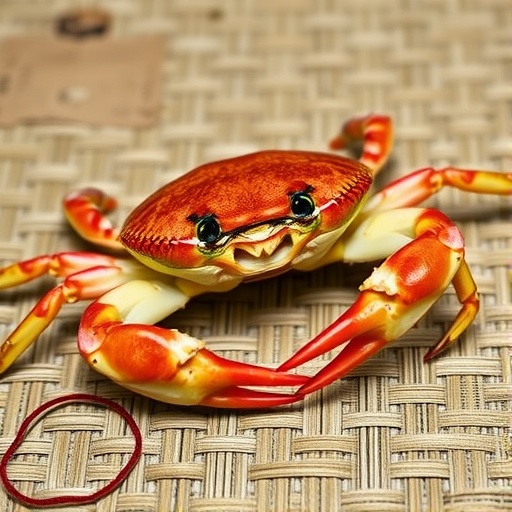
A groundbreaking study published as a Reviewed Preprint in eLife has unveiled new dimensions in our understanding of the evolutionary development of sideways locomotion in crabs, a characteristic movement that defines the “true crabs” or Brachyura, the largest subgroup within the decapod crustaceans. By integrating comprehensive behavioral analyses with a robust phylogenetic framework, researchers have traced the origin of this distinctive sideways gait back approximately 200 million years, illuminating its singular emergence and its pivotal role in the ecological triumph of these marine creatures.
True crabs are renowned for their unique sideways movement, a mode of locomotion that has long fascinated biologists and naturalists. This behavior not only facilitates rapid and agile movement, crucial for evading predators by adding an element of unpredictability to their escape routes, but also correlates with their extraordinary diversification. Comprising nearly 7,904 species, true crabs have colonized a vast array of habitats, ranging from terrestrial and freshwater environments to the uncharted depths of the ocean floor. This diversification is notably contrasted with their close relatives, such as members of the Anomura group, highlighting a key evolutionary innovation linked to locomotor behavior rather than mere morphological transformations.
Yuuki Kawabata, Associate Professor at Nagasaki University and senior corresponding author of the study, emphasizes the evolutionary significance of sideways locomotion. The research team sought to unravel questions that had remained obscured: when did this sideways walk originate within true crabs? Did it evolve multiple times independently, or was there a singular evolutionary leap? Furthermore, they probed the instances in which this behavior may have been lost or reverted, considering that some crab taxa exhibit forward walking instead.
The methodology combined detailed behavioral observations with high-resolution phylogenetic analyses. The research involved filming 50 different species of true crabs in controlled environments that mimicked their natural habitats, capturing footage for extended ten-minute sessions to obtain comprehensive locomotion profiles. Unavoidably, given logistical constraints, each species was represented by one individual specimen; however, the behavioral data were meticulously recorded and categorized, distinguishing between sideways and forward walking species.
Complementing this data, Kawabata’s team incorporated a recently published molecular phylogeny encompassing 344 species across the Brachyura, which employed sequences from 10 genes to reconstruct the evolutionary history with unparalleled resolution. Since every species in the behavioral dataset did not align perfectly with the phylogenetic sampling, the researchers prudently condensed the evolutionary tree to encompass 44 genera, five families, and one superfamily, thereby ensuring that closely related species representative of observed behaviors could stand in for those absent from the genetic dataset.
The analytical outcome was striking. Of the 50 species studied, 35 exhibited the iconic sideways gait, while 15 demonstrated forward locomotion. Phylogenetic reconstruction revealed that sideways walking evolved only once—originating from an ancestor that walked forward at the base of the Eubrachyura clade, which includes the more evolutionarily advanced true crabs. Since this emergence, the sideways locomotion trait has remained remarkably conserved, diverging little through the subsequent diversification of true crab lineages.
This finding stands in stark contrast to the phenomenon of carcinisation—the evolutionary convergence of crab-like forms—which has occurred repeatedly across decapods. While body morphology has been flexible and prone to reorganization through parallel evolutionary pathways, locomotory behavior such as sideways walking appears to be a highly constrained and singular innovation. This suggests that certain behavioral traits may be fundamentally more difficult to evolve due to complex anatomical, neurological, or ecological constraints.
The evolutionary success of Eubrachyura, the lineage characterized by sideways walking, underscores the adaptive importance of this locomotor strategy. Sideways movement likely provides biomechanical advantages, enabling rapid displacement with lateral symmetry, facilitating swift and evasive responses from both the left and right sides. This agility would be especially beneficial in predator-rich environments, offering a selective advantage that has been maintained for over 200 million years.
Despite its advantages, sideways locomotion has proven to be an evolutionary rarity in the animal kingdom. The specialized musculoskeletal and neural adaptations required for such lateral movement may constrain its evolution in other groups. Additionally, behaviors related to burrowing, mating, and foraging could be affected by changes in locomotion directionality, making the transition to sideways gait a complex evolutionary hurdle. The study notes similar sideways movement patterns in crab spiders and leafhopper nymphs, though these occur in vastly different ecological and taxonomic contexts.
Beyond the intrinsic innovation of sideways walking, the researchers highlight external macroevolutionary pressures that likely played a synergistic role in promoting the ecological dominance of true crabs. The inception of this locomotor behavior corresponds closely with the end-Triassic extinction event and the early Jurassic period, a time of significant ecological upheaval and opportunity. The breakup of the supercontinent Pangaea and the expansion of shallow marine habitats, paired with the Mesozoic Marine Revolution, created rich ecological niches ripe for colonization by innovative taxa.
Kawabata emphasizes the necessity for further research to disentangle the complex interplay between intrinsic biological innovations and extrinsic environmental changes. Integrating fossil records with trait-dependent diversification models and biomechanical performance assessments could deepen understanding of how such rare locomotor adaptations influence diversification rates and evolutionary trajectories.
In conclusion, the study presents sideways locomotion in true crabs as a rare yet potent evolutionary innovation that has underpinned one of the most successful adaptive radiations in marine environments. Its singular evolutionary origin contrasts with the pluralistic pathways of morphological convergence, indicating that behavioral evolution can be both a driver and a constraint in the diversification of life forms. By synthesizing behavioral data with genetic and phylogenetic insights, this research enriches our comprehension of the evolutionary dynamics shaping animal locomotion and the profound impacts of seemingly simple behavioral shifts.
This study was conducted by Yuuki Kawabata and co-first authors Junya Taniguchi, Tsubasa Inoue, and Kano Kohara from the Kawabata Laboratory. Collaborators included Jung-Fu Huang (National Kaohsiung University of Science and Technology, Taiwan), Atsushi Hirai (Susami Crustacean Aquarium, Japan), Nobuaki Mizumoto (Auburn University, USA), and Fumio Takeshita (Kitakyushu Museum of Natural History & Human History, Japan). Their interdisciplinary approach bridged taxonomy, ethology, biomechanics, and phylogenetics, epitomizing the multifaceted nature of evolutionary biology today.
Subject of Research: Animals
Article Title: Evolution of sideways locomotion in crabs
News Publication Date: 21-Apr-2026
Web References:
– https://doi.org/10.7554/eLife.110015.1
– https://doi.org/10.1093/sysbio/syad066
References:
– Wolfe, J.M., Ballou, L., Luque, J., Watson-Zink, V.M., Ahyong, S.T., Barido-Sottani, J. et al. 2024. Convergent Adaptation of True Crabs (Decapoda: Brachyura) to a Gradient of Terrestrial Environments. Systematic Biology 73:247–262.
Image Credits: Tsubasa Inoue and Junya Taniguchi (CC BY 4.0)
Keywords: Evolutionary biology, Animal locomotion, Phylogenetic analysis, Crustaceans, Behavioral evolution, Eubrachyura, Carcinisation, Ecological adaptation, Marine biology, Biomechanics, True crabs, Evolutionary innovation
Tags: 200 million years crab evolutionAnomura vs Brachyura differencesBrachyura evolutionary historycrab predator evasion strategiescrab sideways locomotion evolutiondecapod crustacean diversificationecological success of true crabsevolutionary origin of crab gaitmarine animal locomotion adaptationmarine biodiversity and evolutionphylogenetic study of crabstrue crabs behavioral analysis