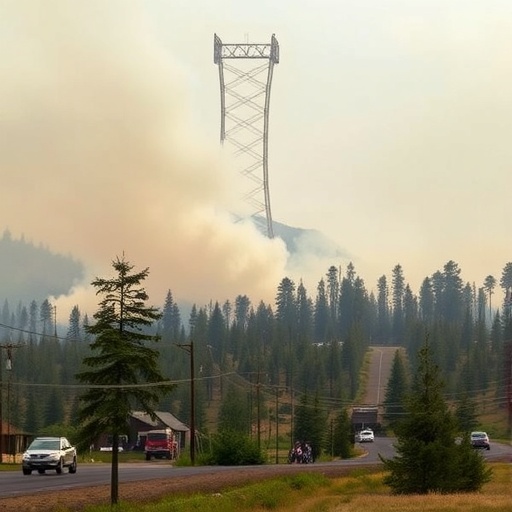
In a compelling new study unveiled at the American Association for Cancer Research (AACR) Annual Meeting 2026, scientists have established a significant link between long-term exposure to wildfire smoke (WFS) and an elevated risk of several major cancers, including lung, colorectal, breast, bladder, and hematologic malignancies. This groundbreaking research sheds light on the pervasive, yet underappreciated, systemic health risks posed by wildfire smoke toxicity beyond its well-known respiratory consequences.
Wildfire smoke is a complex mixture of fine particulate matter (PM2.5), black carbon, and a myriad of chemical toxins such as polycyclic aromatic hydrocarbons (PAHs), many of which are proven carcinogens. While previous studies have predominantly focused on the immediate pulmonary effects of wildfire smoke, this comprehensive investigation conducted by researchers at the University of New Mexico (UNM) reveals the multifaceted, systemic implications of WFS exposure over extended periods. Toxic compounds inhaled through the lungs do not remain localized but enter the bloodstream, enabling widespread distribution of carcinogenic agents throughout the body. Moreover, wildfire smoke represents a substantial inflammatory stimulus that may potentiate carcinogenesis via chronic systemic inflammation.
Shuguang Leng, MBBS, PhD, associate professor at the UNM Comprehensive Cancer Center and senior author of the study, emphasized the urgency of understanding wildfire smoke’s ramifications. He highlighted that wildfires are escalating in frequency and intensity across the United States and globally, exacerbating ambient air pollution and undermining decades of progress made under regulatory frameworks like the Clean Air Act. This investigation sought to rigorously evaluate whether chronic exposure to wildfire smoke correlates with an increased likelihood of cancer development in a large, demographically diverse general population.
To accomplish this, the research team leveraged data from the Prostate, Lung, Colorectal, and Ovarian (PLCO) Cancer Screening Trial, which monitors cancer incidence among adult participants who initially had no history of these cancers. Housing data on more than 90,000 individuals spanning the entire United States, the PLCO study provided a robust platform to assess correlations between environmental exposures and subsequent disease outcomes. The researchers integrated high-resolution satellite imagery and environmental monitoring data from 2006 onward to identify and quantify episodes of wildfire smoke exposure in participants’ residential areas. Specifically, they focused on fine particulate matter less than 2.5 microns in diameter (PM2.5) and black carbon as exposure markers for wildfire smoke toxicity, further refining exposure metrics using plume-day counts—representing the number of days wildfire smoke plumes impacted residents’ locations each month.
Through sophisticated statistical modeling incorporating 36-month moving averages updated monthly, the investigators examined the association between incremental increases in wildfire smoke exposure and cancer incidence until each participant’s first cancer diagnosis or end of follow-up. The results were unequivocal: significant associations appeared between WFS exposure and heightened risk of lung, colorectal, breast, bladder, and blood (hematologic) cancers. The dose-response relationship was approximately linear, reflecting escalating risk with higher cumulative exposures. Notably, ovarian cancer and melanoma did not show statistically significant associations, underscoring cancer-type specific susceptibilities or etiologies related to WFS constituents.
Elaborating on quantitative risk estimates, the analysis demonstrated that each additional microgram per cubic meter (µg/m3) increase in the 36-month average concentration of wildfire-specific PM2.5 corresponded with starkly elevated cancer risks—lung cancer risk increased by 92%, colorectal cancer by 131%, breast cancer by 109%, bladder cancer by 249%, and blood cancers by 63%. These alarming figures illustrate wildfire smoke’s profound capacity to incite carcinogenesis across diverse tissue types, demanding urgent public health attention. While both black carbon and plume-day counts generally mirrored these trends, associations involving black carbon reached statistical significance primarily for breast and bladder cancers, suggesting possibility of differential impacts of specific particulate constituents.
Underlying the biological plausibility of these associations is the concept that wildfire smoke’s inhaled carcinogenic particles penetrate pulmonary barriers, entering systemic circulation where DNA-damaging agents can initiate neoplastic transformation in distal organs. Furthermore, chronic systemic inflammation induced by sustained wildfire smoke exposure may serve as a tumor-promoting milieu, facilitating initiation and progression of malignancies. This mechanistic insight provides a critical framework for future experimental and epidemiologic research to dissect molecular pathways linking wildfire smoke toxicity and carcinogenesis.
For the broader public, the study’s findings drive home a pivotal message: wildfire smoke exposure merits consideration not only as an acute respiratory hazard but as a chronic carcinogenic threat. Alarmingly, increased cancer risk may manifest even at relatively low ambient concentrations of wildfire-specific PM2.5 typically encountered by urban and rural populations during wildfire events. This amplifies the need for vigilant air quality monitoring, exposure mitigation strategies, and targeted public health advisories to protect vulnerable groups, including the elderly, children, and those with preexisting conditions.
The investigators advocate for intensified research efforts to delineate region-specific characteristics of wildfire smoke, as the chemical composition of smoke plumes can vary substantially depending on fuel types, geographic provenance, and atmospheric transformation processes during transport. Understanding these nuances will be essential to accurately evaluate cancer risks in different populations and inform tailored intervention policies. Moreover, the temporal gap between initial carcinogenic exposure and overt cancer onset complicates establishing causality, especially given the limited availability of satellite-derived smoke data prior to 2006.
Another limitation acknowledged by the researchers is the residential location-based exposure assessment methodology, which, by necessity, assumed participants remained within their home areas during smoke events and did not account for time spent indoors versus outdoors or mobility patterns affecting personal exposure. Such constraints highlight the challenges inherent in environmental epidemiology and underscore the importance of developing refined exposure measurement techniques integrating personal monitoring devices and real-time activity logs.
Amid escalating wildfire prevalence linked to climate change, this seminal study serves as a clarion call to the scientific community and public health authorities alike. Its revelations about wildfire smoke’s multifaceted carcinogenic potential underscore the imperative for proactive policies encompassing wildfire prevention, air pollution control, population-level health surveillance, and expanded research into long-term health outcomes associated with environmental disasters. By illuminating the systemic harms of wildfire smoke beyond traditional respiratory endpoints, these findings pave the way for a new paradigm in understanding and mitigating environmental cancer risks in the 21st century.
Subject of Research:
The association between long-term exposure to wildfire smoke particulate matter and the risk of developing various cancers in a general population cohort.
Article Title:
Wildfire Smoke Exposure Linked to Increased Risk of Lung, Colorectal, Breast, Bladder, and Blood Cancers: Evidence from the PLCO Cancer Screening Trial
News Publication Date:
April 2026
Web References:
American Association for Cancer Research (AACR) Annual Meeting 2026: https://www.aacr.org/meeting/aacr-annual-meeting-2026/
PLCO Cancer Screening Trial: https://clinicaltrials.gov/study/NCT00339495
References:
Not provided in detail within the content.
Image Credits:
Not applicable.
Keywords:
Wildfire Smoke, Carcinogens, Polycyclic Aromatic Hydrocarbons, PM2.5, Black Carbon, Cancer Risk, Lung Cancer, Colorectal Cancer, Breast Cancer, Bladder Cancer, Blood Cancer, Environmental Epidemiology, Air Pollution, Systemic Inflammation, Public Health.
Tags: long-term wildfire smoke exposurepolycyclic aromatic hydrocarbons carcinogenicitysystemic effects of wildfire smokewildfire smoke and lung cancerwildfire smoke bladder cancer riskwildfire smoke breast cancer riskwildfire smoke cancer riskwildfire smoke chemical toxinswildfire smoke colorectal cancer riskwildfire smoke hematologic malignancieswildfire smoke inflammation and cancerwildfire smoke particulate matter health impact