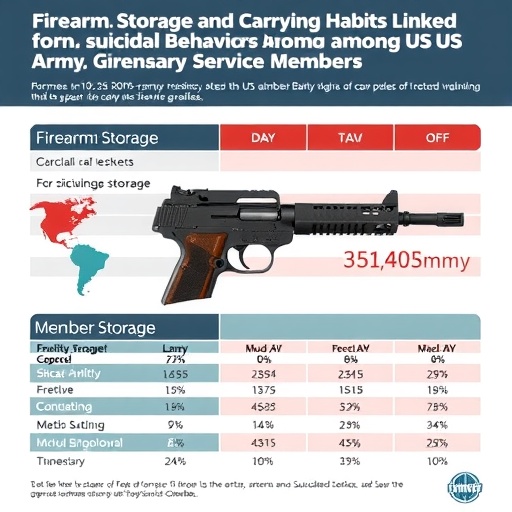
A groundbreaking retrospective cross-sectional study has delivered new insights into the relationship between firearm storage practices and suicide risk among military service members. Conducted with meticulous controls for confounding variables such as lifetime mental health disorders and histories of stressful life events, this research highlights a nuanced but significant connection: unsecured firearm storage correlates strongly with an increased risk of suicide across all monitored time frames. The implications extend beyond firearms, suggesting that carrying any type of weapon may be indicative of elevated suicide risk, a revelation that challenges traditional assumptions in military behavioral health.
The military community has long grappled with mental health challenges given the high-stress environment service members endure, but this study pinpoints a tangible behavioral marker—weapon storage and carrying habits—that could serve as a critical indicator for suicide risk assessment. Unlike previous studies that often correlated mental health diagnoses directly with suicide risk, this research introduces an observable behavioral component that could augment existing clinical screening methods, thus potentially improving prevention strategies within armed forces.
Critically, the research controlled for lifetime mental health disorders, which are well-documented contributors to suicide risk, as well as histories of stressful life events, ensuring that the association between unsecured firearm storage and suicide risk is not merely a byproduct of existing psychological conditions or acute stress exposure. This level of control adds robustness to the findings, elevating their relevance for both clinical practice and policy formulation within military health systems.
Moreover, the study’s designation of carrying weapons other than firearms—such as knives or other potentially harmful objects—as a factor linked with heightened suicide risk broadens the scope of concern. This suggests that vigilance must extend beyond firearms alone, encompassing all forms of weaponry to identify individuals potentially at risk. Such attention to nuanced behavioral signals could revolutionize how suicide prevention programs in the military and comparable high-risk populations approach risk assessment, shifting from purely psychiatric evaluation to integrative behavioral analytics.
Understanding the mechanisms underpinning these associations poses an intriguing challenge. The unsecured storage of firearms may reflect underlying impulsivity, covert suicidal ideation, or perceived access to lethal means, combined with behavioral tendencies that increase vulnerability. It underscores the importance of educational interventions emphasizing safe firearm storage, not merely as a matter of accident prevention but as a vital psychological health safeguard within military culture.
Further, these findings highlight the critical role that weapon carrying behaviors play as potentially modifiable risk factors. Intervention programs can now explore targeted approaches to secure weapon storage and address reasons why service members might carry weapons even when not on active duty, which might reflect underlying distress or intent. The study’s insights thus pave the way for innovative, behaviorally-informed preventive measures with the potential to save lives.
This study’s retrospective cross-sectional design allowed researchers to analyze a broad dataset, providing statistical power and comprehensive control for confounders. While causal inferences remain limited by the design’s inherent constraints, the strength and consistency of the associations observed argue compellingly for the incorporation of weapon storage behaviors into suicide risk frameworks. Future prospective studies could build upon this foundation to determine causality and refine intervention timing.
Importantly, the research addresses a critical gap in military mental health literature, where firearm safety discussions often prioritize accidental injury prevention but less frequently encompass suicide risk implications. By linking specific firearm and weapon behaviors to potential suicidality, this study advocates for policies that integrate secure storage compliance as part of mental health care protocols for enlisted personnel and veterans.
These findings resonate deeply amid ongoing public health concerns around firearm-related suicides in military and civilian populations alike. Suicide remains a leading cause of death among service members, with access to lethal means being a pivotal factor. This study’s empirical evidence thus calls for renewed urgency in developing culturally competent educational campaigns, legislative support for safe storage mandates, and improved access to mental health resources tailored specifically for military contexts.
Beyond military applications, the lessons inferred from this research spotlight broader societal issues where unsecured weapons and suicidal behaviors intersect. Civilian populations sharing analogous access concerns might benefit from adapted risk assessment models, inspired by these military findings, to mitigate suicide rates more effectively across diverse demographics and settings.
Collectively, this comprehensive investigation advances our understanding of suicide risk markers and behavioral predictors in profound ways. It elevates weapon-related conduct into the spotlight as a powerful signal worthy of clinical attention and systematic intervention. With implications that could enhance suicide prevention strategies significantly, the study paves the way for an evolved interdisciplinary approach incorporating psychology, behavioral science, public health, and military policy.
The corresponding author, Catherine L. Dempsey, PhD, can be contacted for further details or media inquiries, representing a pivotal source for follow-up discussions and elaborations on the study’s methodology and potential applications. The full peer-reviewed research article is accessible through JAMA Network Open, an open-access platform committed to disseminating cutting-edge medical and psychological science worldwide.
Subject of Research: Suicide risk factors among military service members related to firearm and weapon storage/carrying behaviors.
Article Title: (Not provided)
News Publication Date: (Not provided)
Web References: (Not provided)
References: doi:10.1001/jamanetworkopen.2026.8268
Image Credits: (Not provided)
Keywords: Suicide, Firearms, Military service members, Suicide risk, Weapon carrying, Behavioral psychology, Mental health, Risk factors, Military technology, Stressors, Psychiatric disorders, Behaviorism
Tags: behavioral markers for suicide riskcross-sectional study on suicidefirearm safety in militaryfirearm storage and suicide riskimpact of stressful life events on suicidemilitary mental health challengesmilitary service members mental healthsuicide prevention in armed forcessuicide prevention strategies in militarysuicide risk assessment methodsunsecured firearm storage dangersweapon carrying and suicide correlation