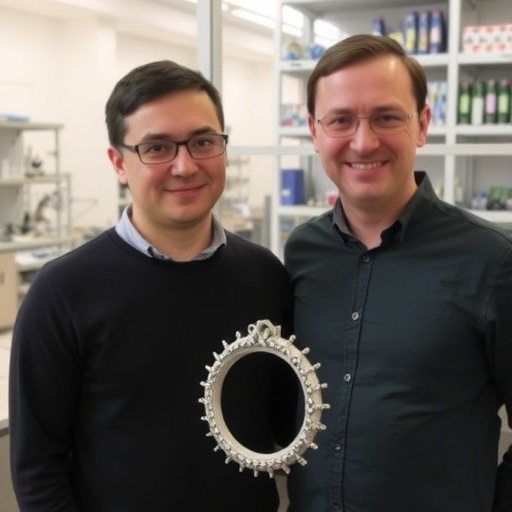
In a groundbreaking advancement poised to redefine the fundamental understanding of aromaticity, a research team led by Professor Stephen Liddle at the University of Manchester has unveiled a new class of aromatic molecules composed entirely of metal atoms. This discovery marks the heaviest aromatic ring structure confirmed to date, featuring a rare three-atom ring of bismuth stabilized through an innovative structural motif known as the “inverse-sandwich” complex. Here, the unique triatomic Bi₃ ring is delicately cradled between two sizable metal centers—uranium or thorium—highlighting an unprecedented chemical architecture that challenges traditional paradigms of aromaticity.
Aromaticity, a cornerstone concept in chemistry, traditionally evokes images of stable organic rings like benzene, where delocalized π-electrons circulate seamlessly, granting the molecule extraordinary stability. However, the present study shatters these conventional boundaries by revealing that aromaticity extends beyond organic frameworks into realms dominated by bulky, heavy-metal elements. The tri-bismuth ring, despite its entirely metallic composition, sustains these hallmark circulating electron currents, confirming its status as an aromatic system. Notably, this aromatic behavior predominantly arises from σ-electrons, deviating from the classic organic model where π-electrons are the principal contributors to aromatic stabilization.
The implications of this discovery are vast and transformative. Uniting classical organic chemistry with emerging all-metal aromaticity, the research introduces the heaviest aromatic ring ever to be documented, composed of three bismuth atoms. This achievement is further underscored by the creation of the first actinide “inverse sandwich” complexes accommodating such metal rings, where uranium and thorium atoms play crucial roles in maintaining the structural integrity of the Bi₃ unit. Robust experimental and computational evidence substantiates the presence of strong ring currents within the bismuth ring—even in the magnetic influence of these hefty metal ions—further reinforcing its aromatic character.
Delving into the experimental methodology, the research team synthesized two new complexes: one diuranium and one dithorium, both featuring the cyclo-Bi₃⁻³ ring. Through precision X-ray crystallography, the team ascertained the geometric parameters and symmetry of the bismuth triatomic ring, confirming its planar and cyclic nature requisite for aromatic behavior. Complementing this, magnetic susceptibility measurements and spectroscopic analyses detected continuous electron circulation, akin to ring currents observed in classical organic aromatics. Advanced computational modeling provided insights into electron distribution and current density, revealing that despite the pronounced magnetic fields generated by the actinide centers, the Bi₃ ring supports stable, delocalized electron flow.
Particularly fascinating is the observation of exalted diamagnetism in the dithorium complex, a rare magnetic phenomenon linked inherently to the aromatic ring current effect. Such exquisite magnetic behavior reveals that metal-based aromatic systems can manifest properties generally considered exclusive to carbon-centric organic molecules. This finding not only enriches the understanding of ring current dynamics in metals but also benchmarks how aromatic stabilization operates under heavy-element regimes, expanding the conceptual framework of chemical bonding.
From a theoretical perspective, the predominance of σ-electrons in sustaining aromaticity within the Bi₃ ring challenges longstanding notions founded on π-electron delocalization. The metal atoms’ valence orbitals and relativistic effects significantly influence this electron arrangement, offering rich avenues for exploring heavy-element electronic structure and bonding. This insight paves the way for revisiting aromaticity with a broader scope, incorporating the effects of spin–orbit coupling and electron correlation peculiar to actinide and post-transition-metal chemistry.
This research signifies a paradigm shift not only in chemical theory but also in practical synthetic chemistry and materials science. By harnessing the unique bonding abilities of actinides to stabilize exotic all-metal clusters, scientists can now envision novel metal-based architectures with tailored electronic, magnetic, and catalytic properties. Such complexes may serve as prototypes for new classes of materials with applications ranging from molecular electronics to quantum computing, where the interplay between heavy atom effects and electronic delocalization is crucial.
The discovery also underlines the vast unexplored potential of heavy-element chemistry, a domain traditionally overshadowed by the dominant focus on lighter, more abundant elements. Actinides like uranium and thorium, positioned at the bottom of the periodic table, exhibit complex and often unpredictable behavior due to their large atomic sizes, rich electron shells, and relativistic effects. Stabilizing a structurally and electronically unique ligand such as Bi₃ opens doors to inventive synthetic strategies, offering insights that ripple across organometallic and inorganic chemistry.
Professor Liddle emphasizes that while aromaticity has been a staple of organic chemistry education, usually exemplified by benzene, this research demonstrates it transcends carbon frameworks. The robust aromatic currents measurable in a three-atom ring of bismuth, supported by actinides, reaffirm that the fundamental principles of chemical bonding apply universally—even among the heaviest, most complex elements. This breakthrough invites chemists to rethink the limits of aromatic systems and challenges researchers to identify other heavy-element assemblies manifesting similar behaviors.
As the team moves forward, this foundational work lays the groundwork for systematic exploration of metal clusters showcasing all-metal aromaticity. The juxtaposition of large actinide ions with heavy main-group elements in stable compounds provides a versatile platform to probe the nature of electronic currents and bonding in unprecedented chemical environments. The ability to experimentally isolate and analyze these complexes with modern spectroscopic techniques and computational methods heralds a new era of chemistry, where the interplay of fundamental research and materials innovation will continue to flourish.
Ultimately, the discovery of the all-metal aromatic tri-bismuth ring stabilized by actinide inverse-sandwich complexes revolutionizes the conceptual boundaries of aromaticity. It bridges organic and inorganic chemistry, challenges textbook definitions, and charts unexplored territory in chemical bonding. As chemists embrace this expanded vista, the prospects for innovative chemistry, novel materials, and deepened understanding of the periodic table’s heaviest members are brighter than ever.
Subject of Research: Not applicable
Article Title: All-metal aromaticity of cyclo-Bi33− in diuranium and dithorium inverse-sandwich-type complexes
News Publication Date: 20-Apr-2026
Web References: http://dx.doi.org/10.1038/s41557-026-02123-8
Image Credits: Credit: Steve Liddle, The University of Manchester
Keywords
Organometallic chemistry, Organic chemistry, Inorganic chemistry, Aromaticity, All-metal aromaticity, Actinide complexes, Bismuth clusters, Uranium chemistry, Thorium chemistry, Inverse-sandwich complexes, Heavy-element chemistry, Ring current
Tags: all-metal aromatic systemsaromaticity beyond organic compoundsbismuth triatomic ringheavy element chemistryheavy metal aromatic moleculesinverse-sandwich complexmetal aromaticitynovel aromaticity phenomenonthree-atom metal ringUniversity of Manchester chemistry researchuranium thorium metal centersσ-electron aromatic stabilization