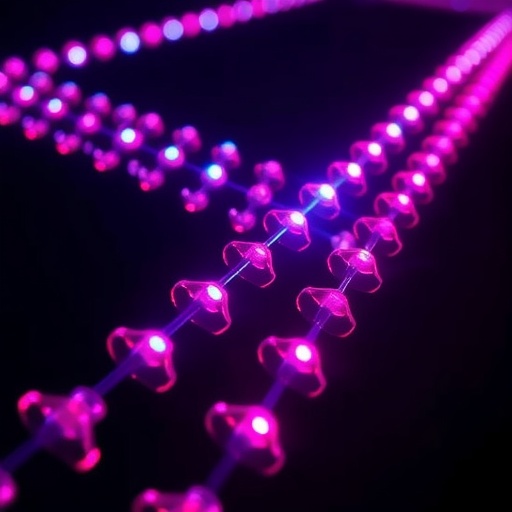
In a groundbreaking advance at the intersection of supramolecular chemistry and optoelectronic materials science, a team of Japanese researchers has unveiled a novel molecular design strategy that enables artificial π-luminophore dyads to self-assemble into highly ordered, curved supramolecular nanotubes exhibiting unprecedented multidirectional exciton transport. Led by Professor Shiki Yagai at Chiba University’s Graduate School of Engineering, the study demonstrates how sterically demanding diphenylanthracene (DPA) derivatives, previously thought aggregation-incompetent, can be programmed via folding-mediated self-assembly to form intricate curved nanostructures with sophisticated energy-transport functionalities, opening new pathways for advanced luminescent materials.
Nature often inspires molecular engineering, especially the elegant nanotubular architectures formed by protein folding in biological systems, where molecular folding orchestrates interaction sites to create complex structures with remarkable precision. Translating such principles into synthetic small molecules has, until now, remained elusive due to the complexity of engineering directional interactions and hierarchical assembly processes on the nanoscale. This challenge motivated Professor Yagai’s group to explore how conformational control through molecular folding could direct supramolecular assembly into highly ordered nanotubes.
The researchers synthesized a series of artificial π-luminophore dyads composed of central aromatic units systematically varied from terphenylene to diphenylnaphthalene, culminating with diphenylanthracene (DPA). Crucially, DPA structures are sterically bulky and had been assumed incapable of stable aggregation due to potential steric hindrance disrupting efficient stacking. However, combining folding-induced preorganization with cooperative directional π–π interactions and hydrogen bonding, the team successfully programmed the molecules to self-fold and assemble into hollow cylindrical nanotubes exhibiting a complex curved morphology.
Employing state-of-the-art characterization methods such as X-ray diffraction and neutron scattering, the researchers elucidated how the folded molecules organize within the nanotubes, revealing alternating molecular tilts that generate a herringbone-like chromophore wall topology. This alternating tilt arrangement alleviates stacking frustration typically encountered in curved assemblies, thereby stabilizing the supramolecular nanotube architecture. Polarized UV–vis and infrared spectroscopy further characterized the internal ordering, confirming the presence of directional intermolecular interactions fundamental to maintaining the tubular structure.
The study’s systematic structural exploration revealed a fascinating progression: terphenylene-based dyads assembled into twisted ribbon-like morphologies, diphenylnaphthalene derivatives formed curved helical coils and toroidal rings, while the DPA analogues uniquely produced robust hollow nanotubes. These findings illuminate the delicate interplay between molecular structure, folding behavior, and the resulting supramolecular architecture, underscoring folding as a potent handle to direct complex nanoscale assemblies.
A particularly striking feature of the DPA-derived nanotubes is their ability to form luminescent fibers of macroscopic length, reaching several centimeters in concentrated solutions. This macroscopic fiber formation translates molecular-level folding precision into material-scale architectures, showcasing the potential for practical optoelectronic applications. Molecular simulations corroborated these findings, showing that the nanotube’s stability arises from alternating tilts of DPA units between stacked toroidal layers, creating a coherent three-dimensional chromophore packing pattern conducive to excitonic communication.
Excitingly, the team uncovered that these nanotubes support multidirectional exciton migration — energy transport not only along the longitudinal tube axis but also circumferentially around the tube’s perimeter. Such a multidimensional exciton diffusion mechanism contrasts with conventional tubular or linear supramolecular assemblies where energy transfer is predominantly unidirectional. Time-resolved fluorescence anisotropy measurements quantified axial exciton migration lengths of approximately 55 nm and circumferential migration nearing 11 nm, highlighting remarkable excitonic mobility within these curved nanotubes.
This revelation of complex excited-state dynamics intimately linked to supramolecular topology could have transformative implications for designing next-generation organic photonic and optoelectronic devices. The closed tubular chromophore packing provides a new model system to understand and harness multidirectional exciton behavior, potentially inspiring artificial photosynthetic materials, highly efficient light-harvesting systems, and novel luminescent architectures.
By harnessing folding-mediated self-assembly, the team has unlocked fundamental design principles for constructing curved supramolecular microstructures, including rings, helices, and tubes, which have been historically challenging to achieve through conventional synthetic methods. Folding orchestrates the spatial orientation and interaction sites during assembly, enabling precise control over nanoscale curvature and topology, emulating the elegant order found in biological systems.
Professor Yagai emphasized that the elaboration of molecular folding as a nanoconstruction tool paves the way for fabricating artificial nanostructures with protein-like complexity and functional sophistication. These advances open fertile ground for developing materials featuring tailored three-dimensional exciton transport for applications spanning organic photovoltaics, light-emitting diodes, and photocatalysis.
The research drew on a broad interdisciplinary collaboration including Dr. Takumi Aizawa, Dr. Hikaru Sotome, Professor Martin Vacha, and Dr. Go Watanabe, integrating expertise in synthetic chemistry, spectroscopy, neutron scattering, and computational modeling. Their publication in the Journal of the American Chemical Society represents a seminal contribution advancing the frontiers of supramolecular assembly and excitonic materials science.
Furthermore, the study benefited from advanced computational resources and neutron facilities, including the Research Center for Computational Science in Okazaki and ISIS Pulsed Neutron Source, underscoring the importance of cutting-edge infrastructure in unraveling the complexities of nanoscale materials. It was supported by multiple grants from the Japan Society for the Promotion of Science (JSPS) and the Japan Science and Technology Agency (JST), reflecting the high strategic value of this research area.
In summary, this pioneering study demonstrates that molecular folding, when exploited as a programmable design principle, can drive the self-assembly of sterically hindered π-luminophore dyads into nanotubular architectures exhibiting rich multidirectional exciton transport properties. The findings promise to inspire innovative molecular architectures for sophisticated light-energy conversion and luminescence technologies, marking a watershed moment in supramolecular photonics.
For more information on this cutting-edge work and other advances from Chiba University, please visit the university’s news portal.
Article Title: Folding-mediated self-assembly of sterically demanding π-luminophore dyads into nanotubes exhibiting multidirectional exciton transport
News Publication Date: April 1, 2026
References: Aizawa, T. et al. Folding-mediated self-assembly of sterically demanding π-luminophore dyads into nanotubes exhibiting multidirectional exciton transport. Journal of the American Chemical Society, DOI: 10.1021/jacs.6c00854
Image Credits: Professor Shiki Yagai, Chiba University, Japan
Keywords
Supramolecular nanotubes, molecular folding, diphenylanthracene, exciton transport, π-luminophores, self-assembly, curved nanostructures, multidirectional energy transfer, supramolecular photonics, macroscopic luminescent fibers, excitonic materials, optoelectronic applications
Tags: artificial π-luminophore dyadsbiomimetic nanotubular architecturescurved nanostructures in optoelectronicsdiphenylanthracene derivativesenergy transport in nanomaterialsfolding-mediated self-assemblyhierarchical molecular assemblymolecular folding in synthetic chemistrymultidirectional exciton transportoptoelectronic luminescent materialsself-assembling luminophoressupramolecular nanotubes