In a groundbreaking development poised to transform how the world extracts critical rare-earth elements, researchers have unveiled a novel technique that detects and quantifies these valuable metals within living plants without causing any harm. This advances the emerging field of “phytomining,” where plants are leveraged to absorb and concentrate rare-earth materials from soils, offering a sustainable and economically viable alternative to conventional mining practices. The new method’s precision and non-destructive nature mark a significant stride in optimizing the timing and selection of plant species for maximal yield of these essential elements.
Rare-earth metals such as dysprosium, terbium, and europium are indispensable components of modern technology, underpinning devices ranging from smartphones and wind turbines to electric vehicles. Despite the name, these elements are not inherently scarce in the Earth’s crust but are rarely found in concentrations high enough for cost-effective extraction. At present, the U.S. and numerous countries depend heavily on international supply chains for these metals, often facing geopolitical and economic vulnerabilities. This prompted North Carolina State University researchers to seek innovative methods that would unlock domestic sources via eco-friendly techniques like phytomining.
One major hurdle has long been the difficulty in accurately measuring how much rare-earth element a plant has absorbed, especially without damaging or destroying the specimen. Traditional chemical assays require crushing the plant material, thus precluding longitudinal studies needed to determine the optimal harvesting window. The new approach hinges on fluorescence spectroscopy, an advanced optical method where compounds absorb light at specific wavelengths and then re-emit it at longer wavelengths. By scrutinizing these emissions, scientists can identify and quantify specific rare-earth elements within the complex matrix of living plant tissues.
A particularly challenging aspect of using fluorescence for this purpose lies in distinguishing the emission of rare-earth elements from the broad autofluorescence naturally exhibited by plant tissues themselves. Plant biomolecules inherently emit light across diverse spectra, potentially masking the signals from the targeted elements. To circumvent this, the research team focused on dysprosium, a rare-earth element selected for its relatively long luminescence lifetime post-excitation, allowing its signal to be detected after the plant’s autofluorescence has subsided. This temporal separation is critical for achieving high sensitivity and accuracy in detection.
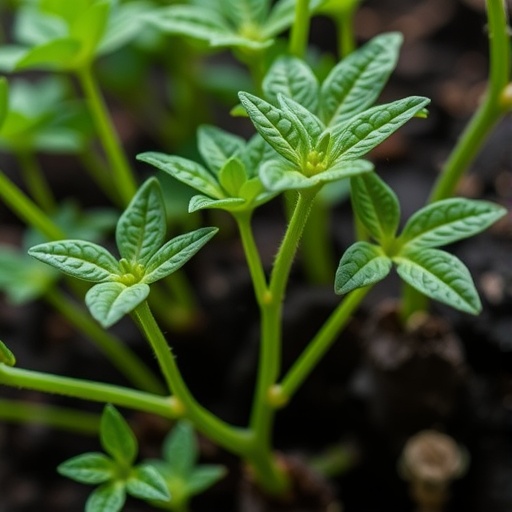
The experimental process involved growing two species of pokeweed in substrates containing dysprosium, then externally treating the plant tissues with sodium tungstate. This reagent selectively enhances the fluorescence emitted by dysprosium, boosting the signal without interfering with its quantification. The plants were excited with a deep ultraviolet laser, prompting fluorescence. Subsequently, high-resolution spectroscopic measurements recorded the characteristic emissions and their intensities. Because the intensification effect of sodium tungstate is well-characterized and consistent, the researchers were able to precisely calculate the concentration of dysprosium present in the plant samples.
Importantly, this technique emerged as not only highly accurate but also remarkably rapid, capable of producing measurements in real time. Such efficiency is transformative, enabling researchers and industry practitioners to monitor the same plants repeatedly over time. This dynamic insight facilitates determination of the precise harvest point when rare-earth element concentration peaks, thereby optimizing material recovery and improving the overall economics of phytomining ventures. Unlike destructive sampling, repeated measurements from living plants enhance resource efficiency and reduce operational costs.
While dysprosium served as the principal proof-of-concept element, the researchers are already confident in extending this methodology to other vital rare-earth elements including terbium and europium with little modification. Further adaptations may allow detection of erbium and neodymium, thus broadening the applicability of this optical sensing platform. Although the detection of additional rare earth metals remains a subject for ongoing investigation, the foundational work laid out here signals a pivotal step towards comprehensive phytomining capabilities.
This research initiative integrates a larger framework aimed at revitalizing the U.S. domestic rare-earth supply chain while simultaneously addressing environmental contamination issues at toxic sites such as fly ash ponds and acid mine drainage locations. By harvesting rare-earth metals from plants that bioaccumulate these elements on polluted lands, this approach offers a dual benefit: recovering critical raw materials and contributing to environmental remediation efforts. This synergy can potentially offset cleanup costs through the sale of recovered materials, presenting an economically and ecologically compelling model.
The innovation detailed in this study also highlights the multidisciplinary nature of cutting-edge scientific inquiry. Collaboration between molecular biochemistry and electrical engineering provided the expertise necessary to overcome both biological and optical challenges. By combining advanced laser spectroscopy with a nuanced understanding of plant physiology and chemical interactions, the team successfully bridged multiple fields to achieve a functional and scalable solution. Such integrative efforts underscore the future direction of materials science and environmental technology.
Beyond industrial applications, this technique may influence ecological monitoring and fundamental plant science research by enabling non-invasive, repeated measurements of metal uptake dynamics under differing environmental conditions. The ability to track temporal changes in rare-earth accumulation within individual plants opens new avenues for studying the interplay between plant metabolism, soil chemistry, and metal bioavailability. It may also inform genetic or agronomic strategies to enhance phytomining efficiency through crop improvement.
Funding for this promising research was provided by the Defense Advanced Research Projects Agency under a Young Investigator Award, underscoring its national significance in advancing technology and sustainability. The study, published openly in the journal Plant Direct, represents a collaborative effort led by NC State, highlighting the potential for academic inquiry to address pressing global supply chain and environmental challenges.
As nations worldwide grapple with securing essential mineral resources amid geopolitical tension and environmental concerns, such breakthroughs in green resource recovery stand at the vanguard of sustainable innovation. The confluence of environmental stewardship, advanced optical techniques, and plant biology exhibited here offers a tangible path forward to meet future technological demands while healing contaminated lands. This pioneering work exemplifies the transformative power of science in shaping a more resilient and circular economy.
Subject of Research: Not applicable
Article Title: Detection and Quantification of Dysprosium in Plant Tissues
News Publication Date: 12-Apr-2026
Web References: https://onlinelibrary.wiley.com/doi/10.1002/pld3.70164
Keywords
phytomining, rare-earth elements, dysprosium, fluorescence spectroscopy, plant mining, nondestructive analysis, sodium tungstate, environmental remediation, rare-earth detection, spectral analysis, sustainable resource recovery, deep ultraviolet laser
Tags: domestic rare earth resource developmenteco-friendly mining alternativesnon-destructive rare earth measurementNorth Carolina State University rare earth researchoptimizing phytomining plant speciesphytomining technology advancementsrare earth element absorption by plantsrare earth metals detection in plantsrare earth metals for green technologyrare earth metals in agriculturerare earth supply chain securitysustainable rare earth extraction methods